Ab11 Guitar Chord | Play, Hear and Master Interactively
Want a structured chord roadmap instead of jumping between pages?
Download the step-by-step Guitar Chord Ebook
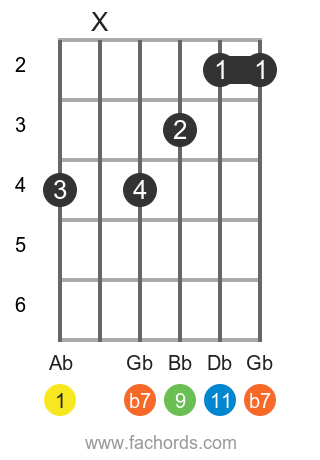
The Ab 11 chord is a rich member of the Dominant Chords family, constructed from the notes Ab, C, Eb, Gb, Bb, and Db. These notes correspond to the intervals 1, 3, 5, b7, 9, and 11. Use the interactive fretboard tool at the top of this page to visually explore every fingering, hear the chord played as a strum or arpeggio, and receive instant, real-time microphone feedback on your playing technique.
This extended dominant chord, with its distinctive eleventh, adds rich harmonic color and a sense of unresolved tension to your playing. Understanding its construction, built by stacking intervals, is key to mastering it. Dive deeper into the theory with our Chord Construction tutorial, or explore the wider family with our guide to Dominant Chords and Ninth Chords. Many voicings of the Ab11 chord will involve movable barre shapes; our guide on Guitar Bar Chords can help you navigate these effectively.
Below the tool, you'll discover comprehensive Ab 11 chord diagrams, presented from the simplest open positions to more advanced barre shapes. We also break down the underlying music theory, list popular songs that feature this chord, and identify the keys where it commonly appears. Before you scroll down, take a moment to engage with the interactive tool above. Use the drum & BPM tool to set a rhythm, play the chord, and let the real-time mic feedback guide your finger placement. This direct, hands-on practice will solidify your understanding and help you confidently incorporate the Ab11 into your playing.
Notes that compose the Ab 11 chord:
How the Dominant Eleventh chord is built:
Ab Dominant Eleventh Guitar Chord Fingers Positions
Position 1
Barre
Movable
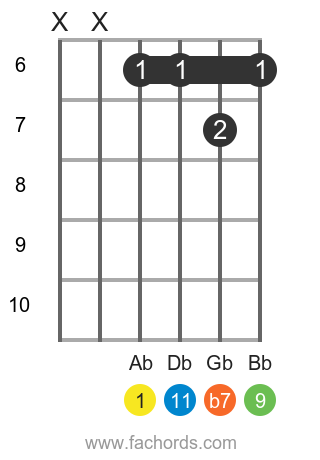
Position 2
Barre
Movable
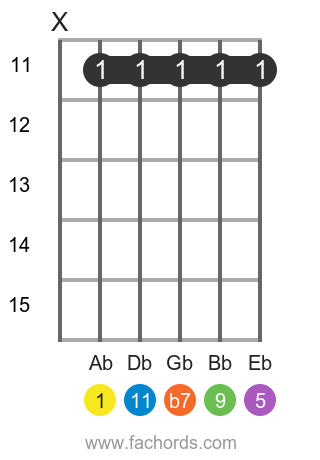
Position 3
Barre
Movable
 Find more shapes in our all guitar chords online library. If you
prefer a printable pdf, download
the Free Guitar Chords Chart Pdf
Find more shapes in our all guitar chords online library. If you
prefer a printable pdf, download
the Free Guitar Chords Chart Pdf
You can also use this accessible Ab11 chord page, with written diagram instructions and screen-reader support for blind users.
FAQ
What specifically makes the Ab 11 chord a 'dominant chord'?
The Ab 11 chord is classified as a dominant chord primarily because it contains a Minor Seventh interval (b7). This interval, along with the Root and Major Third, creates the characteristic tension and distinctive sound found in all dominant chords.
Why is this chord named 'Ab 11' if it also includes a 9th?
The '11' in Ab 11 signifies that the chord includes the Perfect Eleventh interval (11) in its construction, in addition to the Root, Major Third, Perfect Fifth, Minor Seventh (b7), and Major Ninth (9). When an 11th is present, the chord name reflects the highest extension, implying the presence of the lower extensions (like the 9th) as well.
What are all the notes that comprise the Ab 11 chord?
The Ab 11 chord is composed of six distinct notes: Ab (Root), C (Major Third), Eb (Perfect Fifth), Gb (Minor Seventh), Bb (Major Ninth), and Db (Perfect Eleventh).
How do the intervals (1, 3, 5, b7, 9, 11) help me understand and play the Ab 11 chord?
Understanding these intervals clarifies the theoretical structure of the Ab 11 chord. Each number represents a specific note's relationship to the root (Ab). Knowing these relationships allows you to identify and locate these specific notes on the fretboard, which is crucial for building and playing the chord accurately and in different voicings.
What kind of 'distinctive sound' does the Ab 11 chord add to my playing?
The Ab 11 chord, being a dominant chord, contributes a rich, complex, and often tension-filled sound. This complexity arises from the combination of the Minor Seventh (b7) with the higher extensions like the Major Ninth (9) and Perfect Eleventh (11), creating a sophisticated harmonic color that stands out from simpler chords.