A#m7 Guitar Chord | Play, Hear and Master it with Mic Feedback
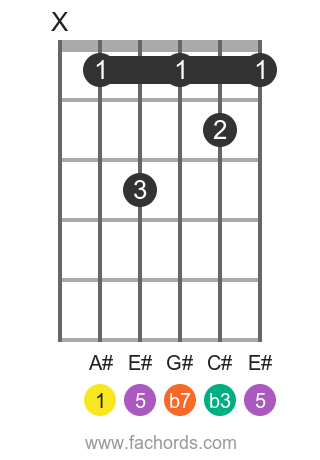
The A#m7 chord, a versatile member of the Minor Seventh family, is built from four essential notes: A#, C#, E#, and G#. These notes correspond to the intervals Root (1), Minor Third (b3), Perfect Fifth (5), and Minor Seventh (b7). Utilize the interactive fretboard tool on this page to visualize fingerings, hear the chord played as a strum or arpeggio, and get instant guidance on your playing accuracy with real-time mic feedback.
Understanding the unique combination of the Root, Minor Third, Perfect Fifth, and Minor Seventh intervals is key to mastering the A#m7 and other similar chords. If you're looking to deepen your understanding of how chords are structured, our tutorial on Chord Construction is an excellent resource. For a more concise approach to playing 7th chords, check out how to play 3-Note 7th Chords. Many common A#m7 voicings are movable barre shapes; our guide on Guitar Bar Chords can help you perfect them. Once you're comfortable with the fingering, focus on improving your chord changes for seamless playing.
As you scroll further down, you'll discover a collection of A#m7 chord diagrams, carefully ranked from the easiest open positions to more advanced barre shapes. We also dive deeper into the music theory behind this chord, provide examples of songs where it shines, and list the keys where it commonly appears. Before you explore the diagrams, take a moment to engage with the interactive tool above. Set a rhythm with the drum tool, strum or pick the A#m7, and let the mic feedback guide you to perfect your finger placement. This hands-on practice is the fastest way to integrate this chord into your playing!
Notes in the A# m7 chord:
Formula of the Minor Seventh chord:
A# Minor Seventh Guitar Chord Fingers Positions
Chord boxes are sorted from the easiest to the hardest. Learn how to read chord diagrams.
If you have difficulties with bar chord shapes, check the Bar Chords Tips tutorial.
You can also use this accessible chords page with written diagrams instruction.
Position 1
Movable
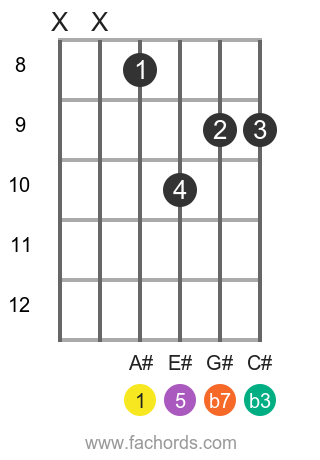
Position 2
Barre
Movable
Position 3
Barre
Movable
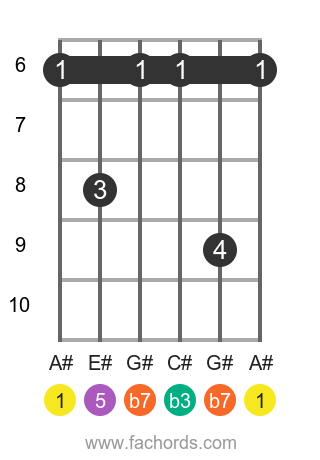
 You can find more shapes in our all guitar chords online library. If you
prefer a printable pdf, download
the Free Guitar Chords Chart Pdf
You can find more shapes in our all guitar chords online library. If you
prefer a printable pdf, download
the Free Guitar Chords Chart Pdf
FAQ
What notes are included in the A#m7 chord?
The A#m7 chord is made up of four specific notes: A#, C#, E#, and G#. These notes combine to create its distinct musical character.
What intervals define the A#m7 chord structure?
The A#m7 chord is constructed using the following intervals relative to the root (A#): the Root (1), a Minor Third (b3), a Perfect Fifth (5), and a Minor Seventh (b7). Understanding these intervals is fundamental to mastering this chord.
Why is the A#m7 classified as a minor chord?
The A#m7 chord is considered a minor chord primarily because it contains a Minor Third (b3) interval above its root. This interval fundamentally defines its minor quality within the chord's structure, alongside the Minor Seventh (b7) interval.
How do chord diagrams and fretboard patterns help in learning the A#m7 chord?
Chord diagrams and fretboard patterns are visual tools that show the specific placement of the notes (A#, C#, E#, G#) for the A#m7 chord on the guitar. They make it easier to visualize and physically learn the chord's shape and structure across the fretboard.
What is the role of the E# note in the A#m7 chord?
In the A#m7 chord, the E# note functions as the Perfect Fifth (5) interval above the root A#. While E# sounds like F, using E# is the correct theoretical spelling to maintain the established interval structure (Root, Minor Third, Perfect Fifth, Minor Seventh) when building the chord from A#.
When might the A#m7 chord be used in musical compositions?
The A#m7 chord is a versatile and expressive chord often utilized in jazz chord progressions. Its unique sound and character make it suitable for adding depth and color in various musical contexts.