Understand and Play the B 7(#9) Guitar Chord
Want a structured chord roadmap instead of jumping between pages?
Go to the full guitar chords tutorial.
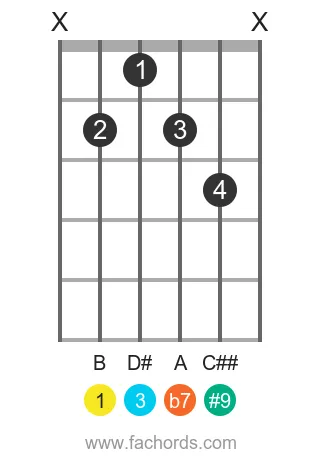
The B 7(#9) is a powerful member of the Dominant Chords family, defined by its unique interval structure: 1 (Root), 3 (Major Third), 5 (Perfect Fifth), b7 (Minor Seventh), and #9 (Augmented Ninth). This striking combination of intervals gives it a distinct sound, built from the notes B, D#, F#, A, and C##. To truly grasp its harmonic character, utilize our interactive virtual fretboard to visualize these intervals and hear the chord's full sound. Practice playing it yourself, and receive instant, precise feedback on your accuracy directly through your microphone, ensuring every note is perfectly fretted.
As a member of the Dominant Chords, the B 7(#9) inherently carries a strong pull towards resolution, making it a foundational sound in blues, jazz, and rock. Its added #9 interval classifies it among the extended Ninth Chords, bringing a rich, sometimes dissonant, color to your harmony. To fully appreciate how such chords are built from stacked intervals, our guide on Chord Construction provides comprehensive insights. Once you're comfortable with its basic shape, exploring Understanding Chord Inversions can unlock new voicings and expand your fretboard mastery.
Before delving into the full array of diagrams, which are meticulously ranked from the easiest to the most challenging, we encourage you to spend time with the interactive fretboard. This allows you to internalize the chord's sound and structure across different keys. Explore the underlying theory, and soon you'll be applying the B 7(#9) chord confidently in your favorite songs. Disciplined practice with our tools will solidify your understanding and technique.
B 7th with sharp 9th guitar chord is also written as B7(#9), B7#9 or B7+9. It is also known as the Hendrix chord.
B 7(#9) chord Notes:
Chord Structure:
B 7(#9) Guitar Chord Diagrams
Position 1
Movable
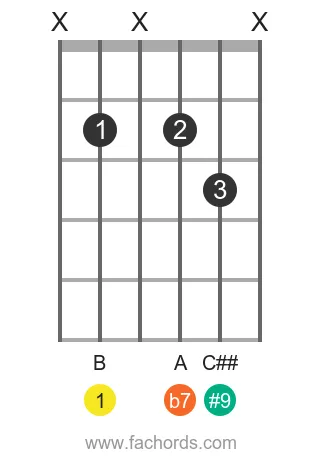
Position 2
Movable
Position 3
Barre
Movable
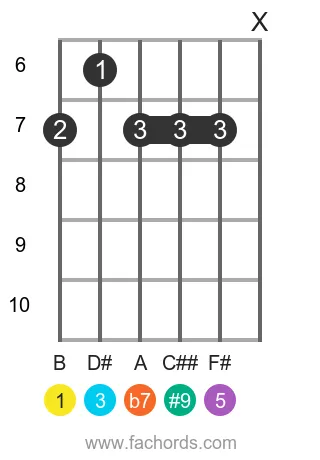
Position 4
Barre
Movable
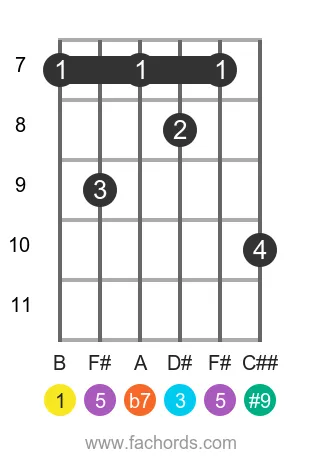
 Find more shapes in our all guitar chords online library. If you
prefer a printable pdf, download
the Free Guitar Chords Chart Pdf
Find more shapes in our all guitar chords online library. If you
prefer a printable pdf, download
the Free Guitar Chords Chart Pdf
You can also use this accessible B7(#9) chord page, with written diagram instructions and screen-reader support for blind users.

Created by
Giancarlo is a musician (teaching guitar since 2000), software engineer, AI consultant and published researcher
FAQ
What notes and intervals make up the B 7(#9) guitar chord?
The B 7(#9) chord is composed of the notes B, D#, F#, A, and C##. These notes correspond to the intervals of the 1 (Root), 3 (Major Third), 5 (Perfect Fifth), b7 (Minor Seventh), and #9 (Augmented Ninth), respectively.
When should I use the B 7(#9) chord in my playing?
The B 7(#9) chord is ideal for adding complexity and intrigue to your chord progressions. It's a common feature in blues, jazz, and rock music, where it functions as a dominant chord with a strong harmonic pull towards resolving to the tonic.
Why is the B 7(#9) considered a dominant chord?
The B 7(#9) chord is a dominant chord because its fundamental structure includes the root, a major third, a perfect fifth, and a minor seventh (B, D#, F#, A). This combination inherently creates a tension that leads the listener's ear to expect resolution to the tonic, a defining characteristic of dominant chords.
What is the significance of the '#9' in the B 7(#9) chord?
The '#9' signifies an Augmented Ninth interval. In the B 7(#9) chord, this specific interval is the C## note. It adds a distinctive, often bluesy or jazzy, color and heightened tension to the dominant seventh chord, making it particularly expressive.
Can I play the B 7(#9) chord in different ways on the guitar?
Yes, once you've learned the basic shape of the B 7(#9) chord, you can explore various chord inversions. Experimenting with inversions allows you to discover new shapes and sounds for the same chord on the fretboard, enhancing your playing versatility.
