Master the F# 7(#9) Guitar Chord: Interactive Learning Tool
Need F7(#9) rather than F#7(#9)? Jump to F7(#9).
F# seventh sharp nine is the full name of F#7#9, a chord of five notes: F#, A#, C#, E and G##. It stacks a major third and a sharp ninth (G##) on the same root, a clash of major and minor that gives the chord its raw, bluesy edge.
The three voicings here run from fret 1 to fret 10, and two of them are barre shapes. For melodies, reach for the F# Half-Whole scale: it is the eight-note scale built from alternating half steps and whole steps, and it holds all five chord tones.
Strum the shape in front of your microphone and the chord player at the top shows which strings ring and which are muted.
F# 7th with sharp 9th guitar chord is also written as F#7(#9), F#7#9 or F#7+9. It is also known as the Hendrix chord.
F#7#9 Chord Notes and Formula
Notes that compose the F# 7(#9) chord:
Chord Structure:
Formula: 1 3 5 b7 #9
Same chord, different name: F#7#9 is also written as Gb7#9 (Gb seventh sharp nine).
F#7#9 Chord Interactive Fretboard
Want a structured chord roadmap instead of jumping between pages?
Go to the full guitar chords tutorial.
F#7#9 Guitar Chord Diagrams
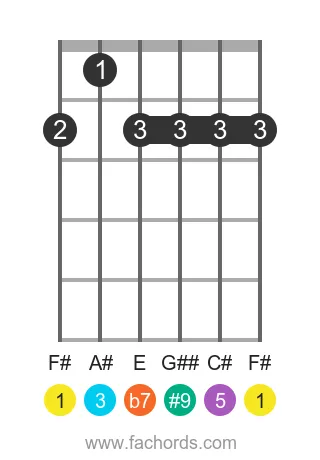
Position 1 Barre Movable
F# Seventh Sharp Nine Finger Positions
- Place your index finger (1) on the fret 1 of the A string
- Place your middle finger (2) on the fret 2 of the low E string
- Place your ring finger (3) on the fret 2 of the D, G, B and high E strings at the same time
Position 2 Barre Movable
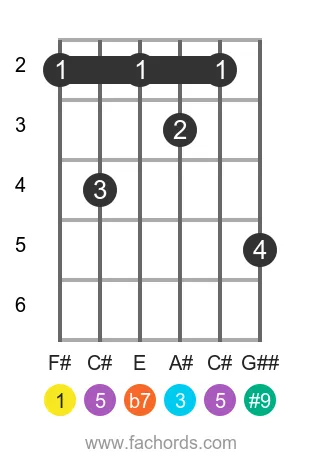
F# Seventh Sharp Nine Finger Positions
- Place your index finger (1) on the fret 2 of the low E, D and B strings at the same time
- Place your middle finger (2) on the fret 3 of the G string
- Place your ring finger (3) on the fret 4 of the A string
- Place your pinky finger (4) on the fret 5 of the high E string
Position 3 Movable
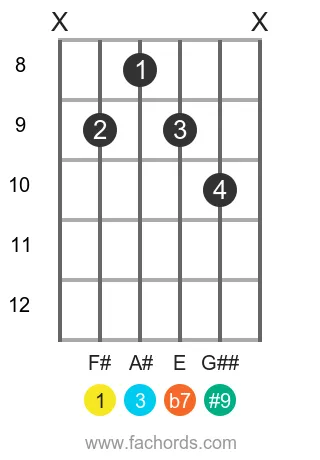
F# Seventh Sharp Nine Finger Positions
- Mute the low E string
- Mute the high E string
- Place your index finger (1) on the fret 8 of the D string
- Place your middle finger (2) on the fret 9 of the A string
- Place your ring finger (3) on the fret 9 of the G string
- Place your pinky finger (4) on the fret 10 of the B string
 Find more shapes in our all guitar chords online library. If you
prefer a printable pdf, download
the Free Guitar Chords Chart Pdf
Chords That Go With F#7#9
One key where F#7#9 fits is B major, where it works as the V chord, an altered chord whose G## is borrowed from outside the key. These are the main chords of that key, the ones you will often hear around it:
See every key in the guitar keys chart, or build a progression with these chords in the chord progression generator.
More F# Chords
Want to know how this chord is built? Read dominant chords explained, or browse all F# guitar chords.

Created by
Giancarlo is a musician (teaching guitar since 2000), software engineer, AI consultant and published researcher
FAQ
What notes does F#7#9 contain?
F#, A#, C#, E and G##. The first four notes make an F# seventh chord, and G## is the sharp ninth, which sounds like A.
How is F#7#9 different from a plain F# seventh chord?
A plain F# seventh has F#, A#, C# and E. F#7#9 keeps all four and adds G##, the sharp ninth. That note sounds like A, a minor third from the root, and gives the chord its edge.
Why is the sharp ninth in F#7#9 written G## and not A?
A ninth higher than F# must carry the letter G, and raising it by a half step gives G##. Writing A would hide that the note is a ninth, because the stack of thirds already runs F#, A#, C#, E.
Which scale suits the F# seventh sharp nine chord?
The F# Half-Whole scale: F#, G, G##, A#, B#, C#, D# and E. It has eight notes and holds every tone of the chord.
How many voicings are there for F#7#9?
Three voicings are listed, from the first fret to the tenth fret. Two of them are barre voicings, and none of them uses open strings.