Understand and Play the C7b9 Guitar Chord
Want a structured chord roadmap instead of jumping between pages?
Go to the full guitar chords tutorial.
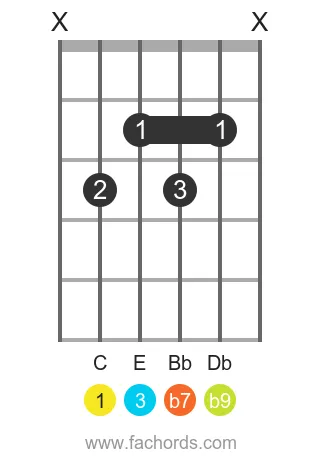
The C7(b9) chord is constructed from the intervals 1 (Root), 3 (Major Third), 5 (Perfect Fifth), b7 (Minor Seventh), and b9 (Minor Ninth), making it a distinct member of the Dominant Chords family. These specific intervals give the chord its notes: C, E, G, Bb, and Db. Our interactive fretboard lets you explore these voicings, offering both chord and arpeggio playback. You can also get real-time verification of your accuracy with our innovative mic feedback feature.
The C7(b9) is a particularly common chord in jazz and blues, renowned for its complex tension and rich harmonic color. Understanding its interval structure is key to mastering this voicing and applying it creatively in various musical contexts. For deeper insights into how chords are built from their fundamental components, explore our guide on Chord Construction. You can also learn more about the specific characteristics of this chord family in our Dominant Chord tutorial.
Below, you'll find comprehensive chord diagrams, arranged from the most accessible to more advanced voicings. Each diagram is accompanied by essential theory, suggesting ways to incorporate the C7(b9) into various songs and musical keys. Before diving into memorization, use our interactive tool to meticulously practice each shape, ensuring disciplined execution of this sophisticated chord.
C 7th with flat 9th guitar chord is also written as C7(b9), C7b9 or C7-9.
Notes in the C 7(b9) chord:
Chord Structure:
C 7(B9) Guitar Chord Diagrams
Position 1
Movable
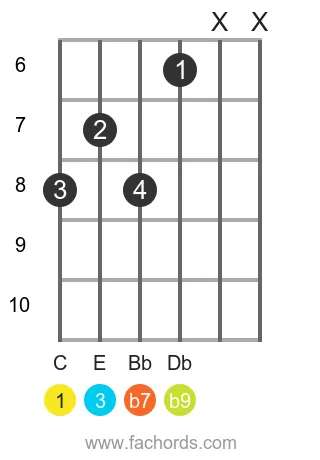
Position 2
Movable
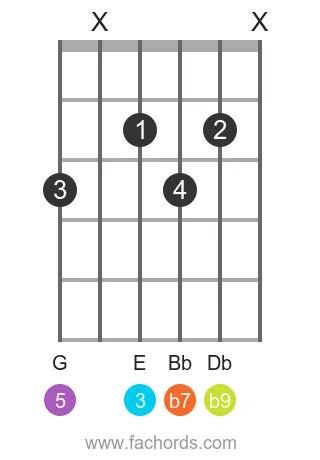
Position 3
Barre
Movable
Position 4
Barre
Movable
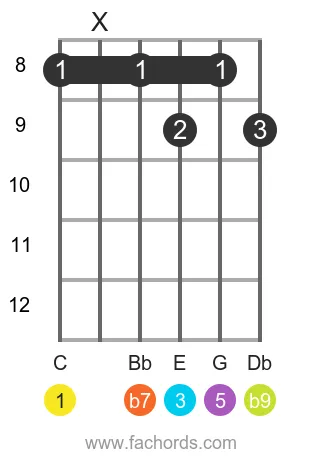
Position 5
Barre
Movable
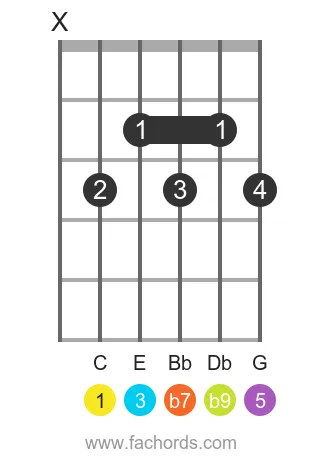
 Find more shapes in our all guitar chords online library. If you
prefer a printable pdf, download
the Free Guitar Chords Chart Pdf
Find more shapes in our all guitar chords online library. If you
prefer a printable pdf, download
the Free Guitar Chords Chart Pdf
You can also use this accessible C7(b9) chord page, with written diagram instructions and screen-reader support for blind users.


Created by
Giancarlo is a musician (teaching guitar since 2000), software engineer, AI consultant and published researcher
FAQ
What exactly is the C7(b9) chord?
The C7(b9) chord is described as a rich and complex chord that belongs to the Dominant Chords family. It is constructed from the notes C, E, G, Bb, and Db.
What are the specific intervals that make up the C7(b9) chord?
The C7(b9) chord is composed of five distinct intervals: the Root (1), Major Third (3), Perfect Fifth (5), Minor Seventh (b7), and Minor Ninth (b9).
In what musical styles or contexts is the C7(b9) chord typically used?
While the C7(b9) chord can be found in various genres of music, it is particularly common in jazz and blues progressions, contributing to their characteristic sound.
Why is the C7(b9) chord classified as a dominant chord?
The tutorial states that the C7(b9) chord belongs to the 'Dominant Chords family.' This classification is based on its specific intervallic structure, which includes a minor seventh (b7).
Is the C7(b9) chord difficult for beginners to learn on guitar?
Yes, the tutorial notes that the C7(b9) chord can be a bit challenging for beginners. However, with consistent practice and a clear understanding of its structure, you can master it.
How does the 'b9' (minor ninth) interval affect the C7(b9) chord?
The 'b9' (Minor Ninth) interval is a crucial component of the C7(b9) chord's intervallic structure. It contributes significantly to the chord's characteristic 'rich and complex' sound, making it a staple in genres like jazz and blues.
