D# m Guitar Chord
Chord Diagrams, Interactive Fretboard and Chord Theory
D# minor guitar chord is also written as D#m, D#min, D#- or D#mi.
Position 1
Movable
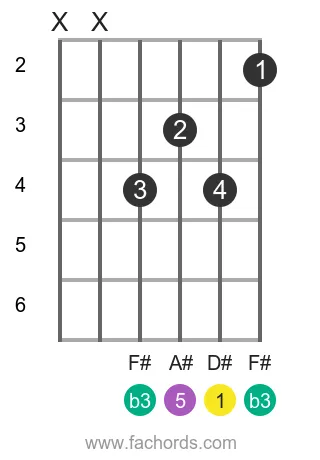
Position 2
Barre
Movable
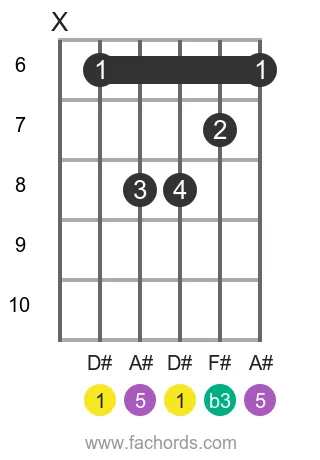
Position 3
Barre
Movable
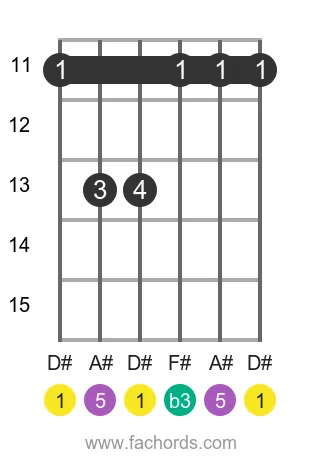
 Find more shapes in our all guitar chords online library. If you
prefer a printable pdf, download
the Free Guitar Chords Chart Pdf
Find more shapes in our all guitar chords online library. If you
prefer a printable pdf, download
the Free Guitar Chords Chart Pdf
You can also use this accessible D#m chord page, with written diagram instructions and screen-reader support for blind users.
Master the D#m Guitar Chord: Theory & Interactive Practice
Want a structured chord roadmap instead of jumping between pages?
Go to the full guitar chords tutorial.
The D# minor chord is constructed as a core member of the Minor Chords family, defined by its characteristic intervals: 1 (Root), b3 (Minor Third), and 5 (Perfect Fifth). These intervals translate to the notes D#, F#, and A#, forming its fundamental harmonic identity. To deeply understand and internalize this structure, utilize the interactive fretboard tool at the top of this page. This virtual environment allows you to visualize every possible fingering, hear the chord played as a strum or arpeggio for auditory reinforcement, and crucially, receive instant confirmation of your accuracy through real-time microphone feedback as you play along.
As a minor chord, D#m contributes a distinct emotional color to music, often conveying moods from introspective to melancholic. Understanding this three-note structure is fundamental to expanding your harmonic vocabulary. Explore the principles behind how chords are built with our dedicated Chord Construction tutorial. Given that many common D#m voicings involve barring, mastering techniques from our guide to Guitar Bar Chords will be highly beneficial. Furthermore, to integrate the D#m chord smoothly into your playing, practice smooth chord changes to enhance your fluidity.
Below this introduction, you'll find a comprehensive collection of D#m chord diagrams, thoughtfully ranked from the most accessible open positions to more intricate barre shapes. Accompanying these are sections detailing its music theory, popular songs that feature this chord, and the musical keys in which it frequently appears. For truly disciplined practice and effective learning, commit to using the interactive tool above first. Set a practice tempo with the drum tool, play the chord, and let the real-time mic feedback meticulously guide your finger placement. This rigorous, hands-on methodology is indispensable for internalizing the sound and precise feel of the D# minor chord.
Notes in the D# m chord:
Tones of the Minor chord:
Play This Chord With Other Roots
C m | D m | E m | F m | G m | A m | B m | C#m | D#m | F#m | G#m | A#m | Abm | Bbm | Dbm | Ebm | Gbm

Created by
Giancarlo is a musician (teaching guitar since 2000), software engineer, AI consultant and published researcher
FAQ
What are the specific notes that form the D# minor chord?
The D# minor chord is composed of three distinct notes: D#, F#, and A#. These are the fundamental tones that create the chord's unique sound.
What do the intervals '1, b3, and 5' mean in the context of the D# minor chord?
For the D# minor chord, '1' represents the root note (D#). 'b3' signifies the minor third interval (F#) above the root, and '5' denotes the perfect fifth interval (A#) above the root. These three intervals are the foundational structure for all minor chords.
Why is this chord specifically called a 'minor' chord?
A chord is classified as 'minor' because of the specific interval of its third note relative to the root. In the D# minor chord, the F# is a 'minor third' (b3) above the D# root. This minor third interval is what defines the chord's characteristic minor quality and sound.
What is the primary difference between a major and a minor chord like D# minor?
The main difference between a major and a minor chord lies in their third interval. A minor chord, such as D# minor, uses a minor third (b3) above its root, which gives it a typically melancholic sound. A major chord, by contrast, uses a major third (3) above its root, resulting in a brighter or happier sound. Both types share the root (1) and the perfect fifth (5).