Open G Tuning for Guitar
How to Tune to D G D G B D, the Chord Shapes You Need and What to Play With Them
Strum the open strings in standard tuning and you get a chord nobody asked for. Strum them in open G tuning and you get a fat G major chord, without touching the fretboard.
Open G is the tuning of Delta blues slide players and, a few decades later, of Keith Richards and some of the most famous rhythm parts in rock. One finger across the strings is a major chord, and two fingers added to it give you the sound of the Rolling Stones.
Here you'll tune up with a reference tone for each string, and then we'll see what to actually play in open G: the chord shapes, with diagrams drawn for this tuning, the Keith Richards move, a blues, a slide riff, and audio for every example.
Open G tuning in one sentence: the six strings are tuned to D G D G B D (low to high), the three notes of a G major chord, so the open strings sound G major.
From standard tuning: lower the 6th, 5th and 1st strings a whole step (E to D, A to G, E to D). The 4th, 3rd and 2nd strings stay where they are.
Open G Tuning Notes
Here is the fretboard in open G. Start from the open strings on the left: D, G, D, G, B, D.

Three strings are D, two are G and one is B. In chord terms: two roots (G), three 5ths (D) and one major 3rd, on the 2nd string. Notice also where the lowest root is: on the 5th string, not the 6th. The 6th string is a D, the 5th of the chord, sitting under everything. Both details will matter in a minute.
The six open strings, low to high, then strummed together
How to Tune Your Guitar to Open G
Starting from standard tuning, you change three strings, and all three go down a whole step (two semitones). Play each reference tone and match your string to it, or use a tuner and check the note names in the table.
| String | Standard | Open G | What to do | Check without a tuner | Reference tone |
|---|---|---|---|---|---|
| 6th | E | D (D2, 73.42 Hz) | Down a whole step | One octave below the open 4th string. Its 5th fret matches the retuned open 5th string | |
| 5th | A | G (G2, 98 Hz) | Down a whole step | One octave below the open 3rd string. Its 7th fret matches the open 4th string | |
| 4th | D | D (D3, 146.83 Hz) | Leave it | ||
| 3rd | G | G (G3, 196 Hz) | Leave it | ||
| 2nd | B | B (B3, 246.94 Hz) | Leave it | ||
| 1st | E | D (D4, 293.66 Hz) | Down a whole step | Same note as the 3rd fret of the 2nd string, one octave above the open 4th string |
A few practical tips:
- Use the strings that don't move. The 4th (D), 3rd (G) and 2nd (B) strings are your anchors: every retuned string is an octave of one of them.
- Finish by tuning up to the note. If you overshoot, go below the pitch and come back up to it: the string holds its tuning better.
- Go around twice. Lowering three strings takes tension off the neck, and the strings you tuned first drift a little. Check all six again when you're done.
- Is it safe for the guitar? Yes. Everything goes down, so there is less tension than in standard tuning, not more. The three lowered strings feel a bit looser, and that's all.
If you want the numbers behind those pitches, they're in our note frequencies chart.
Open G Tuning Chords: Start With One Finger
Since the open strings are a G major chord, a barre across the strings at any fret is a major chord too. The fret number is the chord.
One detail first. Because the lowest root is on the 5th string, the cleanest sound comes from strumming strings 5 to 1. Add the 6th string and you put the 5th of the chord in the bass (a full barre at the 5th fret is C with a G underneath). It's not wrong, and plenty of players strum all six, but it's the reason the diagrams below skip the 6th string.
G (open)

C (5th fret)

D (7th fret)

G, C and D are the I, IV and V of the key of G: with the open strings, the 5th fret and the 7th fret you can already play hundreds of three-chord songs.
G (open) - C (5th fret) - D (7th fret) - G (open)
The same map works for a slide, because a slide is nothing but a movable barre:
| Fret (barre or slide) | 0 | 2 | 3 | 5 | 7 | 10 | 12 |
|---|---|---|---|---|---|---|---|
| Major chord | G | A | Bb | C | D | F | G |
| In the key of G | I | II | bIII | IV | V | bVII | I |
Careful with frets 2, 4 and 9: a full barre there gives A, B and E major, while the key of G wants A minor, B minor and E minor. For those you need the minor shapes below.
Open G Chord Shapes Beyond the Barre
Remember the 2nd string, the one with the B? It's the 3rd of the chord, and almost every color here comes from moving one note on or around it.
Gsus4, G6 and G7
Gsus4

G6

G7

- Gsus4 (x-0-0-0-1-0): one finger on the 1st fret of the 2nd string turns the B into C, the 4th. Hammer it on and pull it off and you hear the open G rhythm sound right away.
- G6 (x-0-0-0-0-2): the 2nd fret of the 1st string is E, the 6th. Sweet and a bit country.
- G7 (x-0-0-0-0-3): the 3rd fret of the 1st string is F, the b7. The same move works on the barres: add the note three frets above the barre on the 1st string and C becomes C7, D becomes D7.
G - Gsus4 - G6 - G7, one strum each
The Keith Richards move: add two fingers
This is the sound most people are looking for when they tune to open G. Hold the open G chord on the middle strings, then add two fingers: the 2nd fret of the 4th string (E, the 6th of G) and the 1st fret of the 2nd string (C, the 4th of G). Together they make a C chord over the open G bass. Lift them off and you're back on G.
C/G

F/C

The move is movable. Over the C barre at the 5th fret, the same two fingers land on the 7th fret of the 4th string and the 6th fret of the 2nd string, and C becomes F/C. At the 7th fret, D becomes G/D. Play the chord, push the added fingers on an offbeat, release:
D |-------------------------|-------------------------|
B |--0--0--0--1--1--0-------|--5--5--5--6--6--5-------|
G |--0--0--0--0--0--0-------|--5--5--5--5--5--5-------|
D |--0--0--0--2--2--0-------|--5--5--5--7--7--5-------|
G |--0--0--0--0--0--0-------|--5--5--5--5--5--5-------|
D |-------------------------|-------------------------|
     G           C/G   G       C           F/C   C
G - C/G - G, twice, then C - F/C - C, G - C/G - G
Keep it short and choppy, and leave space between the chords: the gaps are half of the groove. For the history of the tuning and more of Keith's rhythm style, see our Keith Richards open G lesson.
Minor chords: Am, Em and Bm
The major 3rd is on the 2nd string, so a minor chord needs that note one fret lower. That gives a movable minor shape on strings 5 to 2.
Am

Em
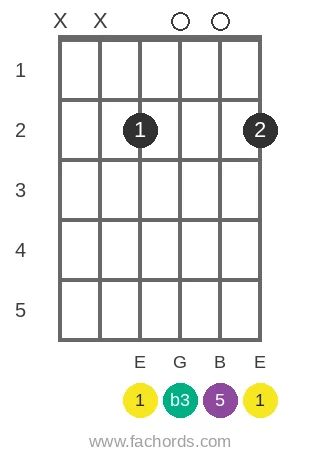
- Am (x-2-2-2-1-x): three fingers on the 2nd fret of the 5th, 4th and 3rd strings, index on the 1st fret of the 2nd string, 1st and 6th strings muted. Slide the whole shape to the 4th fret for Bm and to the 9th fret for Em.
- Em (x-x-2-0-0-2): the open E minor of open G. The 2nd fret of the 4th string gives E in the bass, the open G and B strings do the rest, and the 1st string doubles the E on top.
- Gm: the open B can't go any lower, so the minor 3rd comes from the 3rd fret of the 3rd string instead: x-0-0-3-3-0.
G - Em - Am - D (7th fret) - G
Open G tuning chord chart
All the shapes of this lesson in one table. Frets are written from the 6th string to the 1st, x is a muted string.
| Chord | Frets (6th to 1st string) | Notes (low to high) | Movable? |
|---|---|---|---|
| G | x-0-0-0-0-0 | G D G B D | Yes: barre, any fret |
| C | x-5-5-5-5-5 | C G C E G | Barre |
| D | x-7-7-7-7-7 | D A D F# A | Barre |
| Gsus4 | x-0-0-0-1-0 | G D G C D | Over a barre: 2nd string one fret higher |
| G6 | x-0-0-0-0-2 | G D G B E | Over a barre: 1st string two frets higher |
| G7 | x-0-0-0-0-3 | G D G B F | Over a barre: 1st string three frets higher |
| Gmaj7 | x-0-0-0-0-4 | G D G B F# | Over a barre: 1st string four frets higher |
| C/G | x-0-2-0-1-x | G E G C | Yes: F/C over the 5th fret, G/D over the 7th |
| Am | x-2-2-2-1-x | A E A C | Yes: Bm at fret 4, Em at fret 9 |
| Em | x-x-2-0-0-2 | E G B E | No (open strings) |
| Gm | x-0-0-3-3-0 | G D Bb D D | No (open strings) |
With G, Am, Bm, C, D and Em you have the six main chords in the key of G major, the home key of this tuning.
A 12-Bar Blues in Open G
The three chords of a blues in G are the three one-finger chords you already know, plus the G7 trick in bar 4 to push towards the C.
| G (open) | G | G | G7 |
| C (5th fret) | C | G | G |
| D (7th fret) | C | G | D |
12-bar blues in G: open strings, 5th fret, 7th fret
Once it feels easy, replace some of the plain G bars with the G - C/G - G move from the Keith Richards section: that's a big part of the open G rock sound. You'll find more versions of the form on the 12-bar blues page.
Slide Guitar in Open G
Open G is one of the two classic slide guitar tunings (the other is open D). Lay the slide across the strings at the 12th fret and you play G; at the 5th fret, C; at the 7th fret, D. Many open G slide riffs live on the top three strings, G B D, a G major triad you can move anywhere.
D |--12-12-12-12--10-10--12---|--5--5--5--3--0-----------|
B |--12-12-12-12--10-10--12---|--5--5-----------1--0-----|
G |--12-12-12-12--10-10--12---|--5--5-----------------0--|
D |---------------------------|--------------------------|
G |---------------------------|--------------------------|
D |---------------------------|--------------------------|
     G               F    G       C     line down to G
The riff played fretted. With a slide, glide into the 12th and 5th frets from a fret below
Two slide tips. Rest the slide lightly on the strings, right above the fret wire, not behind it, or you'll sound flat. And mute the strings you're not playing with the fingers behind the slide and the palm of the picking hand.
Keith Richards' Open G: Five Strings
The most famous open G player plays it on five strings. Keith Richards tunes to open G and takes the 6th string off the guitar (or simply avoids it), so his tuning is G D G B D, low to high. The low D is gone, the lowest note is the root on the 5th string, and every barre and every "add two fingers" move sounds tight, with nothing muddy underneath.
You don't need to remove a string to get that sound: tune to open G and don't strike the 6th string, which is exactly what the diagrams in this lesson already do. Fun fact: the 5-string banjo is tuned to an open G chord too (g D G B D, with the high g as a drone string), which is why open G riffs and banjo rolls fit together so well.
Songs in Open G Tuning
Open G was a blues tuning long before it was a rock tuning. Old blues players called it Spanish tuning, and many recordings were made with the same layout tuned higher or lower, so a "song in open G" sometimes sounds in another key on the record. Here are some well-documented examples:
| Song | Artist | What to listen for |
|---|---|---|
| Cross Road Blues | Robert Johnson | Slide in Spanish (open G) tuning, pitched higher on the original record |
| Honky Tonk Women | The Rolling Stones | Keith Richards' 5-string open G rhythm part |
| Can't You Hear Me Knocking | The Rolling Stones | Choppy open G intro riff, five strings |
| Brown Sugar | The Rolling Stones | The whole rhythm track is built on open G |
| Tumbling Dice | The Rolling Stones | Open G with a capo on the 4th fret, so it sounds in B |
| That's the Way | Led Zeppelin | Jimmy Page's strummed acoustic part in open G |
| Start Me Up | The Rolling Stones | The three-chord intro on a Telecaster in 5-string open G |
With a capo, open G covers any key: put it on the 2nd fret for A, on the 4th for B, and so on. Our guide to the capo explains how to work out the sounding key.
Open G vs Open D, Open A, Open C and DADGAD
These tunings get mixed up all the time. Here is how they relate to open G:
| Tuning | Strings (6th to 1st) | Open strings sound | Compared with open G |
|---|---|---|---|
| Open G | D G D G B D | G major | |
| Open G, 5 strings | G D G B D | G major | The Keith Richards version: no 6th string, root in the bass |
| Open A | E A E A C# E | A major | Same intervals, a whole step higher: all open G shapes work |
| Open D | D A D F# A D | D major | Same 6th, 4th and 1st strings, root on the 6th string. Strings 6 to 2 of open D have the same intervals as strings 5 to 1 of open G, a 4th lower |
| Open C | C G C G C E | C major | Lower and wider, with the root on the 6th string |
| DADGAD | D A D G A D | Dsus4 | Four strings in common; the 5th and 2nd strings are A instead of G and B |
The open D link is the most useful one: a shape on strings 6 to 2 in open D works on strings 5 to 1 in open G, a 4th higher. The open D minor shape 2-2-2-1-x-x, for example, is the open G minor shape x-2-2-2-1-x moved one string over. Put a capo on the 2nd fret in open G and you get the pitches of open A without raising any string. For the complete tour, see our list of alternate guitar tunings, and the open E lesson if you want open D's sister slide tuning, a whole step higher.
Conclusion
Open G is three strings down and a whole style of playing up. Here is the recap:
| Notes | D G D G B D (D2 G2 D3 G3 B3 D4) |
| From standard | 6th, 5th and 1st strings down a whole step |
| Major chords | Barre on strings 5 to 1: open = G, 5th fret = C, 7th fret = D |
| The Keith Richards move | Add 4th string fret 2 and 2nd string fret 1: G becomes C/G |
| Minor chords | x-2-2-2-1-x (Am), movable. Em = x-x-2-0-0-2 |
| Seventh chords | 1st string three frets above the barre (G7 = x-0-0-0-0-3) |
| Best for | Rock rhythm guitar, slide, blues, acoustic strumming |
Your next step: tune down, skip the 6th string, and play the G - C/G - G move until it grooves. Then try the 12-bar blues with it. You'll understand very quickly why some guitarists never tune back.
That's all for today.
Remember that you can subscribe here to stay updated on new tutorials and gain access to the free download area, where you'll find some free chords and scales PDFs.

Created by
Giancarlo is a musician (teaching guitar since 2000), software engineer, AI consultant and published researcher
FAQ
What is open G tuning on guitar?
Open G tuning is D G D G B D, from the 6th (lowest) string to the 1st. With octaves: D2, G2, D3, G3, B3, D4. The open strings contain only the three notes of a G major chord: G (the root), B (the major 3rd) and D (the 5th), so strumming the guitar without fretting anything gives you G major.
How do you tune a guitar to open G?
Start from standard tuning and lower three strings a whole step each: the 6th string from E to D, the 5th string from A to G and the 1st string from E to D. The 4th (D), 3rd (G) and 2nd (B) strings do not change. Everything goes down, so there is less tension on the neck, not more.
What is Keith Richards' open tuning?
Keith Richards plays in open G with five strings: G D G B D, low to high. He either takes the 6th string off the guitar or avoids it, so the lowest note is the G of the 5th string, the root of the chord. That tuning is behind Rolling Stones riffs like Honky Tonk Women, Brown Sugar and Start Me Up. You can get the same sound on a six-string guitar by tuning to open G and not playing the 6th string.
How do you play minor chords in open G tuning?
The major 3rd of every barre chord is on the 2nd string, so a minor chord needs that note one fret lower. A movable shape is x-2-2-2-1-x (A minor): three fingers on the 2nd fret of the 5th, 4th and 3rd strings and the index one fret behind on the 2nd string. Move it to the 4th fret for Bm and to the 9th fret for Em. In open position, E minor is x-x-2-0-0-2.
Is open G good for slide guitar?
Yes, it's one of the two classic slide tunings, with open D. The open strings are a G major chord, so the slide laid across the strings at the 12th fret plays G, at the 5th fret C and at the 7th fret D: the I, IV and V of a blues in G. Many players keep the slide on the top three strings (G B D), where the riffs sit.
What is the difference between open G and open D tuning?
Open D is D A D F# A D, open G is D G D G B D. They share three strings (D on the 6th, 4th and 1st), but the layout is different: in open G the root is on the 5th string, in open D on the 6th. Strings 5 to 1 of open G have the same intervals as strings 6 to 2 of open D, a 4th higher, so shapes move from one tuning to the other one string over.
What is the difference between open G and DADGAD?
DADGAD is D A D G A D and its open strings sound Dsus4, a chord that is neither major nor minor. Open G is D G D G B D and sounds G major. They share four strings (6th, 4th, 3rd and 1st); the 5th string is A in DADGAD and G in open G, the 2nd string is A in DADGAD and B in open G.
Is open G tuning bad for the guitar?
No. The three strings you change all go down a whole step, so the total tension on the neck decreases. The lowered strings feel a little looser and can buzz with a very light set; if you plan to stay in open G or to play slide, a slightly heavier set of strings helps.