Open E Tuning for Guitar
How to Tune to E B E G# B E, Is It Safe for Your Guitar, the Chord Shapes and What to Play With Them
Strum the open strings in standard tuning and you get a vague Em7add11. Tune three strings up, strum again, and the guitar rings out a full E major chord without a single finger on the fretboard. That's open E tuning.
It's the tuning of a lot of electric slide guitar, from Duane Allman to Derek Trucks, and of some of the most famous Rolling Stones riffs. One finger across the strings is a major chord, every open string is a note you can let ring, and the key of E sits right where blues and rock love to be.
Here you'll tune up with a reference tone for each string, find out honestly what the extra string tension means for your guitar, and then see what to play: chord shapes drawn for open E, a slide-style blues and the songs, with audio for every example.
Open E tuning in one sentence: the six strings are tuned to E B E G# B E (low to high), the three notes of an E major chord, so the open strings sound E major.
From standard tuning: raise the 5th and 4th strings a whole step (A to B, D to E) and the 3rd string a half step (G to G#). The 6th, 2nd and 1st strings stay where they are.
Open E Tuning Notes
Here are the notes on the fretboard in open E, from the open strings to the 12th fret. The 6th string is at the bottom of the table, like on a fretboard notes map.
| String | 0 | 1 | 2 | 3 | 4 | 5 | 6 | 7 | 8 | 9 | 10 | 11 | 12 |
|---|---|---|---|---|---|---|---|---|---|---|---|---|---|
| 1st | E | F | F# | G | G# | A | A# | B | C | C# | D | D# | E |
| 2nd | B | C | C# | D | D# | E | F | F# | G | G# | A | A# | B |
| 3rd | G# | A | A# | B | C | C# | D | D# | E | F | F# | G | G# |
| 4th | E | F | F# | G | G# | A | A# | B | C | C# | D | D# | E |
| 5th | B | C | C# | D | D# | E | F | F# | G | G# | A | A# | B |
| 6th | E | F | F# | G | G# | A | A# | B | C | C# | D | D# | E |
Three strings are E, two are B and one is G#. In chord terms: three roots, two 5ths and one major 3rd, on the 3rd string. That string decides whether a chord is major, minor or suspended, and we'll use it a lot.
The six open strings, low to high, then strummed together
How to Tune Your Guitar to Open E
Starting from standard tuning, you change three strings, and all three go up. Play each reference tone and match your string to it, or use a tuner and check the note names in the table.
| String | Standard | Open E | What to do | Check without a tuner | Reference tone |
|---|---|---|---|---|---|
| 6th | E | E (E2, 82.41 Hz) | Leave it | One octave below the open 4th string. Its 7th fret matches the open 5th string | |
| 5th | A | B (B2, 123.47 Hz) | Up a whole step | Same note as the 7th fret of the 6th string | |
| 4th | D | E (E3, 164.81 Hz) | Up a whole step | Same note as the 5th fret of the retuned 5th string, one octave above the open 6th string | |
| 3rd | G | G# (G#3, 207.65 Hz) | Up a half step | Same note as the 4th fret of the retuned 4th string | |
| 2nd | B | B (B3, 246.94 Hz) | Leave it | Same note as the 3rd fret of the retuned 3rd string, one octave above the open 5th string | |
| 1st | E | E (E4, 329.63 Hz) | Leave it | Same note as the 5th fret of the 2nd string, two octaves above the open 6th string |
A few practical tips:
- Tune up to the note, never down to it. Raise each string slowly and stop on the pitch. If you overshoot, drop below the note and come back up: the string holds its tuning better.
- Start with the 5th string. The 6th, 2nd and 1st strings don't move, so they are your anchors. Tune the 5th string to the 7th fret of the 6th, then the 4th string to the 5th fret of the 5th, then the 3rd string.
- Go around twice. Three strings pulling harder bend the neck a tiny bit, and the strings you tuned first go slightly flat. Check all six again when you're done.
- Listen to the G#. It's the only 3rd in the chord and the note that sounds wrong first. Strum all six strings and adjust it until the chord sounds calm.
If you want the numbers behind those pitches, they're in our note frequencies chart.
Is Open E Tuning Bad for Your Guitar?
This is the question to ask before you turn the pegs, because open E, like open A, is one of the few popular open tunings that add tension instead of removing it. Three strings go up:
- The tension of a string grows with the square of its pitch. A string raised a whole step (the 5th and the 4th) pulls about 26% harder, a string raised a half step (the 3rd) about 12% harder.
- On an electric guitar with a normal light set (9s or 10s), that's usually fine for a song or an evening. The truss rod and the neck are built with some margin. You may notice slightly higher action and a stiffer feel on those three strings.
- On an acoustic, especially an old one, a light-built one or one with a heavy set of strings, the extra pull goes straight onto the bridge and the top. Occasional use is normally OK, but leaving it in open E for weeks is not a great idea.
- The risk you're most likely to meet is a broken string, and the 3rd string is the thinnest of the three you raise. Tune up slowly.
The common alternative, and what many players do: tune to open D (D A D F# A D) and put a capo on the 2nd fret. Open D has exactly the same intervals as open E, a whole step lower, and it lowers four strings instead of raising three. With the capo on, the open strings sound E B E G# B E, and every shape on this page works if you count the frets from the capo.
The trade-off: slide players often prefer real open E because the higher tension keeps the strings from sagging under the slide and gives a brighter, punchier sound. If you plan to play a lot of slide in open E, a guitar kept in that tuning (with a setup to match) is the classic solution.
Open E Tuning Chords: Start With One Finger
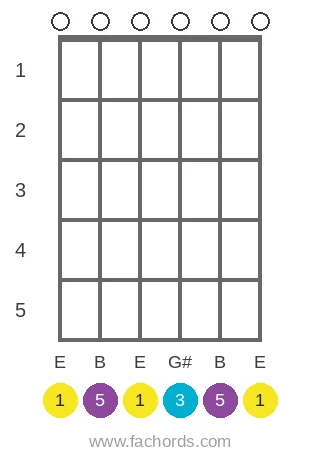
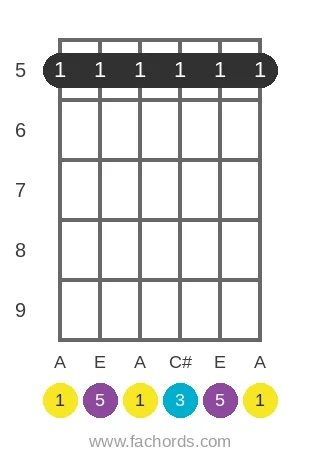
Since the open strings are an E major chord, a barre across all six strings at any fret is a major chord too. No shape to remember: the fret number is the chord.
E (open)
A (5th fret)
B (7th fret)
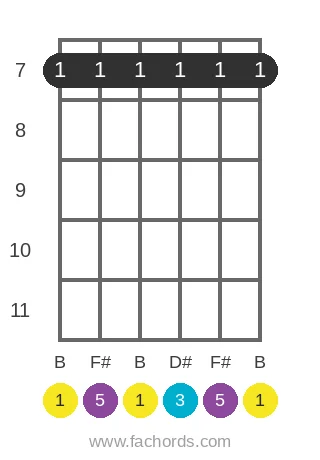
E, A and B are the I, IV and V of the key of E: with the open strings, the 5th fret and the 7th fret you can already play hundreds of three-chord songs.
E (open) - A (5th fret) - B (7th fret) - E (open)
This is also the map every slide player uses, because a slide is nothing but a movable barre:
| Fret (full barre or slide) | 0 | 2 | 3 | 5 | 7 | 10 | 12 |
|---|---|---|---|---|---|---|---|
| Major chord | E | F# | G | A | B | D | E |
| In the key of E | I | II | bIII | IV | V | bVII | I |
Careful with frets 2 and 9: a full barre there gives F# major and C# major, while the key of E wants F# minor and C# minor. For those you need the minor shapes below.
Open E Chord Shapes Beyond the Barre
Barre chords get boring fast, and you want open strings ringing. Remember the 3rd string? Almost every shape here is the open E chord with one or two notes moved. (If you know open D, these are the same shapes at the same frets.)
Esus4, E7 and E minor
Esus4
E7
Em
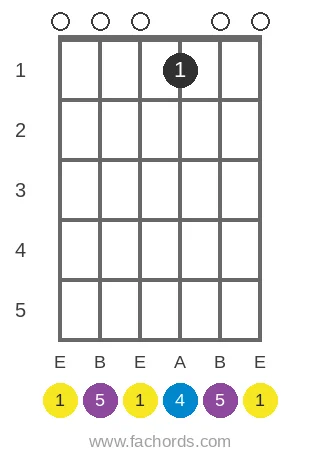
- Esus4 (0-0-0-1-0-0): one finger on the 1st fret of the 3rd string turns the G# into A. Hammer it on and pull it off and you get that classic open-tuning rock rhythm sound.
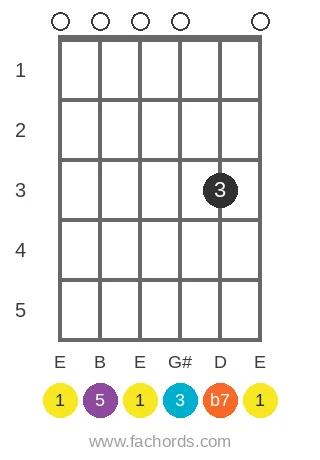
- E7 (0-0-0-0-3-0): the 3rd fret of the 2nd string is D, the b7. The same move works on the barres: add the note three frets above the barre on the 2nd string and A becomes A7 (5-5-5-5-8-5), B becomes B7 (7-7-7-7-10-7). That's every chord of a blues.
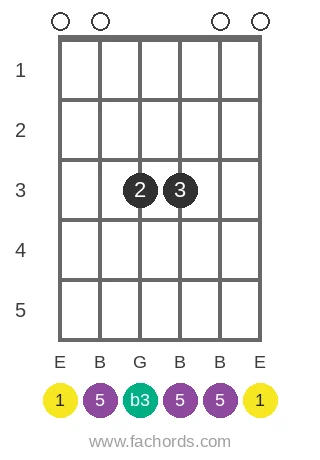
- Em (0-0-3-3-0-0): the open G# is the major 3rd, so it has to go. The 3rd fret of the 4th string gives you G, the minor 3rd, and the 3rd fret of the 3rd string replaces G# with B.
E - Esus4 - E7 - Em, one strum each
A/E, C#m7 and F# minor
A/E
C#m7
F#m
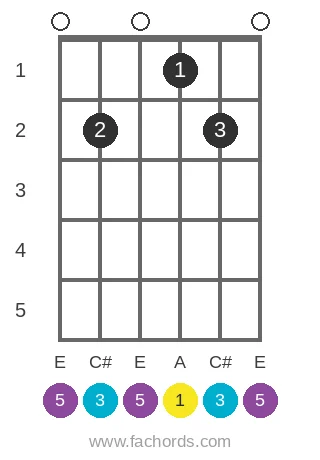
- A/E (0-2-0-1-2-0): an A chord in open position, with the open E strings ringing below and above it. Rock players flick between E and this shape all the time: it's the heart of many open E rhythm parts.
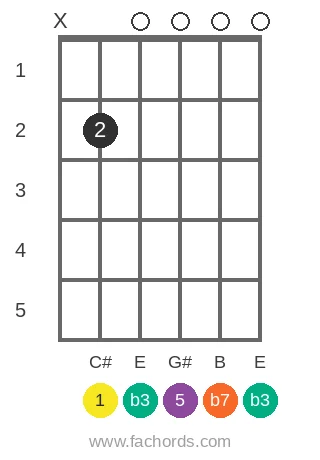
- C#m7 (x-2-0-0-0-0): one finger on the 2nd fret of the 5th string, and skip the 6th string. The C# in the bass turns the open E chord into C#m7, the relative minor sound of the key.
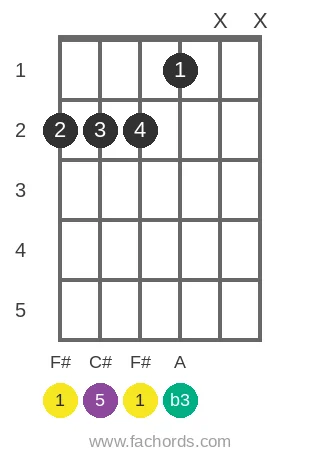
- F#m (2-2-2-1-x-x): the movable minor shape. Three fingers on the 2nd fret of the three low strings, index on the 1st fret of the 3rd string, top two strings muted. Slide the whole thing to the 4th fret for G#m and to the 9th fret for C#m.
E - C#m7 - A/E - E
F#m - B (7th fret) - E - E
Open E tuning chord chart
All the shapes of this lesson in one table (print it or save it as your open E chord sheet). Frets are written from the 6th string to the 1st, x is a muted string.
| Chord | Frets (6th to 1st string) | Notes (low to high) | Movable? |
|---|---|---|---|
| E | 0-0-0-0-0-0 | E B E G# B E | Yes: full barre, any fret |
| A | 5-5-5-5-5-5 | A E A C# E A | Barre |
| B | 7-7-7-7-7-7 | B F# B D# F# B | Barre |
| A/E | 0-2-0-1-2-0 | E C# E A C# E | No (open strings) |
| Esus4 | 0-0-0-1-0-0 | E B E A B E | Over a barre: 3rd string one fret higher |
| Esus2 | 0-0-2-3-0-0 | E B F# B B E | No (open strings) |
| E7 | 0-0-0-0-3-0 | E B E G# D E | Over a barre: 2nd string three frets higher |
| A7 | 5-5-5-5-8-5 | A E A C# G A | Same move on the 5th fret barre |
| B7 | 7-7-7-7-10-7 | B F# B D# A B | Same move on the 7th fret barre |
| Emaj7 | 0-0-0-0-4-0 | E B E G# D# E | Over a barre: 2nd string four frets higher |
| Em | 0-0-3-3-0-0 | E B G B B E | No (open strings) |
| F#m | 2-2-2-1-x-x | F# C# F# A | Yes: G#m at fret 4, C#m at fret 9 |
| G#m | 4-4-4-3-x-x | G# D# G# B | Same shape as F#m |
| C#m | 9-9-9-8-x-x | C# G# C# E | Same shape as F#m |
| C#m7 | x-2-0-0-0-0 | C# E G# B E | No (open strings) |
With E, F#m, G#m, A, B and C#m you have the six main chords in the key of E major. For any other chord, the chord library shows the standard tuning shapes, a good reference for the notes you need.
A Slide-Style 12-Bar Blues in Open E
Open E was made for this. The three chords of a blues in E are the three one-finger chords you already know, plus the E7 trick in bar 4 to push towards the A.
| E (open) | E | E | E7 |
| A (5th fret) | A | E | E |
| B (7th fret) | A | E | B |
12-bar blues in E: open strings, 5th fret, 7th fret
Play it with a finger barre first. Then grab a slide and play the same thing: rest the slide lightly on the strings, right above the fret wire and not behind it, and glide into the 5th and 7th frets from a fret or two below. Mute the strings behind the slide with a finger of your fretting hand. That's the sound.
Now the lick every open E slide player knows in some form: the E major chord at the 12th fret, played string by string in triplets, then a short walk down to the low E.
E |-------12-------12-------12-------12-|-15-12-------------|
B |----12-------12-------12-------12----|-------15-12-------|
G#|-12-------12-------12-------12-------|-------------12----|
E |-------------------------------------|----------------12-|
B |-------------------------------------|-------------------|
E |-------------------------------------|----------------0--|
12th fret triplets on the top three strings, then G, E, D, B, G# and the low E (played fretted here: with a slide, glide into each note)
The 15th fret of the 1st and 2nd strings gives you G and D, the b3 and b7 of E: the two notes that make it sound like the blues. Our slide guitar introduction covers the technique, muting included, and you'll find more versions of the form on the 12-bar blues page.
Melody Over a Drone: the Other Open E Sound
The second thing open E does better than standard tuning is the drone: low E strings that keep ringing while you play a melody on top.
Try this. The 1st string is an E, so the E major scale along that string is frets 0, 2, 4, 5, 7, 9, 11 and 12. Play it while your thumb alternates between the open 6th and 4th strings:
E |--0---2---4---5---7---9---11--12--|
B |----------------------------------|
G#|----------------------------------|
E |------0-------0-------0-------0---|
B |----------------------------------|
E |--0-------0-------0-------0-------|
E major scale on the 1st string over the open E strings, up and back down
Every note of the E major scale sounds good over an E drone. Change the order, repeat notes, slide between them, and you're already improvising in open E.
Songs in Open E Tuning
Open E is the tuning of a lot of electric slide guitar and of several Rolling Stones classics. Some of these parts are also played in open D with a capo on the 2nd fret, which gives the same notes.
| Song | Artist | What to listen for |
|---|---|---|
| Statesboro Blues | The Allman Brothers Band | Duane Allman's slide on the live version from At Fillmore East. Open E was his usual slide tuning |
| Gimme Shelter | The Rolling Stones | Keith Richards' rhythm guitar part, with open strings ringing under the chord changes |
| Jumpin' Jack Flash | The Rolling Stones | The opening guitar part |
| Prodigal Son | The Rolling Stones | Acoustic country blues from Beggars Banquet (a Robert Wilkins song) |
| Stay With Me | Faces | Ronnie Wood's crunchy open E guitar part |
| Rocky Mountain Way | Joe Walsh | Joe Walsh's slide guitar |
| She Talks to Angels | The Black Crowes | Acoustic open E picking (some players use open D with a capo on the 2nd fret) |
| Midnight in Harlem | Tedeschi Trucks Band | Derek Trucks' slide melody: open E is his usual tuning |
Open E vs Open D, Open G, Open A, Drop D and DADGAD
These tunings get mixed up all the time. Here is how they relate to open E:
| Tuning | Strings (6th to 1st) | Open strings sound | Compared with open E |
|---|---|---|---|
| Open E | E B E G# B E | E major | |
| Open D | D A D F# A D | D major | Same intervals, a whole step lower: all shapes work. Capo 2 = open E |
| Open E minor | E B E G B E | E minor | 3rd string stays on G |
| Open G | D G D G B D | G major | Different layout: the root is on the 5th string |
| Open A | E A E A C# E | A major | Open G a whole step higher. It raises three strings too |
| Drop D | D A D G B E | Not a chord | Only the 6th string changes from standard |
| DADGAD | D A D G A D | Dsus4 | Open D with the 3rd string on G, so not a major chord |
Open E and open D are twins, and the choice between them is about tension and pitch, not about shapes. Open G is the famous Keith Richards tuning (his open E songs are the exceptions), and it has its own rhythm lesson here. For the complete tour, open C and the drop tunings included, see our list of alternate guitar tunings.
Conclusion
Open E is the bright, punchy sibling of open D: three strings up, and the guitar plays an E major chord by itself. Here is the recap:
| Notes | E B E G# B E (E2 B2 E3 G#3 B3 E4) |
| From standard | 5th and 4th strings up a whole step, 3rd string up a half step |
| Tension | Higher than standard on three strings. Gentler option: open D with a capo on the 2nd fret |
| Major chords | Full barre: open = E, 5th fret = A, 7th fret = B |
| Minor chords | 2-2-2-1-x-x (F#m), movable. Em = 0-0-3-3-0-0 |
| Seventh chords | 2nd string three frets above the barre (E7 = 0-0-0-0-3-0) |
| Best for | Electric slide, blues, open-chord rock rhythm |
Your next step: tune up (slowly), play the 12-bar blues with one finger, then try the 12th fret lick with a slide. When you go back to standard tuning, the guitar will feel new again.
That's all for today.
Remember that you can subscribe here to stay updated on new tutorials and gain access to the free download area, where you'll find some free chords and scales PDFs.

Created by
Giancarlo is a musician (teaching guitar since 2000), software engineer, AI consultant and published researcher
FAQ
What tuning is open E?
Open E tuning is E B E G# B E, from the 6th (lowest) string to the 1st. With octaves: E2, B2, E3, G#3, B3, E4. The open strings contain only the three notes of an E major chord: E (the root), G# (the major 3rd) and B (the 5th), so strumming the guitar without fretting anything gives you E major.
How do you tune a guitar to open E from standard tuning?
Three strings go up, three stay where they are. Raise the 5th string a whole step from A to B, the 4th string a whole step from D to E and the 3rd string a half step from G to G#. The 6th string (E), the 2nd string (B) and the 1st string (E) do not change.
Is open E tuning bad for a guitar?
Not for occasional use on a healthy guitar, but it is one of the few common open tunings (with open A) that add tension. Three strings are tuned up: a string raised a whole step pulls about 26% harder, one raised a half step about 12% harder. Electric guitars with light strings usually cope well. On an older or fragile acoustic, or if you want to stay in open E for weeks, the safer route is open D (D A D F# A D) with a capo on the 2nd fret: same chord shapes and the same pitches, with less tension than standard tuning.
Is open E the same as open D with a capo?
Yes, as far as the notes go. Open D has the same intervals between the strings as open E, a whole step lower. Put a capo on the 2nd fret in open D and the open strings sound E B E G# B E, so every open E shape and song works, counting frets from the capo. Many slide players prefer real open E for the higher string tension, which keeps the slide from clacking against the frets.
What rock songs are in open E tuning?
Well documented examples are Gimme Shelter, Jumpin' Jack Flash and Prodigal Son by the Rolling Stones, Statesboro Blues by the Allman Brothers Band (Duane Allman's slide), Stay With Me by the Faces, Rocky Mountain Way by Joe Walsh, She Talks to Angels by the Black Crowes and Midnight in Harlem by the Tedeschi Trucks Band.
What is Keith Richards' open tuning?
Keith Richards' trademark tuning is open G (D G D G B D), often played on five strings with the 6th string removed. It is not open E, although he has used open E (or open D with a capo) on songs such as Gimme Shelter and Jumpin' Jack Flash. Open G is a different layout: the root is on the 5th string instead of the 6th.
How do you play minor chords in open E tuning?
The major 3rd of every barre chord sits on the 3rd string, so a minor chord needs that note one fret lower. A movable shape is 2-2-2-1-x-x (F# minor): three fingers on the 2nd fret of the three lowest strings and the index on the 1st fret of the 3rd string. Move it to the 4th fret for G#m and to the 9th fret for C#m. In open position, E minor is 0-0-3-3-0-0.