Open C Tuning for Guitar
How to Tune to C G C G C E, the Chord Shapes You Need and What to Play With Them
Drop your low E string two whole steps, to a deep C, and the guitar suddenly sounds like a much bigger instrument. That's the first thing you notice in open C tuning: the open strings ring out a full C major chord, with a bass note you can't get in standard tuning.
It's the lowest of the common open tunings, and it has two very different families of fans. Fingerstyle players use it for its drones and its piano-like spread, from John Fahey's American primitive pieces to Ben Howard's percussive acoustic songs (in open C variants). Heavy players use it for the opposite reason: Devin Townsend has built most of his music on it.
Here you'll tune up with a reference tone for each string, and then we'll see what to play: one-finger chords, minor and 7th shapes, two fingerstyle patterns, all with diagrams drawn for open C and audio for every example.
Open C tuning in one sentence: the six strings are tuned to C G C G C E (low to high), the three notes of a C major chord, so the open strings sound C major.
From standard tuning: lower the 6th string two whole steps (E to C), the 5th and 4th strings a whole step (A to G, D to C), and raise the 2nd string a half step (B to C). The 3rd and 1st strings stay where they are.
Open C Tuning Notes
Here are the notes on the first 12 frets in open C. The open strings are on the left, and the notes of the C major chord (C, E, G) are in bold: wherever you see a column full of bold notes, a straight barre gives you a chord.
| String | Open | 1 | 2 | 3 | 4 | 5 | 6 | 7 | 8 | 9 | 10 | 11 | 12 |
|---|---|---|---|---|---|---|---|---|---|---|---|---|---|
| 1st | E | F | F# | G | Ab | A | Bb | B | C | C# | D | Eb | E |
| 2nd | C | C# | D | Eb | E | F | F# | G | Ab | A | Bb | B | C |
| 3rd | G | Ab | A | Bb | B | C | C# | D | Eb | E | F | F# | G |
| 4th | C | C# | D | Eb | E | F | F# | G | Ab | A | Bb | B | C |
| 5th | G | Ab | A | Bb | B | C | C# | D | Eb | E | F | F# | G |
| 6th | C | C# | D | Eb | E | F | F# | G | Ab | A | Bb | B | C |
Three strings are C, two are G and one is E. In chord terms: three roots, two 5ths and one major 3rd, on the 1st string. That top string decides whether a chord is major, minor or suspended, so keep an eye on it. Notice also that the 6th, 4th and 2nd strings are all C, in three octaves, and the 5th and 3rd are both G: the same note names repeat on every other string, which makes the fretboard easy to map.
The six open strings, low to high, then strummed together
How to Tune Your Guitar to Open C
Starting from standard tuning, you change four strings: three go down, and one goes up. Play each reference tone and match your string to it, or use a tuner and check the note names in the table.
| String | Standard | Open C | What to do | Check without a tuner | Reference tone |
|---|---|---|---|---|---|
| 6th | E | C (C2, 65.41 Hz) | Down two whole steps (4 semitones) | One octave below the open 4th string. Its 7th fret matches the open 5th string | |
| 5th | A | G (G2, 98 Hz) | Down a whole step | One octave below the open 3rd string. Its 5th fret matches the open 4th string | |
| 4th | D | C (C3, 130.81 Hz) | Down a whole step | One octave below the retuned 2nd string. Its 7th fret matches the open 3rd string | |
| 3rd | G | G (G3, 196 Hz) | Leave it | ||
| 2nd | B | C (C4, 261.63 Hz) | Up a half step | Same note as the 5th fret of the 3rd string. Its 4th fret matches the open 1st string | |
| 1st | E | E (E4, 329.63 Hz) | Leave it |
A few practical tips:
- Start from the strings that don't move. The 3rd (G) and the 1st (E) are your anchors. Raise the 2nd string to the C on the 5th fret of the 3rd string, then tune the 4th string an octave below it, the 5th string an octave below the 3rd, and the 6th string an octave below the 4th.
- Raise the 2nd string slowly. It's the only string that goes up, and it carries about 12% more tension than in standard tuning. A half step is a safe change for a normal set, but turn the peg a little at a time and don't overshoot.
- Go around twice. Three strings lose tension and the neck relaxes a little, so the strings you tuned first drift. Check all six again when you're done.
- Listen to the E. It's the only 3rd in the chord. Strum all six strings and adjust the 1st string until the chord sounds calm.
The 6th string: why it buzzes and what to do
Two whole steps is a big drop. The pitch falls from E2 (82.41 Hz) to C2 (65.41 Hz), and since string tension goes with the square of the frequency, the 6th string keeps only about 63% of its standard tension. On a light set that means a floppy string that rattles against the frets, goes sharp when you pick hard and won't stay in tune.
- Dig in less. Pick or thumb the 6th string more gently than the others. It helps right away.
- Use a heavier 6th string. If you'll stay in open C, swap the low E for a thicker gauge (or move to a heavier set). It brings the tension back and the buzz goes away.
- Check the setup. If it still buzzes with a heavier string, a guitar tech can raise the action a little or adjust the neck relief.
Our guitar strings guide explains gauges and sets, and the exact numbers behind each pitch are in the note frequencies chart.
Open C Tuning Chords: Start With One Finger
Since the open strings are a C major chord, a barre across all six strings at any fret is a major chord too. The fret number is the chord.
C (open)

F (5th fret)

G (7th fret)

C, F and G are the I, IV and V of the key of C: with the open strings, the 5th fret and the 7th fret you can already play hundreds of three-chord songs.
C (open) - F (5th fret) - G (7th fret) - C (open)
The same map works with a slide, because a slide is a movable barre. Open C is less common for slide than open D or open G, but it works the same way, with a deeper bass:
| Fret (full barre or slide) | 0 | 2 | 3 | 5 | 7 | 10 | 12 |
|---|---|---|---|---|---|---|---|
| Major chord | C | D | Eb | F | G | Bb | C |
| In the key of C | I | II | bIII | IV | V | bVII | I |
Careful with frets 2 and 9: a full barre there gives D major and A major, while the key of C wants D minor and A minor. For those you need the minor shapes below.
Open C Chord Shapes Beyond the Barre
Most of the color in open C comes from the top two strings. The 1st string holds the 3rd of the chord and the 2nd string holds a root, so moving one of them by a fret or two changes the whole chord while the low C strings keep ringing.
Csus4, C7 and C minor
Csus4
C7
Cm

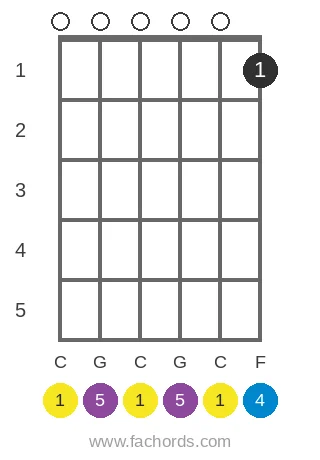
- Csus4 (0-0-0-0-0-1): one finger on the 1st fret of the 1st string turns the E into F. Hammer it on and pull it off while you strum and you get the classic open-tuning folk sound.
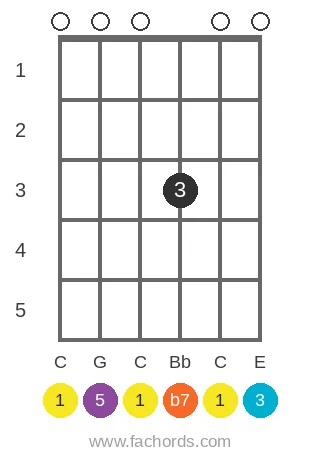
- C7 (0-0-0-3-0-0): the 3rd fret of the 3rd string is Bb, the b7. The same move works on the barres: add the note three frets above the barre on the 3rd string and F becomes F7 (5-5-5-8-5-5), G becomes G7 (7-7-7-10-7-7).
- Cm (0-0-0-0-3-3): the open E is the major 3rd, and you can't lower an open string with a finger. So you take the minor 3rd from the 2nd string instead (3rd fret, Eb) and put a G on the 1st string (3rd fret) to cover the E.
C - Csus4 - C7 - Cm, one strum each
Am7, F/C and the movable minor shape
Am7
F/C

Dm

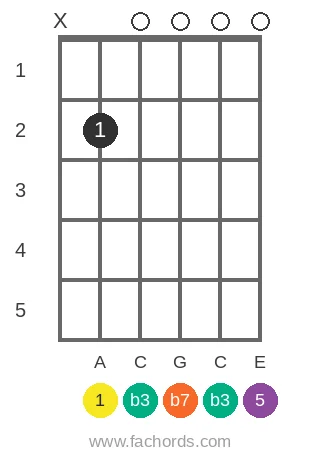
- Am7 (x-2-0-0-0-0): one finger on the 2nd fret of the 5th string, and skip the 6th string. The A in the bass turns the open C chord into Am7, the relative minor sound of the key.
- F/C (0-2-0-2-0-1): an F chord in open position with the low C strings ringing under it. Much softer than the barre on the 5th fret when you're playing quietly.
- Dm (2-2-2-2-5-5): the movable minor shape. Index finger across the 2nd fret of the four low strings, ring and pinky three frets higher on the 2nd and 1st strings. Slide it to the 4th fret for Em (4-4-4-4-7-7) and to the 9th fret for Am (9-9-9-9-12-12).
C - Am7 - F/C - C
Dm (2nd fret) - G (7th fret) - C - C: a ii-V-I in C
Open C tuning chord chart
All the shapes of this lesson in one table. Frets are written from the 6th string to the 1st, x is a muted string.
| Chord | Frets (6th to 1st string) | Notes (low to high) | Movable? |
|---|---|---|---|
| C | 0-0-0-0-0-0 | C G C G C E | Yes: full barre, any fret |
| F | 5-5-5-5-5-5 | F C F C F A | Barre |
| G | 7-7-7-7-7-7 | G D G D G B | Barre |
| F/C | 0-2-0-2-0-1 | C A C A C F | No (open strings) |
| Csus4 | 0-0-0-0-0-1 | C G C G C F | Over a barre: 1st string one fret higher |
| Cadd9 | 0-0-0-0-2-0 | C G C G D E | Over a barre: 2nd string two frets higher |
| C6 | 0-2-0-0-0-0 | C A C G C E | No (open strings) |
| C7 | 0-0-0-3-0-0 | C G C Bb C E | Over a barre: 3rd string three frets higher |
| Cmaj7 | 0-0-0-4-0-0 | C G C B C E | Over a barre: 3rd string four frets higher |
| Cm | 0-0-0-0-3-3 | C G C G Eb G | Yes: it's the minor shape at fret 0 |
| Dm | 2-2-2-2-5-5 | D A D A F A | Yes: Em at fret 4, Am at fret 9 |
| Am7 | x-2-0-0-0-0 | A C G C E | No (open strings) |
With C, Dm, Em, F, G and Am you have the six main chords in the key of C major, which is where this tuning lives most of the time.
Fingerstyle in Open C: Alternating Thumb and Drones
Open C is above all a fingerstyle tuning. With C on the 6th, 4th and 2nd strings, your thumb always has a low root to play, and the top strings can carry a melody over it. If fingerpicking is new to you, start with our fingerstyle basics.
Alternating thumb over the one-finger chords
The thumb alternates between the 6th and the 4th string on every beat, while index and middle fill the off-beats on the 2nd and 3rd strings, and on beats 1 and 3 you pinch the 1st string together with the bass. Play it on the open strings, then barre the 5th and the 7th fret and keep the same right hand:
     C (open)          F (5th fret)      G (7th fret)      C (open)
E |0-------0-------|5-------5-------|7-------7-------|0-------0-------|
C |--0-------0-----|--5-------5-----|--7-------7-----|--0-------0-----|
G |------0-------0-|------5-------5-|------7-------7-|------0-------0-|
C |----0-------0---|----5-------5---|----7-------7---|----0-------0---|
G |----------------|----------------|----------------|----------------|
C |0-------0-------|5-------5-------|7-------7-------|0-------0-------|
Alternating thumb pattern: C - F - G - C
Melody over a drone
The 2nd string is a C, so the C major scale along that string is frets 0, 2, 4, 5, 7, 9, 11 and 12. Play it while your thumb alternates between the open 6th and 4th strings:
E |----------------------------------|
C |--0---2---4---5---7---9---11--12--|
G |----------------------------------|
C |------0-------0-------0-------0---|
G |----------------------------------|
C |--0-------0-------0-------0-------|
C major scale on the 2nd string over the open C strings, up and back down
Every note of the C major scale sounds good over a C drone, so you can't play a wrong note here. Change the order, repeat notes, let the open 1st and 3rd strings ring between them, and you're already improvising in open C.
Songs in Open C Tuning
Here are songs whose tuning is confirmed by at least two independent sources (interviews, guitar magazines, the artist's own site, reference works). Some of them use a close variant of open C, shown in the second column.
| Song | Artist | Tuning | What to listen for |
|---|---|---|---|
| Question | The Moody Blues | C G C G C E | Justin Hayward's fast strumming on a 12-string acoustic in the opening section |
| Requiem for John Hurt | John Fahey | C G C G C E | Alternating-thumb fingerpicking, Fahey's tribute to Mississippi John Hurt |
| The Townshend Shuffle | William Ackerman | C G C G C E | Steel-string instrumental with open strings ringing under the melody |
| The Fear | Ben Howard | C G C G G C, a variant (capo 4 on the album, 3 live) | Bright, percussive acoustic picking |
| Most of his catalog (Strapping Young Lad, Devin Townsend Project, Casualties of Cool) | Devin Townsend | C G C G C E | Huge sustained chords: he has described the tuning as "basically a C major chord" |
| Can't Get Enough | Bad Company | An open C tuning (Wikipedia gives C C G C E C) | Mick Ralphs' ringing open-string riff on a Fender Esquire |
| Friends, Bron-Yr-Aur | Led Zeppelin | C A C G C E (C6 variant) | Jimmy Page's acoustic parts on Led Zeppelin III and Physical Graffiti |
| Burden in My Hand | Soundgarden | C G C G G E (variant) | The folky strummed intro by Chris Cornell |
You'll also find Led Zeppelin's "Poor Tom" listed in open C on some sites and in C6 on others: the sources disagree, so we left it out of the table.
Open C vs Open G, Open D, Drop C and the Variants
Open C gets confused with several other C tunings, and it has a few close relatives of its own. Here is how they compare:
| Tuning | Strings (6th to 1st) | Open strings sound | Compared with open C |
|---|---|---|---|
| Open C | C G C G C E | C major | |
| Open C6 | C A C G C E | C6 | 5th string on A instead of G (it stays at standard pitch). Jimmy Page's tuning for "Friends" and "Bron-Yr-Aur" |
| Soundgarden variant | C G C G G E | C major | 2nd string lowered to G instead of raised to C. Soundgarden's "Burden in My Hand" |
| Open C minor | C G C G C Eb | C minor | 1st string a half step lower, to Eb |
| Drop C | C G C F A D | Not a chord | Drop D a whole step lower. Only the three low strings are the same as open C |
| Open G | D G D G B D | G major | Strings 6 to 2 have the same intervals as strings 5 to 1 of open C |
| Open D | D A D F# A D | D major | Different layout: the 3rd is on the 3rd string, not the 1st |
- Open C vs drop C. The names sound alike, but they're different tunings. Drop C (C G C F A D) is D standard with the 6th string dropped to C, and it's made for heavy one-finger power chords on the low strings. Our D standard tuning lesson covers drop C too.
- Open C vs open G. Look at the top five strings of open C: G C G C E. Their intervals are the same as the bottom five strings of open G (D G D G B), a perfect 4th higher. So a shape you know from open G, played one string higher in open C, gives you the chord a 4th above it. Open C then adds a low C on top of that, which is why it sounds so much deeper.
- Open C vs open D. They're not the same tuning at two pitches: open D puts the 3rd on the 3rd string, open C puts it on the 1st, so the shapes don't transfer. Open D lowered a whole step would be C G C E G C, a different layout.
- The C6 trick. Put one finger on the 2nd fret of the 5th string in open C (0-2-0-0-0-0) and you hear exactly the C6 tuning. If a Page song sounds wrong in open C, that's usually why.
- More variants. Guitar World's open C lesson gives C G C F C E (3rd string down to F) for Nick Drake's "Pink Moon", and Wikipedia lists other C-based tunings, so if a tab says "open C", check the actual notes before you retune.
For open E, DADGAD, drop D, half step down and the rest, see our list of alternate guitar tunings. And if open C is too low for a singer, a capo moves every shape up without retuning: Ben Howard plays "The Fear" in a close variant (C G C G G C) with a capo on the 4th fret.
Conclusion
Open C is the deepest of the common open tunings: four strings change, and the guitar plays a big C major chord by itself. Here is the recap:
| Notes | C G C G C E (C2 G2 C3 G3 C4 E4) |
| From standard | 6th string down two whole steps, 5th and 4th down a whole step, 2nd string up a half step |
| Strings | A heavier 6th string stops the buzz |
| Major chords | Full barre: open = C, 5th fret = F, 7th fret = G |
| Minor chords | Movable: barre plus strings 2 and 1 three frets higher (Dm = 2-2-2-2-5-5). Cm = 0-0-0-0-3-3 |
| Seventh chords | 3rd string three frets above the barre (C7 = 0-0-0-3-0-0) |
| Best for | Fingerstyle with drones, alternating-thumb picking, big ringing chords, heavy sustained riffs |
Your next step: tune down, play C, F and G with one finger, then spend five minutes on the alternating-thumb pattern. Once your thumb runs by itself, the drone melody is the door to writing your own open C pieces.
That's all for today.
Remember that you can subscribe here to stay updated on new tutorials and gain access to the free download area, where you'll find some free chords and scales PDFs.

Created by
Giancarlo is a musician (teaching guitar since 2000), software engineer, AI consultant and published researcher
FAQ
What are the notes of open C tuning?
Open C tuning is C G C G C E, from the 6th (lowest) string to the 1st. With octaves: C2, G2, C3, G3, C4, E4. The open strings contain only the three notes of a C major chord: C (the root, on three strings), G (the 5th, on two strings) and E (the major 3rd, on the 1st string only), so strumming the open strings gives you C major.
How do you tune a guitar to open C from standard tuning?
Lower the 6th string 4 semitones (two whole steps) from E to C, lower the 5th string a whole step from A to G, lower the 4th string a whole step from D to C, and raise the 2nd string a half step from B to C. The 3rd string (G) and the 1st string (E) do not change.
Is open C tuning bad for the guitar or the strings?
No, but two strings need attention. The 2nd string goes up a half step, so it carries about 12% more tension: tune it up slowly. The 6th string drops 4 semitones and loses about 37% of its tension, so with a light set it gets floppy and buzzes. A heavier 6th string, or a heavier set, fixes that. Overall the neck carries less tension than in standard tuning.
What is drop C tuning?
Drop C is a different tuning: C G C F A D, low to high. It is drop D lowered a whole step: the whole guitar goes down a whole step to D standard (D G C F A D) and then the 6th string drops one more whole step to C. The open strings of drop C do not form a chord, and its three lowest strings play one-finger power chords. Open C (C G C G C E) shares only the three lowest strings with it.
What is the difference between open C and open G tuning?
Open G is D G D G B D and its open strings sound G major. The two tunings are closely related: the 5th to 1st strings of open C (G C G C E) have the same intervals as the 6th to 2nd strings of open G (D G D G B), a perfect 4th higher. So an open G shape played one string higher in open C gives the chord a 4th above. Open C adds a low C on the 6th string and sounds deeper.
What is the difference between open C and open D tuning?
Open D is D A D F# A D: the major 3rd is on the 3rd string. Open C is C G C G C E: the major 3rd is on the 1st string and the 6th string is a low C, two whole steps below standard. They are not the same tuning at different pitches, so the shapes do not transfer directly. Open D lowered a whole step would be C G C E G C, which is a different layout.
How do you play minor chords in open C tuning?
The only major 3rd is on the 1st string, so you need a minor 3rd from somewhere else. A movable shape is the barre on strings 6 to 3 with strings 2 and 1 three frets higher: 2-2-2-2-5-5 is D minor, 4-4-4-4-7-7 is E minor and 9-9-9-9-12-12 is A minor. In open position, C minor is 0-0-0-0-3-3 and A minor 7 is x-2-0-0-0-0.
What songs are in open C tuning?
Question by The Moody Blues (Justin Hayward on a 12-string), Requiem for John Hurt by John Fahey and The Townshend Shuffle by William Ackerman are in C G C G C E, and Devin Townsend uses it for most of his music. Led Zeppelin's Friends and Bron-Yr-Aur use the C6 variant C A C G C E, and Soundgarden's Burden in My Hand uses C G C G G E; Ben Howard's The Fear uses C G C G G C (capo 4 on the album).