Learn C maj13: Theory, Diagrams, and Interactive Practice
Want a structured chord roadmap instead of jumping between pages?
Go to the full guitar chords tutorial.
The C maj13 chord, a complex member of the Major Chords family, is constructed from a specific set of intervals: the Root (1), Major Third (3), Perfect Fifth (5), Major Seventh (7), Major Ninth (9), Perfect Eleventh (11), and Major Thirteenth (13). This gives it the notes C, E, G, B, D, F, and A. To truly grasp its composition and practice its various voicings, utilize our interactive virtual fretboard with real-time chord and arpeggio playback. Our unique mic feedback system will provide instant verification of your accuracy as you play.
The C maj13 offers a sophisticated sound, often enriching jazz and advanced music styles. Understanding its extended harmony requires a solid grasp of how chords are built by stacking intervals. This knowledge, coupled with an awareness of transposing chords across the fretboard, is crucial for effectively utilizing such complex voicings in your playing. Delving into the intricate interval structure of ninth chords also provides a foundational understanding for mastering even further extensions like the maj13.
Below, you'll find various C maj13 chord diagrams, ranked from simpler voicings to more challenging shapes, alongside detailed theory. We encourage you to first experiment with these shapes on the interactive fretboard to hear their sound in different keys and apply them to various songs. Consistent, disciplined practice with our tools is key to mastering this rich chord.
C major 13th guitar chord is also written as Cmaj13, CM13, CΔ13 or Cma13.
Notes in the C maj13 chord:
Tones of the Major Thirteen chord:
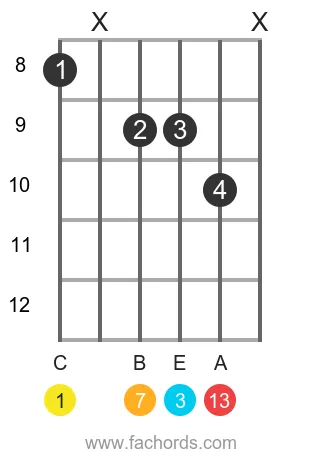
C Maj13 Guitar Chord Diagrams
Position 1 Movable
Finger Positions
- Mute the A string
- Mute the high E string
- Place your index finger (1) on the fret 8 of the low E string
- Place your middle finger (2) on the fret 9 of the D string
- Place your ring finger (3) on the fret 9 of the G string
- Place your pinky finger (4) on the fret 10 of the B string
Position 2 Movable
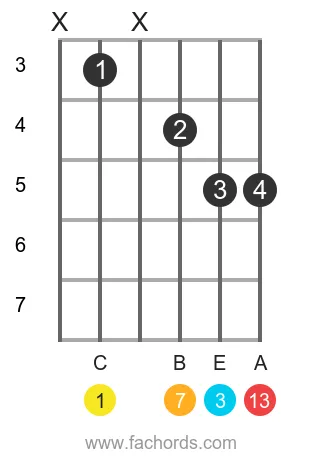
Finger Positions
- Mute the low E string
- Mute the D string
- Place your index finger (1) on the fret 3 of the A string
- Place your middle finger (2) on the fret 4 of the G string
- Place your ring finger (3) on the fret 5 of the B string
- Place your pinky finger (4) on the fret 5 of the high E string
Position 3 Barre Movable
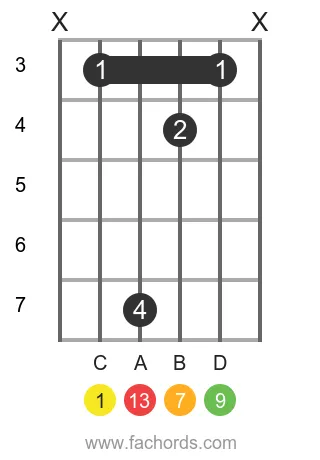
Finger Positions
- Mute the low E string
- Mute the high E string
- Place your index finger (1) on the fret 3 of the A and B strings at the same time
- Place your middle finger (2) on the fret 4 of the G string
- Place your pinky finger (4) on the fret 7 of the D string
Position 4 Barre Movable
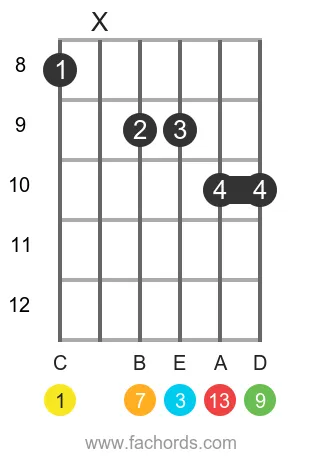
Finger Positions
- Mute the A string
- Place your index finger (1) on the fret 8 of the low E string
- Place your middle finger (2) on the fret 9 of the D string
- Place your ring finger (3) on the fret 9 of the G string
- Place your pinky finger (4) on the fret 10 of the B and high E strings at the same time
Position 5 Barre Movable
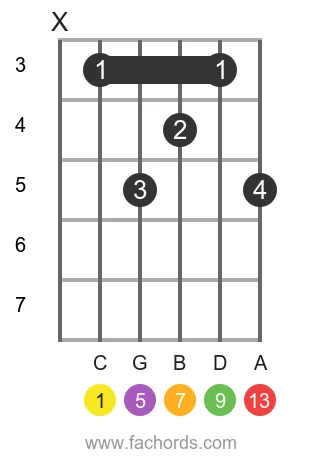
Finger Positions
- Mute the low E string
- Place your index finger (1) on the fret 3 of the A and B strings at the same time
- Place your middle finger (2) on the fret 4 of the G string
- Place your ring finger (3) on the fret 5 of the D string
- Place your pinky finger (4) on the fret 5 of the high E string
Position 6 Barre Movable
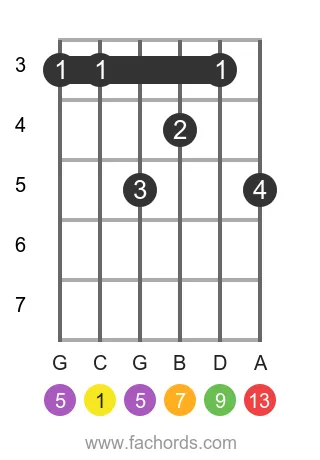
Finger Positions
- Place your index finger (1) on the fret 3 of the low E, A and B strings at the same time
- Place your middle finger (2) on the fret 4 of the G string
- Place your ring finger (3) on the fret 5 of the D string
- Place your pinky finger (4) on the fret 5 of the high E string
 Find more shapes in our all guitar chords online library. If you
prefer a printable pdf, download
the Free Guitar Chords Chart Pdf

Created by
Giancarlo is a musician (teaching guitar since 2000), software engineer, AI consultant and published researcher
FAQ
What is the C maj13 chord?
The C maj13 chord is a rich and complex chord that belongs to the Major Chords family. It's used to add depth and sophistication to guitar playing, particularly in jazz and more advanced music styles.
What are the specific notes and intervals that make up a C maj13 chord?
The C maj13 chord is composed of seven distinct notes: C, E, G, B, D, F, and A. These notes correspond to the intervals Root (1), Major Third (3), Perfect Fifth (5), Major Seventh (7), Major Ninth (9), Perfect Eleventh (11), and Major Thirteenth (13).
Why is the C maj13 chord considered a complex chord?
The C maj13 chord is considered complex because it is built by stacking many intervals, specifically up to the Major Thirteenth. This results in a total of seven notes, making it more intricate than simpler, shorter chords.
In what musical styles or situations is the C maj13 chord typically used?
The C maj13 chord is often found in jazz and other more advanced music styles due to its rich and sophisticated sound. It can also be incorporated into simpler songs to add harmonic interest and depth.