Slash Chords on Guitar
What G/B, D/F# and C/E Mean, How to Play Them and Why They Sound So Good
Sooner or later every chord sheet throws one at you: G/B, D/F#, C/E. A chord, a slash, and a second note. Is it a typo? A flat sign? Two chords at once?
None of the above. Slash chords are one of the friendliest symbols in music: they tell you which chord to play and which note to put in the bass. Once you can read them, they are also the quickest way to make plain chord changes sound like a real song, because they let the bass walk from one chord to the next.
Below you'll learn to read any slash chord in two seconds, play the 11 you'll meet most often, and hear them at work in four short progressions.
Slash chord in one sentence: in X/Y, X is the chord and Y is the lowest note, the one in the bass.
Example: G/B = a G major chord (G, B, D) with B as the lowest note. On guitar: x20003, your open G without the low G string.
How to Read a Slash Chord
Read the symbol from left to right: chord first, bass second. The part on the left of the slash is a normal chord symbol (G, Am, D7, Cmaj7...). The part on the right is a single note name.
| Symbol | Say it | Chord to play | Lowest note |
|---|---|---|---|
| G/B | "G over B" | G major (G, B, D) | B |
| D/F# | "D over F sharp" | D major (D, F#, A) | F# |
| C/E | "C over E" | C major (C, E, G) | E |
| Am/G | "A minor over G" | A minor (A, C, E) | G |
The same rule answers the question people google the most: what does B/D# mean? It's a B major chord (B, D#, F#) with D# in the bass. And A/C# is an A chord with C# in the bass, D/C# is a D chord with C# in the bass, and so on.
G/B is not Gb. The slash is not a flat sign. Gb (G flat) is a completely different chord: Gb, Bb and Db. G/B is a plain G major with B at the bottom.
Hear the Difference: Same Chord, New Bass
Why bother with the bass note at all? Listen to G, then G/B; D, then D/F#; C, then C/E. Each pair has the same three notes. The only thing that changes is the lowest one, and yet the second chord sounds lighter, less "settled", as if it wants to move somewhere.
G
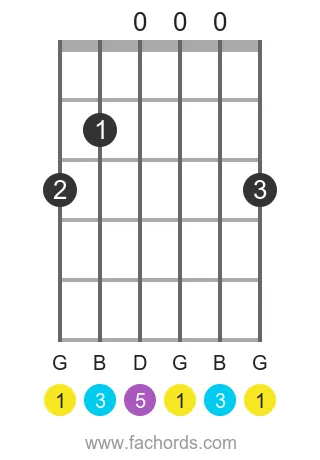
G/B

D/F#
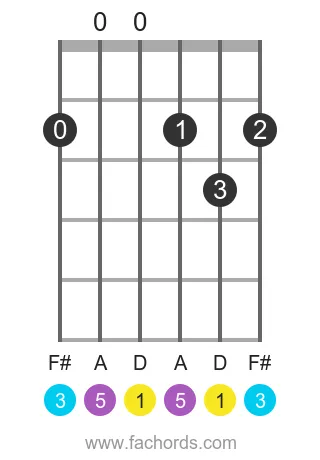
G - G/B - D - D/F# - C - C/E
Look at the note names under each diagram: in G the lowest note is G, in G/B it's B. Same chord, different foundation.
Two Kinds of Slash Chords
Here is the only bit of theory you need. Ask yourself one question: is the bass note part of the chord?
1. The bass is a chord tone: an inversion
G/B, D/F# and C/E all put a note of the chord in the bass. That's just a chord inversion written in a compact way:
- 3rd in the bass = first inversion: G/B, D/F#, C/E, A/C#, B/D#
- 5th in the bass = second inversion: C/G, D/A, Gm/D
2. The bass is not in the chord: a new colour
G/F#, Am/G and Bm/A put a note in the bass that the chord doesn't contain. Now the bass adds a fourth note and the chord changes colour:
- G/F# = G, B, D + F#: the notes of Gmaj7, with the major 7th at the bottom.
- Am/G = A, C, E + G: the notes of Am7, with the b7 at the bottom.
- Bm/A = B, D, F# + A: the notes of Bm7, with the b7 at the bottom.
Jazz and pop arrangers push this further: Bb/C is a Bb triad over a C bass, a compact way to write a C9sus4 sound. That's upper-structure territory, covered in advanced chord construction.
| Slash chord | Bass note is the... | Type |
|---|---|---|
| G/B, D/F#, C/E, A/C#, B/D# | 3rd | First inversion |
| C/G, D/A, Gm/D | 5th | Second inversion |
| G/F#, D/C# | major 7th (not in the triad) | Sounds like maj7, 7th in the bass |
| Am/G, Bm/A | b7 (not in the triad) | Sounds like m7, b7 in the bass |
The Most Common Slash Chords on Guitar
These are the slash chords you'll meet on chord sheets again and again. All of them come straight from our chord library: where a diagram shows the note names at the bottom, the leftmost one is always the bass.
G/B Chord
The king of slash chords, and the one guitarists search for most. Take your open G and drop the low G: mute the 6th string, B on the 2nd fret of the A string, then G on the 3rd fret of the high E (x20003). The second shape (x20033) adds D on the B string for a fuller sound.
G/B
G/B (fuller)

G/F#

G/F# (2x0003) is its cousin: F# on the 2nd fret of the low E string, A string muted, G on top. You'll use it to step from G down to Em.
D/F# Chord
Your open D on the top four strings plus F# on the 2nd fret of the low E: 200232. The note on the low string is fretted with the thumb (T), wrapped over the neck. The open A in between is a chord tone, so it can ring. No thumb yet? Play the plain D (xx0232) and let the bass player cover the F#.
D/F#
D/A
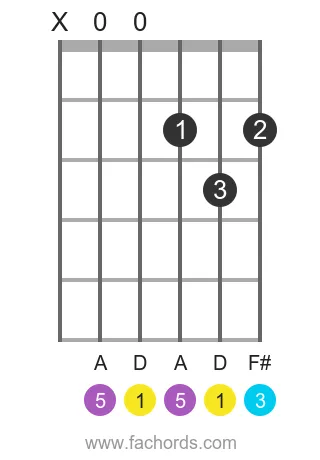
A/C#
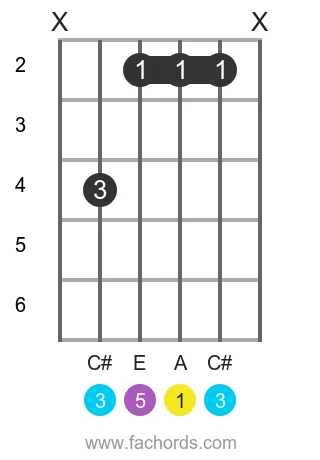
D/A (x00232) is simply the open D with the open A string included: you've probably been playing it for years without knowing its name. A/C# (x4222x) puts C# on the 4th fret of the A string with the ring finger, while the index finger holds a small barre on the 2nd fret.
C/E and C/G Chords
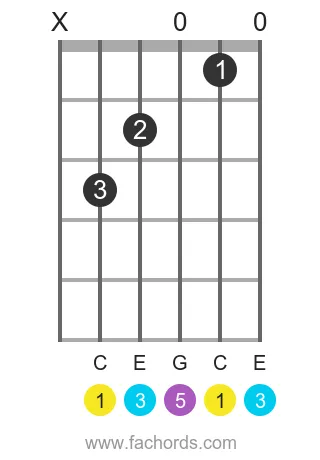
Two of the easiest, because the open C chord already sits next to both bass notes. C/E (032010) lets the open low E ring; C/G (332010) adds G on the 3rd fret of the low E. Both hide in plain sight in countless strummed songs.
C/E
C/G

F/A

F/A (5x356x) puts A, the 3rd of F, in the bass on the 5th fret of the low E string.
Minor Slash Chords: Em/G, Dm/F, Bm/A
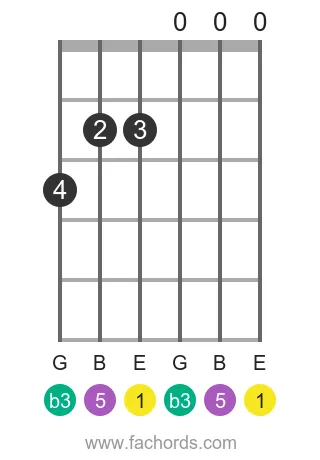
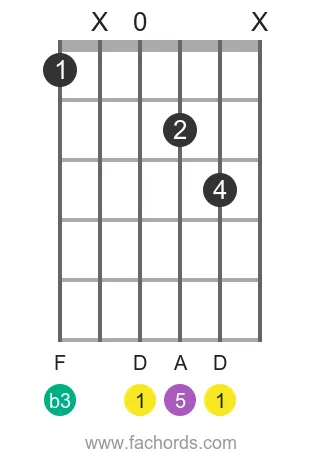
Minor chords take a bass note too. Em/G (322000) is the open Em with G on the 3rd fret of the low E; Dm/F (1x023x) puts F, the b3 of Dm, on the 1st fret of the low E; Bm/A (x04432) is your Bm barre shape with the open A string as the bass.
Em/G
Dm/F
Bm/A

Slash Chords in Action: Walking Bass Lines
Here's where slash chords earn their keep. Most of the time they're there to make the bass move by step instead of jumping. Follow the lowest note in each example and you'll hear a little melody under the chords.
G - D/F# - Em
The bass walks down G, F#, E. Without the slash chord you'd play G - D - Em and the bass would jump from G up to D and back down to E. With D/F# it slides down a step at a time.
G - D/F# - Em - C - D
C - G/B - Am - C/G - F
The classic descending line: C, B, A, G, F, five notes down the C major scale. Use C (x32010), G/B (x20003), Am (x02210), C/G (332010) and F (133211).
C - G/B - Am - C/G - F
D - A/C# - Bm
The same move in D: the bass goes D, C#, B. A/C# is the bridge between D and Bm.
D - A/C# - Bm - G - A
G - G/F# - Em
Here the chord stays G and only the bass moves: G, F#, E. That F# under a G chord gives the moment a soft Gmaj7 colour before landing on Em.
G - G/F# - Em - C - D
This descending pattern is so common it has its own page: the descending bass line progression, with the songs that use it, like Tears in Heaven (A - E/G# - F#m - A/E) and Always on My Mind (G - D/F# - Em - G/D), in five keys.
How to Work Out Any Slash Chord
Meet a symbol you've never seen, like Gm/D or D/C#? Three steps:
- Play the chord on the left in a shape whose lowest string you can control. Gm: G, Bb, D.
- Find the bass note on the low E or A string. D is the open 4th string, or the 5th fret of the A string.
- Remove anything below it. Mute the strings under the bass note, so it's really the lowest sound.
If the bass note is already in the chord (D is the 5th of Gm), you're playing an inversion. If it's not (C# is the major 7th of D), you're adding a note, and D/C# will sound like a Dmaj7 with the 7th at the bottom. Not sure which notes are in a chord? Our guide on how to name any guitar chord shows how to spell it, and chord construction covers the formulas.
Tips for Playing Slash Chords
- Aim the pick. The bass note only counts if it's the lowest thing you play: start the strum on the bass string and skip (or mute) the strings below it.
- Use your thumb. D/F# and G/F# get much easier with the fretting thumb over the neck on the low E string.
- Keep the common fingers down. C to Am: the index and middle fingers don't move at all. Moving as little as possible is the secret of smooth chord transitions.
- In a band, you can simplify. If the bassist plays the bass line, strum the plain chord (G instead of G/B). Playing solo, keep the bass note: it's half the sound.
- Train your ear for it. When the chords don't seem to change but the bottom note does, you're hearing slash chords. It's a big help when you figure out songs by ear.
Conclusion
A slash chord is just a chord plus a bass note. Read it left to right, play the chord, put the note at the bottom, and you've got it.
| Slash chord | Frets (low E to high E) | Typical job |
|---|---|---|
| G/B | x20003 | C - G/B - Am |
| D/F# | 200232 | G - D/F# - Em |
| A/C# | x4222x | D - A/C# - Bm |
| C/G | 332010 | Am - C/G - F |
| G/F# | 2x0003 | G - G/F# - Em |
| C/E | 032010 | C - C/E - F |
Your next step: pick a song you already strum with G, D, Em and C, and try sneaking D/F# between G and Em. Once you hear that bass walk down, you won't want to go back. Then explore the inversions of the chords you know: every one of them is a slash chord waiting to happen.
That's all for today.
Remember that you can subscribe here to stay updated on new tutorials and gain access to the free download area, where you'll find some free chords and scales PDFs.

Created by
Giancarlo is a musician (teaching guitar since 2000), software engineer, AI consultant and published researcher
FAQ
What is a slash chord?
A slash chord is a chord written as X/Y: X is the chord you play and Y is the note that must sound lowest, in the bass. G/B means a G major chord (G, B, D) with B as the bass note. On guitar you play the G chord and make sure the lowest string you strum sounds a B, for example x20003.
Is G/B the same as Gb?
No. Gb (G flat) is a different chord, built on the note a half step below G: Gb, Bb and Db. G/B is a plain G major chord (G, B, D) with B in the bass instead of G. The slash separates the chord from the bass note, it is not a flat sign.
How do you play D/F# on guitar?
The most common shape is 200232: the usual open D chord on the top four strings, plus F# on the 2nd fret of the low E string, fretted with the thumb over the neck. Leave the A string ringing (it is A, a chord tone) or mute it. If the thumb does not reach, play xx0232 and let the bassist cover the F#.
What does B/D# mean?
B/D# means a B major chord (B, D#, F#) with D# as the lowest note. D# is the 3rd of B, so B/D# is a B major chord in first inversion. You will often see it between B and a chord a half step above the bass, like E: the bass walks B, D#, E.
Are slash chords the same as inversions?
Sometimes. When the bass note belongs to the chord, the slash chord is an inversion: 3rd in the bass is the first inversion (C/E), 5th in the bass is the second inversion (C/G). When the bass note is not in the chord, like G/F# or Bb/C, it is not an inversion: the bass adds a new note and the chord gets a new colour.
Can I ignore the bass note of a slash chord?
In a band, often yes: if a bass player is covering the bass line you can strum the plain chord (G instead of G/B) and the song still works. Playing alone, keep the bass note, because it is what makes the walking line you hear on the recording.
How do you play G/B on guitar?
Mute the low E string, fret B on the 2nd fret of the A string, leave the D, G and B strings open and fret G on the 3rd fret of the high E string: x20003. It is your open G chord with the low G removed, so the B on the A string becomes the bass.