Understand and Play the G m11 Chord on Guitar
Want a structured chord roadmap instead of jumping between pages?
Go to the full guitar chords tutorial.
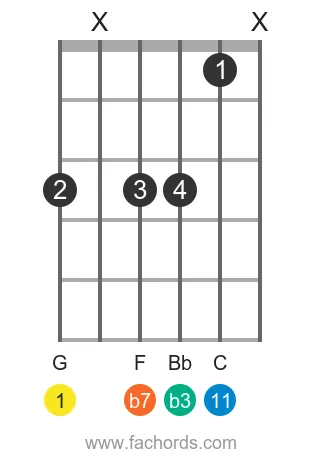
The G m11 chord is constructed by stacking specific intervals: the 1 (Root), b3 (Minor Third), 5 (Perfect Fifth), b7 (Minor Seventh), 9 (Major Ninth), and 11 (Perfect Eleventh). As a prominent member of the Minor Chords family, its distinct sound is formed by the notes G, Bb, D, F, A, and C. Our interactive fretboard allows you to visualize these precise voicings, hear chord and arpeggio playback, and receive instant mic feedback to confirm your finger placement and accuracy.
Understanding the specific intervals that constitute the G m11 chord is essential for mastering its unique sound. These building blocks are key to truly grasping how it functions within harmony. For a deeper dive into the fundamental principles of chord building and interval stacking, explore our guide on Chord Construction. Additionally, as an extended chord, the m11 builds upon the concepts found in Ninth Chords, adding further color and complexity.
Scroll down to find comprehensive chord diagrams, arranged from the easiest to the most challenging voicings of the G m11 chord. Each diagram is accompanied by detailed theory explanations and suggestions for applying this chord in songs across various keys. Before diving into memorization, use our interactive tool to experiment with different voicings, ensuring disciplined practice and solidifying your understanding.
G minor 11th guitar chord is also written as Gm11, Gmin11 or G-11.
G m11 chord Notes:
How the Minor Eleventh chord is built:
G M11 Guitar Chord Diagrams
Position 1 Movable
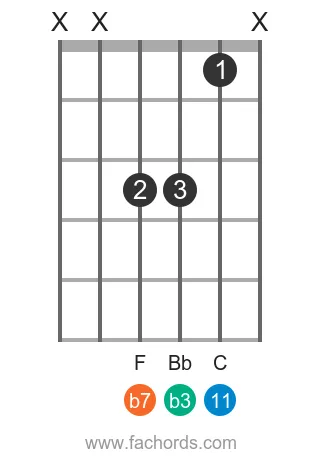
Finger Positions
- Mute the low E string
- Mute the A string
- Mute the high E string
- Place your index finger (1) on the fret 1 of the B string
- Place your middle finger (2) on the fret 3 of the D string
- Place your ring finger (3) on the fret 3 of the G string
Position 2 Movable
Finger Positions
- Mute the A string
- Mute the high E string
- Place your index finger (1) on the fret 1 of the B string
- Place your middle finger (2) on the fret 3 of the low E string
- Place your ring finger (3) on the fret 3 of the D string
- Place your pinky finger (4) on the fret 3 of the G string
Position 3 Barre Movable
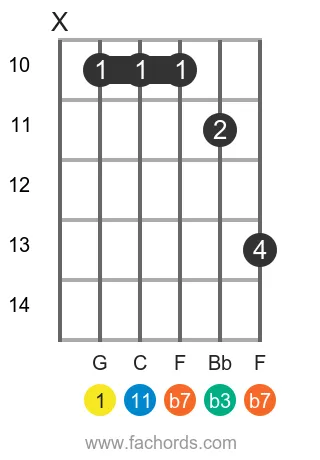
Finger Positions
- Mute the low E string
- Place your index finger (1) on the fret 10 of the A, D and G strings at the same time
- Place your middle finger (2) on the fret 11 of the B string
- Place your pinky finger (4) on the fret 13 of the high E string
Position 4 Barre Movable
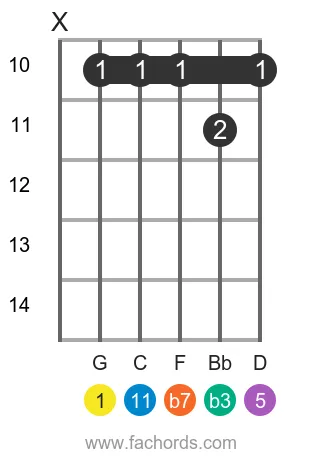
Finger Positions
- Mute the low E string
- Place your index finger (1) on the fret 10 of the A, D, G and high E strings at the same time
- Place your middle finger (2) on the fret 11 of the B string
Position 5 Barre Movable
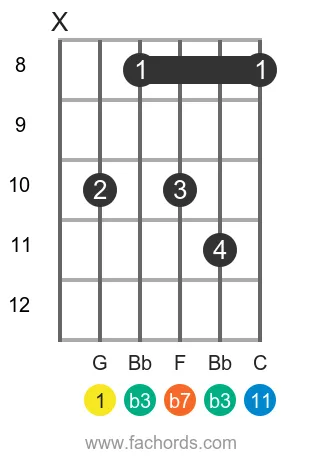
Finger Positions
- Mute the low E string
- Place your index finger (1) on the fret 8 of the D and high E strings at the same time
- Place your middle finger (2) on the fret 10 of the A string
- Place your ring finger (3) on the fret 10 of the G string
- Place your pinky finger (4) on the fret 11 of the B string
Position 6 Barre Movable
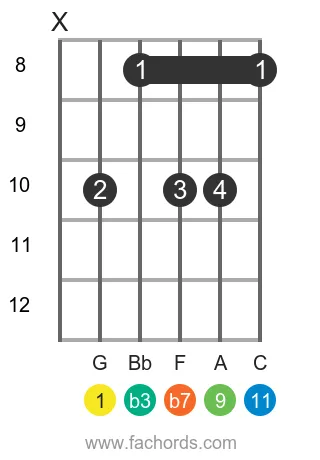
Finger Positions
- Mute the low E string
- Place your index finger (1) on the fret 8 of the D and high E strings at the same time
- Place your middle finger (2) on the fret 10 of the A string
- Place your ring finger (3) on the fret 10 of the G string
- Place your pinky finger (4) on the fret 10 of the B string
 Find more shapes in our all guitar chords online library. If you
prefer a printable pdf, download
the Free Guitar Chords Chart Pdf

Created by
Giancarlo is a musician (teaching guitar since 2000), software engineer, AI consultant and published researcher
FAQ
What specific notes make up the G m11 chord?
The G m11 chord is composed of six distinct notes: G, Bb, D, F, A, and C.
What are the musical intervals that define the G m11 chord?
The G m11 chord is built using these intervals relative to its root (G): the Root (1), Minor Third (b3), Perfect Fifth (5), Minor Seventh (b7), Major Ninth (9), and Perfect Eleventh (11).
Is the G m11 chord suitable for beginner guitarists?
No, the G m11 chord is not considered a beginner's chord. It typically requires a certain level of guitar knowledge and finger dexterity due to its complex construction and the number of notes involved.
How do visual aids like chord diagrams help in learning the G m11 chord?
Chord diagrams and fretboard patterns are highly beneficial for visual learners. They provide a clear, visual representation of where each of the chord's notes (G, Bb, D, F, A, C) should be placed on the guitar fretboard, making it easier to understand and execute the chord shape.
What does the 'm11' part of the G m11 chord name signify?
The 'm' in G m11 indicates that the chord has a minor quality, specifically incorporating a minor third (Bb) and a minor seventh (F). The '11' signifies that the chord includes the 9th (A) and 11th (C) intervals, extending beyond a simple minor seventh chord.