Practice E7 Chord Forms on Guitar with Live Mic Feedback
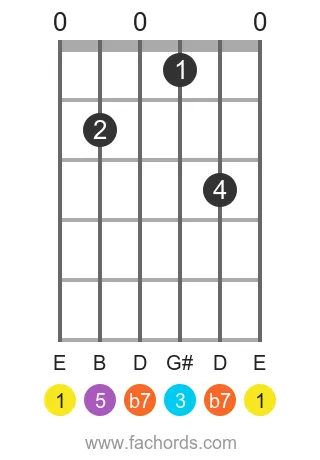
E, G#, B and D spell the E7 chord, also called E dominant seventh. It has 20 listed voicings, and eleven of them ring open strings.
In A major, E7 is the V7 chord, and it is also the V chord of a twelve-bar blues in A. The stripped-down, three-note versions are covered in three-note seventh chords. A solo over it can come from the E Mixolydian scale.
Strum it near the microphone and the page will show whether each string sounds clearly, which is a quick way to find a muted or buzzing string.
E dominant 7th guitar chord is also written as E7, Edom7 or Edom.
Notes that compose the E 7 chord:
How the Dominant Seventh chord is built:
Formula: 1 3 5 b7
E 7 Chord Interactive Fretboard
Want a structured chord roadmap instead of jumping between pages?
Go to the full guitar chords tutorial.
E 7 Guitar Chord Diagrams
Position 1 Open
Finger Positions
- Let the low E string play without pressing any fret
- Let the D string play without pressing any fret
- Let the high E string play without pressing any fret
- Place your index finger (1) on the fret 1 of the G string
- Place your middle finger (2) on the fret 2 of the A string
- Place your pinky finger (4) on the fret 3 of the B string
Position 2 Open
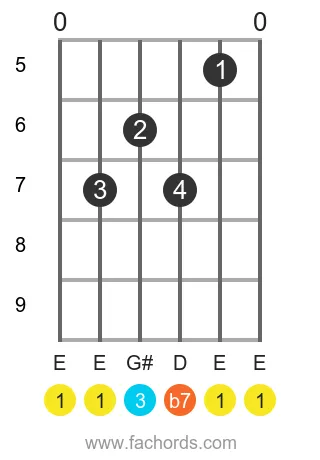
Finger Positions
- Let the low E string play without pressing any fret
- Let the high E string play without pressing any fret
- Place your index finger (1) on the fret 5 of the B string
- Place your middle finger (2) on the fret 6 of the D string
- Place your ring finger (3) on the fret 7 of the A string
- Place your pinky finger (4) on the fret 7 of the G string
Position 3 Barre Open
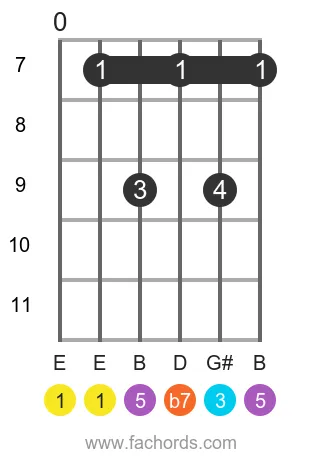
Finger Positions
- Let the low E string play without pressing any fret
- Place your index finger (1) on the fret 7 of the A, G and high E strings at the same time
- Place your ring finger (3) on the fret 9 of the D string
- Place your pinky finger (4) on the fret 9 of the B string
Position 4 Open
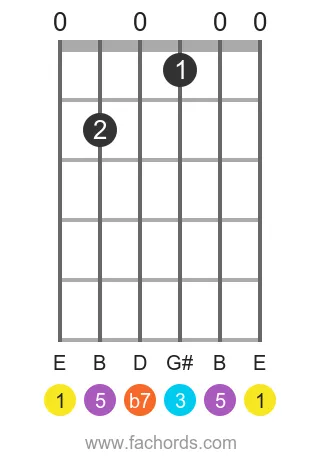
Finger Positions
- Let the low E string play without pressing any fret
- Let the D string play without pressing any fret
- Let the B string play without pressing any fret
- Let the high E string play without pressing any fret
- Place your index finger (1) on the fret 1 of the G string
- Place your middle finger (2) on the fret 2 of the A string
Position 5 Barre Movable
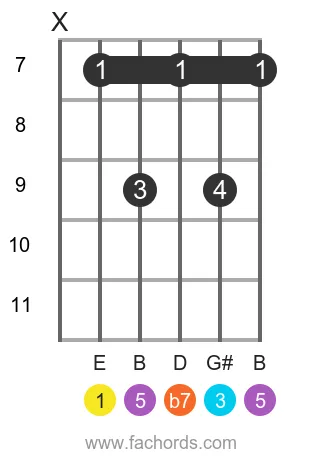
Finger Positions
- Mute the low E string
- Place your index finger (1) on the fret 7 of the A, G and high E strings at the same time
- Place your ring finger (3) on the fret 9 of the D string
- Place your pinky finger (4) on the fret 9 of the B string
Position 6 Open
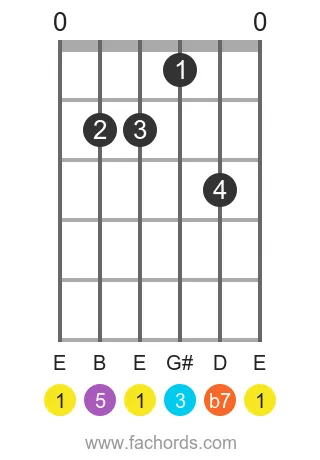
Finger Positions
- Let the low E string play without pressing any fret
- Let the high E string play without pressing any fret
- Place your index finger (1) on the fret 1 of the G string
- Place your middle finger (2) on the fret 2 of the A string
- Place your ring finger (3) on the fret 2 of the D string
- Place your pinky finger (4) on the fret 3 of the B string
Position 7 Movable
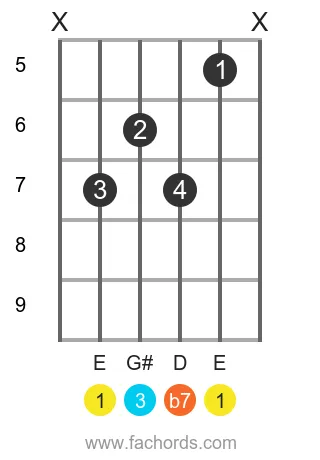
Finger Positions
- Mute the low E string
- Mute the high E string
- Place your index finger (1) on the fret 5 of the B string
- Place your middle finger (2) on the fret 6 of the D string
- Place your ring finger (3) on the fret 7 of the A string
- Place your pinky finger (4) on the fret 7 of the G string
Position 8 Open
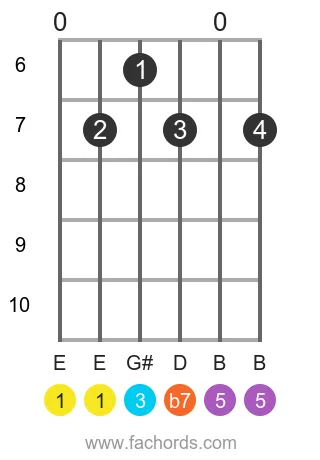
Finger Positions
- Let the low E string play without pressing any fret
- Let the B string play without pressing any fret
- Place your index finger (1) on the fret 6 of the D string
- Place your middle finger (2) on the fret 7 of the A string
- Place your ring finger (3) on the fret 7 of the G string
- Place your pinky finger (4) on the fret 7 of the high E string
Position 9 Barre Movable
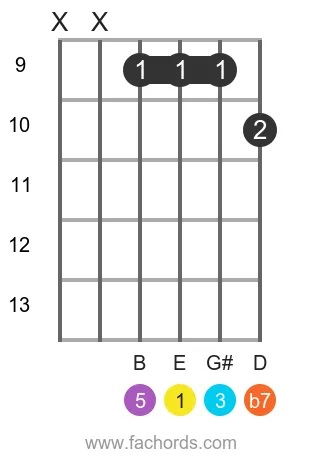
Finger Positions
- Mute the low E string
- Mute the A string
- Place your index finger (1) on the fret 9 of the D, G and B strings at the same time
- Place your middle finger (2) on the fret 10 of the high E string
Position 10 Movable
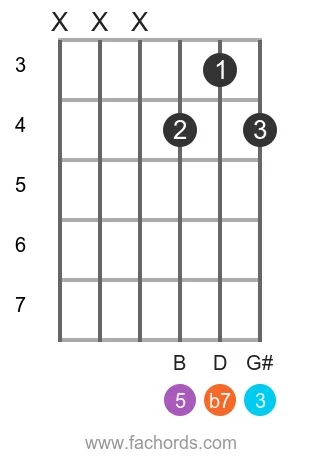
Finger Positions
- Mute the low E string
- Mute the A string
- Mute the D string
- Place your index finger (1) on the fret 3 of the B string
- Place your middle finger (2) on the fret 4 of the G string
- Place your ring finger (3) on the fret 4 of the high E string
Position 11 Movable
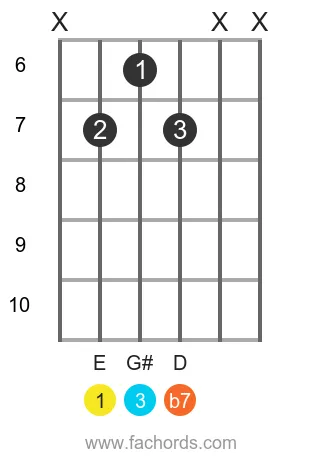
Finger Positions
- Mute the low E string
- Mute the B string
- Mute the high E string
- Place your index finger (1) on the fret 6 of the D string
- Place your middle finger (2) on the fret 7 of the A string
- Place your ring finger (3) on the fret 7 of the G string
Position 12 Movable
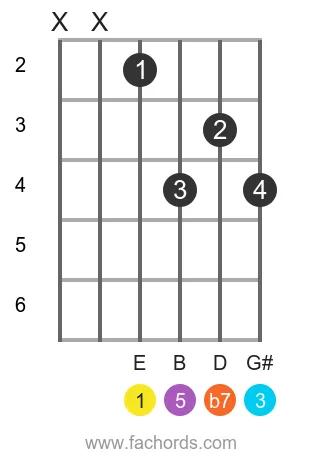
Finger Positions
- Mute the low E string
- Mute the A string
- Place your index finger (1) on the fret 2 of the D string
- Place your middle finger (2) on the fret 3 of the B string
- Place your ring finger (3) on the fret 4 of the G string
- Place your pinky finger (4) on the fret 4 of the high E string
Position 13 Open
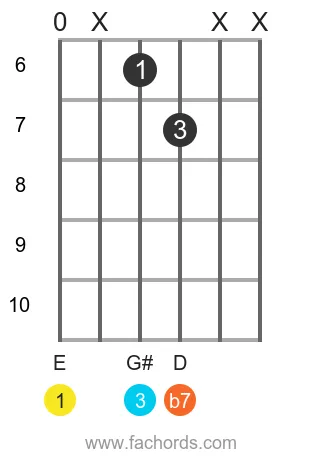
Finger Positions
- Let the low E string play without pressing any fret
- Mute the A string
- Mute the B string
- Mute the high E string
- Place your index finger (1) on the fret 6 of the D string
- Place your ring finger (3) on the fret 7 of the G string
Position 14 Open
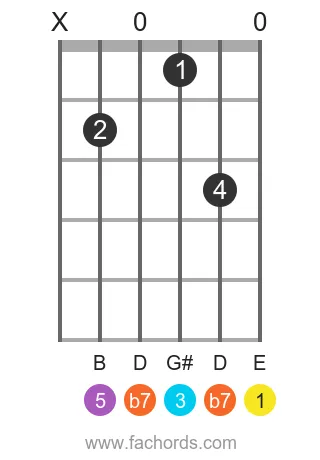
Finger Positions
- Mute the low E string
- Let the D string play without pressing any fret
- Let the high E string play without pressing any fret
- Place your index finger (1) on the fret 1 of the G string
- Place your middle finger (2) on the fret 2 of the A string
- Place your pinky finger (4) on the fret 3 of the B string
Position 15 Open
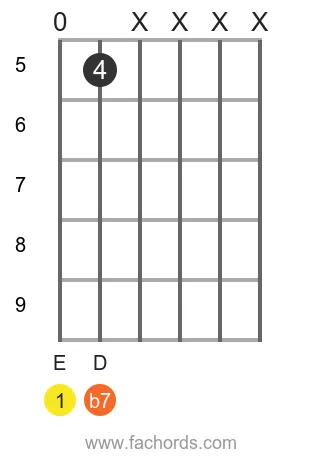
Finger Positions
- Let the low E string play without pressing any fret
- Mute the D string
- Mute the G string
- Mute the B string
- Mute the high E string
- Place your pinky finger (4) on the fret 5 of the A string
Position 16 Open
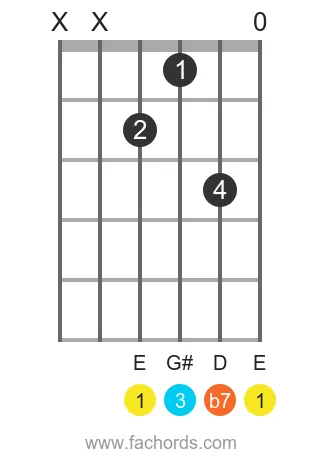
Finger Positions
- Mute the low E string
- Mute the A string
- Let the high E string play without pressing any fret
- Place your index finger (1) on the fret 1 of the G string
- Place your middle finger (2) on the fret 2 of the D string
- Place your pinky finger (4) on the fret 3 of the B string
Position 17 Barre Movable
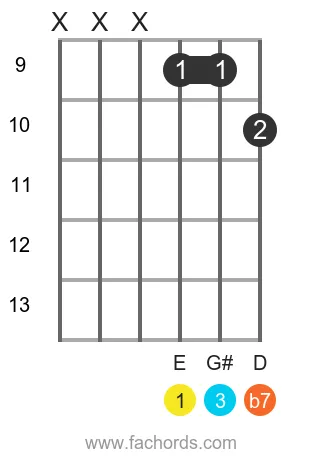
Finger Positions
- Mute the low E string
- Mute the A string
- Mute the D string
- Place your index finger (1) on the fret 9 of the G and B strings at the same time
- Place your middle finger (2) on the fret 10 of the high E string
Position 18 Open
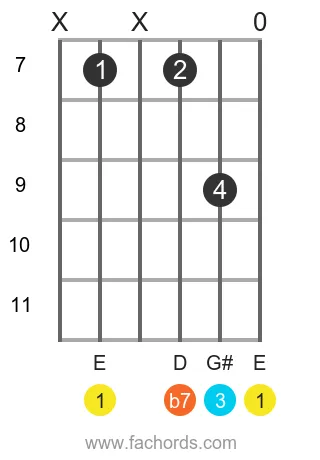
Finger Positions
- Mute the low E string
- Mute the D string
- Let the high E string play without pressing any fret
- Place your index finger (1) on the fret 7 of the A string
- Place your middle finger (2) on the fret 7 of the G string
- Place your pinky finger (4) on the fret 9 of the B string
Position 19 Barre Movable
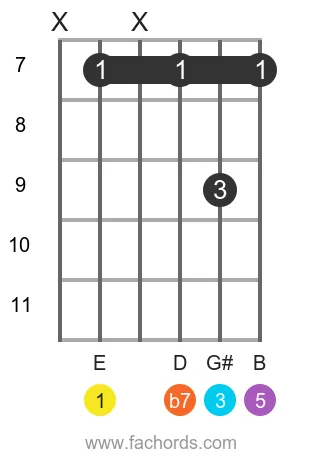
Finger Positions
- Mute the low E string
- Mute the D string
- Place your index finger (1) on the fret 7 of the A, G and high E strings at the same time
- Place your ring finger (3) on the fret 9 of the B string
Position 20 Movable
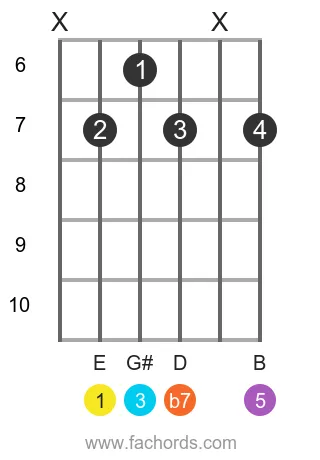
Finger Positions
- Mute the low E string
- Mute the B string
- Place your index finger (1) on the fret 6 of the D string
- Place your middle finger (2) on the fret 7 of the A string
- Place your ring finger (3) on the fret 7 of the G string
- Place your pinky finger (4) on the fret 7 of the high E string
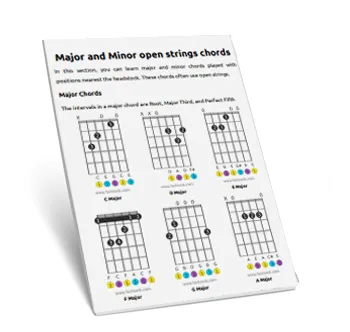
 Find more shapes in our all guitar chords online library. If you
prefer a printable pdf, download
the Free Guitar Chords Chart Pdf
Play This Chord With Other Roots
C 7 | D 7 | E 7 | F 7 | G 7 | A 7 | B 7 | C#7 | D#7 | F#7 | G#7 | A#7 | Ab7 | Bb7 | Db7 | Eb7 | Gb7
E7 Chord Tutorial
Remember the notes for the E major scale are:
E F# G# A B C# D#
An E major triad or chord is made up of the root, major third, and fifth note of that scale, thus E major is E G# B
How the E7 chord is built
Now an E7 is otherwise known as a dominant seventh, and to make a dominant seventh chord we use the btn rounded blue-border btn-default; root, major third, fifth, and minor seventh.
So the E7 chord will be made up of the notes E G# B D.
There are multiple seventh chords that exist and the dominant seventh is the most important of all.
Here below you find the intervals formula in the 7th dominant chord (1, 3, 5 and b7):
Formula: 1 3 5 b7
E7 Chord Guitar Shapes

Using the tones above we come up with some of the more popular versions of how to finger the E7 The most common E7 is the open position 020100:

Other common positions are barre chords of other 7ths. For example an open A7 chord is 002020, if we move that position up 7 frets we get an E7 that is X79797.
(This is the version of the chord that you will often see played in the funk genre.)

Another barre position is the C7 shape. C7 is X3231X, if we move that position up four frets we get another E7 that is X7675.

If we move the D7 chord (XX0212) up two frets and play it XXX434 we essentially get a rootless E7 (only made up of the notes B D G#).

Notice how some of the chords have an X, which means a muted string. If the muted string is the low or high E then it is also fine not to mute those strings.
Drill Down: To learn more about chord structure and building across all the fretboard, check my ebook Chords Domination | Play Any Chord You Want Across All The Fretboard
How to use the Dominant Chord
The main function of the dominant seventh is to lead up to a tonic resolution.
For example one very common place you will find dominant sevenths is in blues music and the seventh is often played right before the root or tonic chord.
We created an handy chords in keys pdf to help you manage this stuff.
The dominant seventh is often used in rock n roll, pop, and blues.
Try playing the progression A D E A, now play A D E7 A and you will notice how it gives it a much more bluesy and even rocking sound depending on how it is strummed.
As far as E7 chord use, it is not as common as other 7ths.
You will often find it in some folk tunes and a number of Christmas pop songs use it.
However, one genre that really loves the E7 chord is funk. You will see E7 often with E9 and E7+9 (which is known as the Jimi Hendrix chord).
In fact if you were trying out to play guitar for James Brown he would have you play E7 and E9 repetitively to give you an idea of what you would mostly be doing on stage!
In funk music we usually play the E7 higher up on the fretboard, like the positions shown above
Songs with the E7 chord
Some specific songs that use the E7 chord are:
- All About the Bass
- House of the Rising Sun
- Up on the Housetop
- Auld Lang Syne, and a ton of funk music.
Music Keys containing the E7 chord
The most common keys we will find with the E7 chord is the Keys of A, B, and E.
However you will also potentially find it in some more random places depending on where the songwriter was looking for some tension leading to resolution.
| Key | I | ii | iii | IV | V | vi | vii |
|---|---|---|---|---|---|---|---|
| A | A | Bm | C#m | D | E7 | F#m | G#m/b5 |

Created by
Giancarlo is a musician (teaching guitar since 2000), software engineer, AI consultant and published researcher
FAQ
What notes does E7 contain?
E, G#, B and D. It is an E major triad with a D, the minor seventh, added on top.
Which major key has E7 as its V7 chord?
A major. E is the fifth degree of A major, and the D in the chord is its fourth degree, so E7 pulls towards A.
How many E dominant seventh voicings are there?
There are 20 voicings, between fret 1 and fret 10. Eleven of the voicings use open strings, and five are barre voicings.
Which scale matches E7?
E Mixolydian is E, F#, G#, A, B, C# and D. It contains the whole chord, with D as the flat seventh in place of the D# of the major scale.
What do the intervals of E7 mean?
1 is the root E, 3 is G# (a major third), 5 is B (a perfect fifth) and b7 is D (a minor seventh). Together they form the dominant seventh sound.