Guitar Harmony: Every Way to Harmonize a Twin Guitar Line
Thirds, Sixths, Fourths, Fifths, Octaves and Beyond, With the Same Melody So You Can Hear the Difference
Put two guitars on the same melody, a few notes apart, and something magic happens: the line gets wider, stronger, almost vocal. That's the sound of Thin Lizzy, of Iron Maiden's The Trooper, of the twin guitars of Judas Priest and the Allman Brothers.
Most lessons stop at thirds. Thirds are the classic choice, and we have a full step-by-step lesson on harmonizing twin guitars in thirds. But guitar harmony is a much bigger toolbox: sixths, fourths, fifths, octaves, tenths, three-part harmony, dissonant seconds, fixed intervals that leave the key, lines that move in opposite directions.
So here is the plan: one melody, harmonized seventeen ways. Every example has a tab and an audio clip with guitar 1 on the left speaker and guitar 2 on the right. Same notes on top, different harmony underneath: you'll hear exactly what each interval does, and why.
Guitar harmony in one sentence: a second guitar plays the melody's rhythm and contour at a fixed number of scale steps away (diatonic harmony) or a fixed number of half steps away (parallel harmony).
Example in A minor: guitar 1 plays A B C D E, guitar 2 plays two scale steps higher, C D E F G. That's harmony in diatonic thirds, the Iron Maiden sound.
The Two Rules Behind Every Guitar Harmony
Before we play, two ideas. Get these and every other section of this page is just a variation.
1. Count in scale steps, not in frets
A third is "skip one note of the scale". In A minor (A B C D E F G), the third above A is C, the third above C is E, the third above E is G. Notice the size changes: A to C is 3 half steps (a minor third), C to E is 4 half steps (a major third).
That's the point. If guitar 2 stays inside the scale, the interval quality (major or minor, perfect or not) follows the key, and every note sounds right. This is diatonic harmony, and it's what you hear in most twin guitar parts.
2. Or keep the same distance in half steps
The other option is to move guitar 2 by an exact number of half steps for every note: always 5 (a perfect fourth), always 4 (a major third). This is parallel or fixed harmony, the way a cheap pitch shifter works. With some intervals it sounds great (fourths, fifths, octaves), with others it falls out of the key at once (thirds). We'll hear both.
Here is the whole diatonic family in A minor. Each row is guitar 2 moving the same number of scale steps above every note of the scale:
| Harmony | Scale steps up | Above A B C D E F G | Qualities you get | Sound |
|---|---|---|---|---|
| Seconds | 1 | B C D E F G A | 5 major, 2 minor seconds | Tense, clustered |
| Thirds | 2 | C D E F G A B | 4 minor, 3 major thirds | Sweet, tight, "one voice" |
| Fourths | 3 | D E F G A B C | 6 perfect fourths, 1 tritone (F-B) | Open, modern, a bit hollow |
| Fifths | 4 | E F G A B C D | 6 perfect fifths, 1 tritone (B-F) | Powerful, power-chord like |
| Sixths | 5 | F G A B C D E | 3 minor, 4 major sixths | Sweet but wider, soul and country |
| Sevenths | 6 | G A B C D E F | 5 minor, 2 major sevenths | Dissonant, rarely used for a whole line |
| Octaves | 7 | A B C D E F G | 7 perfect octaves | Same notes, bigger and brighter |
Look at the mirror pairs: thirds and sixths, fourths and fifths, seconds and sevenths. They are inversions of each other. A third above and a sixth below land on the same note name, one octave apart. Keep that in mind, it's the trick that makes harmony parts easy to finger.
All the examples below use this map, the A minor scale (A natural minor, same notes as C major) around the 5th to 10th fret:
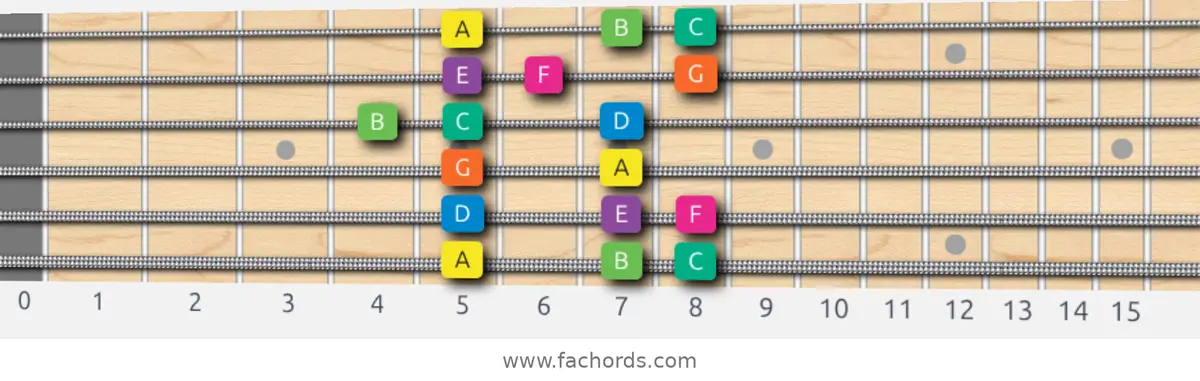
A minor scale, box position 1
The Melody: One Line, Seventeen Harmonies
This is guitar 1 for every A minor example. Four bars of eighth notes in A minor: it climbs from A, peaks on F, comes back down and resolves through B and G to A. Simple on purpose, so the harmony is what you notice.
   1  &  2  &  3  &  4  &    1  &  2  &  3  &  4  &
e|-------------------------|-------------------------|
B|-------------------------|----------------6--5-----|
G|-------5-----------5--7--|-9--7--5--7--9--------7--|
D|-7--9-----9--7--9--------|-------------------------|

   1  &  2  &  3  &  4  &    1  &  2  &  3  &  4  &
e|-------------------------|-------------------------|
B|-------------------------|-------------------------|
G|-5-----------5--7--------|-------------------------|
D|----9--7--9--------9--5--|-7-----------------------|
The melody alone: A B C B A B C D | E D C D E F E D | C B A B C D B G | A
Learn it first. Then, for each harmony below, either play guitar 2 against the clip, or record the melody yourself and add the second part on another track.
Harmonizing in Thirds: the Classic Twin Guitar Sound
Guitar 2 plays two scale steps above every note. A gets C, B gets D, C gets E, and so on up to F, which gets A.
   1  &  2  &  3  &  4  &    1  &  2  &  3  &  4  &
e|-------------------------|-------------------------|
B|-------------------------|----------------10-8-----|
G|-------9-----------9--10-|-12-10-9--10-12-------10-|
D|-10-12----12-10-12-------|-------------------------|

   1  &  2  &  3  &  4  &    1  &  2  &  3  &  4  &
e|-------------------------|-------------------------|
B|-------------------------|-------------------------|
G|-9-----------9--10-------|-------------------------|
D|----12-10-12-------12-9--|-10----------------------|
Melody (left) with guitar 2 a diatonic third above (right)
Listen to how the two guitars blend into one thicker voice. That's the magic of thirds: two notes a third apart are two thirds of a triad, so every pair sounds like a little chord of the key. A with C, C with E, E with G, F with A: these pairs are pieces of Am, C, Em and F.
And note the tab: guitar 2 is not always the same number of frets away. Minor thirds (A-C, B-D, D-F, E-G) and major thirds (C-E, F-A, G-B) alternate, exactly as the scale dictates.
Where you've heard it: the opening riff of Iron Maiden's The Trooper has Adrian Smith a diatonic third above Dave Murray's melody, in E minor. Thin Lizzy's twin leads (Scott Gorham with Brian Robertson) are built largely on the third above the melody, and the closing arpeggios of the Eagles' Hotel California are harmonized in thirds too.
Tenths: thirds with more air
Drop guitar 1 an octave and keep guitar 2 where it was: the third becomes a tenth (an octave plus a third). Same note names, same major/minor pattern, but the parts no longer rub against each other. It sounds more like a bass line and a melody than a single fat voice.
   1  &  2  &  3  &  4  &    1  &  2  &  3  &  4  &
e|-------------------------|-------------------------|
B|-------------------------|-------------------------|
G|-------------------------|-------------------------|
D|-------------------------|-------------------------|
A|----------------------5--|-7--5--3--5--7--8--7--5--|
E|-5--7--8--7--5--7--8-----|-------------------------|

   1  &  2  &  3  &  4  &    1  &  2  &  3  &  4  &
e|-------------------------|-------------------------|
B|-------------------------|-------------------------|
G|-------------------------|-------------------------|
D|-------------------------|-------------------------|
A|-3--------------5--------|-------------------------|
E|----7--5--7--8-----7--3--|-5-----------------------|
Guitar 2 is the same as in the thirds example.
Guitar 1 an octave lower, guitar 2 a tenth above it
Harmonizing in Sixths: Thirds Turned Upside Down
Take the thirds part and drop it one octave: guitar 2 now plays under the melody, a sixth below. A gets the C below it, C gets the E below it, and so on.
   1  &  2  &  3  &  4  &    1  &  2  &  3  &  4  &
e|-------------------------|-------------------------|
B|-------------------------|-------------------------|
G|-------------------------|-------------------------|
D|-------------------------|-5--3--------5--7--5--3--|
A|-3--5--7--5--3--5--7--8--|-------7--8--------------|
E|-------------------------|-------------------------|

   1  &  2  &  3  &  4  &    1  &  2  &  3  &  4  &
e|-------------------------|-------------------------|
B|-------------------------|-------------------------|
G|-------------------------|-------------------------|
D|-------------------------|-------------------------|
A|-7--5--3--5--7--8--5-----|-------------------------|
E|----------------------7--|-8-----------------------|
Melody (left) with guitar 2 a diatonic sixth below (right)
Same note names as the thirds, very different feel. The guitars are further apart, so you hear two distinct voices instead of one fat line. The minor thirds became major sixths (9 half steps) and the major thirds became minor sixths (8 half steps).
Why would you choose sixths? Three reasons:
- Register. When the melody is already high, a third above can climb past the 17th fret. A sixth below keeps both parts in the sweet spot of the neck.
- Clarity. With distortion, two notes very close together can get muddy. A sixth leaves room.
- Double stops. On one guitar, sixths are easy to grab on strings 3 and 1, or 4 and 2 (skip one string). That's the sound of soul and country guitar: Steve Cropper's fills on (Sittin' On) The Dock of the Bay mix sixths and thirds. Our lesson on double stops and dyads shows the shapes.
Where you've heard it: in The Trooper again. After the opening riff in thirds, a later harmony line has Smith's part dropped an octave, under Murray's: the third becomes a sixth. The Allman Brothers' Blue Sky works the same way the other side up, with the harmony a third below the melody (in G major).
Harmonizing in Fourths: Open and Modern
Three scale steps up. A gets D, B gets E, C gets F... and F gets B.
   1  &  2  &  3  &  4  &    1  &  2  &  3  &  4  &
e|-------------------------|-------------------------|
B|-------------------------|----------------12-10-8--|
G|-------10-9--------10-12-|-14-12-10-12-14----------|
D|-12-14-------12-14-------|-------------------------|

   1  &  2  &  3  &  4  &    1  &  2  &  3  &  4  &
e|-------------------------|-------------------------|
B|-------------------------|-------------------------|
G|-10-9--------10-12-9-----|-------------------------|
D|-------12-14----------10-|-12----------------------|
Melody (left) with guitar 2 a diatonic fourth above (right)
The sound is completely different from thirds: hollow, open, a bit medieval. Fourths don't spell a major or minor triad, so the pairs don't tell the ear "major" or "minor". They float.
Now listen to bar 2, on the "and" of beat 3: the melody hits F and guitar 2 plays B. That's not a perfect fourth, it's an augmented fourth, a tritone: 6 half steps, the most unstable interval in the key. In a diatonic harmony in fourths this happens once per octave (F-B in A minor, F-B in C major too, since it's the same set of notes). You have two options: keep it as a moment of tension that resolves on the next note, or "break" the key and play Bb instead. Which leads us to...
Parallel fourths: the same distance for every note
Here guitar 2 is always exactly 5 half steps above. On the guitar it's the easiest harmony there is: on any two adjacent strings except G and B, a perfect fourth is the same fret on the next string up.
   1  &  2  &  3  &  4  &    1  &  2  &  3  &  4  &
e|-------------------------|-------------------------|
B|-------------------------|----------------11-10-8--|
G|-------10-9--------10-12-|-14-12-10-12-14----------|
D|-12-14-------12-14-------|-------------------------|

   1  &  2  &  3  &  4  &    1  &  2  &  3  &  4  &
e|-------------------------|-------------------------|
B|-------------------------|-------------------------|
G|-10-9--------10-12-9-----|-------------------------|
D|-------12-14----------10-|-12----------------------|
Melody with guitar 2 always a perfect fourth above: the F gets Bb, not B
Only one note changed from the diatonic version: the B on the 12th fret of the B string became a Bb on the 11th. Bb is the b2 of A, the darkest note of the Phrygian sound, and for a moment the line leans out of plain minor. Both versions work: the diatonic one is "inside", the parallel one is darker and more riff-like.
Where you've heard it: Deep Purple's Smoke on the Water riff is a G minor blues scale melody harmonized in parallel fourths, played as two-note shapes on one guitar. In Slayer's Mandatory Suicide the two guitars play in parallel fourths, then in octaves, swapping who plays the upper part.
Perfect fourth
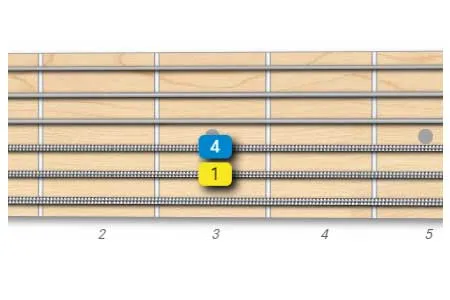
Perfect fifth
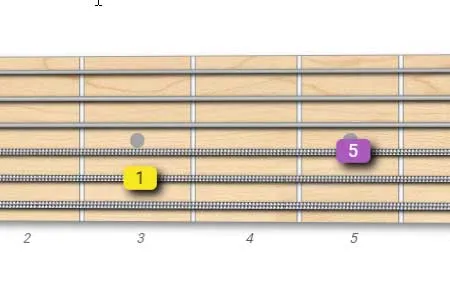
Diminished fifth
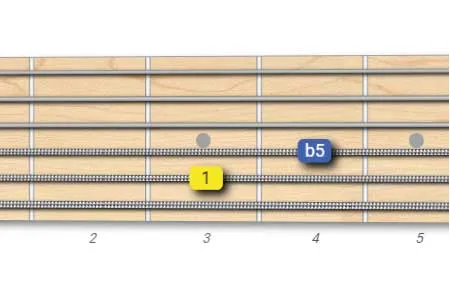
Harmonizing in Fifths: Power Chord Melodies
Four scale steps up. A gets E, C gets G, D gets A: every pair is a little power chord.
   1  &  2  &  3  &  4  &    1  &  2  &  3  &  4  &
e|-------------------------|-------------------------|
B|-------------------------|----------------13-12-10-|
G|-------12-10-------12-14-|-16-14-12-14-16----------|
D|-14-15-------14-15-------|-------------------------|

   1  &  2  &  3  &  4  &    1  &  2  &  3  &  4  &
e|-------------------------|-------------------------|
B|-------------------------|-------------------------|
G|-12-10-------12-14-------|-------------------------|
D|-------14-15-------15-12-|-14----------------------|
Melody (left) with guitar 2 a diatonic fifth above (right)
Big, solid, a little cold. Like fourths, fifths say nothing about major or minor: the melody alone carries the mood.
This melody leans on B a lot (the 2nd note of the scale), and B gets F above it: B-F is a diminished fifth, the same tritone as before, flipped. You'll hear it as a sour flash every time guitar 1 plays B. Some players fix it by raising the F to F#, so every fifth is perfect: that turns the B-F# pair into a Dorian color. Here the rule of thumb is simple: if the tritone falls on a strong beat, fix it; if it passes on a weak eighth note, let it be.
Where you've heard it: the intro of KISS's Detroit Rock City has two guitars and bass moving in parallel fifths, fourths and octaves.
Octaves: Doubling, Not Harmony
Guitar 2 plays the same notes one octave higher.
   1  &  2  &  3  &  4  &    1  &  2  &  3  &  4  &
e|-------------------------|-------------------------|
B|----------------------15-|-17-15-13-15-17-18-17-15-|
G|-14-16-17-16-14-16-17----|-------------------------|
D|-------------------------|-------------------------|

   1  &  2  &  3  &  4  &    1  &  2  &  3  &  4  &
e|-------------------------|-------------------------|
B|-13-12----------15-------|-------------------------|
G|-------14-16-17----16----|-14----------------------|
D|----------------------17-|-------------------------|
Melody (left) with guitar 2 an octave above (right)
Strictly speaking this isn't harmony: no new note names, no chord. But it's one of the most useful tricks in an arrangement. The line becomes brighter and heavier, and it cuts through a loud band. Twin guitar bands use it to set up a harmony: play a phrase in octaves, then split into thirds the second time, and the harmony sounds twice as big.
On one guitar, the octave shape is two strings up and two frets up (three frets up when you cross the B string), the sound of Wes Montgomery and of Jimi Hendrix's octave lines in Third Stone from the Sun.
Three-Part Harmony: a Triad on Every Note
Add a third guitar a fifth above (guitar 3, in the centre) to the thirds harmony, and every note of the melody becomes a full triad of the key: A-C-E is Am, B-D-F is Bdim, C-E-G is C, D-F-A is Dm, E-G-B is Em, F-A-C is F, G-B-D is G. It's the harmonized scale played as a melody.
Guitar 2 is the thirds part above. Guitar 3:
   1  &  2  &  3  &  4  &    1  &  2  &  3  &  4  &
e|-------------------------|-------------------------|
B|-------------------------|----------------13-12-10-|
G|-------12-10-------12-14-|-16-14-12-14-16----------|
D|-14-15-------14-15-------|-------------------------|

   1  &  2  &  3  &  4  &    1  &  2  &  3  &  4  &
e|-------------------------|-------------------------|
B|-------------------------|-------------------------|
G|-12-10-------12-14-------|-------------------------|
D|-------14-15-------15-12-|-14----------------------|
Melody (left), thirds (right), fifths (centre): a triad on every note
Now the sound is orchestral, almost like a horn section. The catch: you need three players, or a multitrack recorder. And the diminished chord on B is still there (B-D-F): it gives the line a moment of drama every time the melody passes through B.
Where you've heard it: Brian May called his solo in Queen's Killer Queen a "three-part thing", three guitars layered like bells. Our lesson on triads across the fretboard gives you all the shapes to build these parts.
Mixing Intervals in One Line
Real twin guitar parts rarely stay on one interval from start to end. Players switch to keep both parts playable, to avoid a clash, or simply because a different interval sounds better on that note. Here guitar 2 plays thirds above for two bars, then drops to sixths below, and the last note lands on the octave, A over A.
   1  &  2  &  3  &  4  &    1  &  2  &  3  &  4  &
e|-------------------------|-------------------------|
B|-------------------------|----------------10-8--6--|
G|-5--7--9--7--5--7--9--10-|-12-10-9--10-12----------|
D|-------------------------|-------------------------|
A|-------------------------|-------------------------|
E|-------------------------|-------------------------|

   1  &  2  &  3  &  4  &    1  &  2  &  3  &  4  &
e|-------------------------|-------------------------|
B|-------------------------|-------------------------|
G|-------------------------|-------------------------|
D|-------------------------|-------------------------|
A|-7--5--3--5--7--8--5-----|-------------------------|
E|----------------------7--|-5-----------------------|
Thirds above, then sixths below, ending on the octave
The ear doesn't notice the switch as a "change of interval": it hears the same harmony, with the second guitar moving out of the way. That's why thirds and sixths mix so naturally, and why ending a harmony on an octave or unison feels like the two guitars coming home.
Where you've heard it: Kirk Hammett said he harmonized the second solo of Metallica's Fade to Black "in minor thirds, major thirds and fifths". And the Allman Brothers often harmonized on the fly, so the same line could move between thirds and fourths.
Contrary motion: when the guitars go opposite ways
Harmony doesn't have to move in parallel. Here guitar 2 is a mirror image of the melody: when guitar 1 goes up, guitar 2 comes down. The intervals change all the time (twelfths, tenths, octaves, sixths, fourths), and the two lines meet on the octave A at the end.
   1  &  2  &  3  &  4  &    1  &  2  &  3  &  4  &
e|-12-10-8--10-12-10-8-----|-------------------------|
B|----------------------12-|-10-12-13-12-10-8--10-12-|

   1  &  2  &  3  &  4  &    1  &  2  &  3  &  4  &
e|-------12-10-8-----------|-------------------------|
B|-13-15----------12-15-12-|-10----------------------|
Guitar 2 moves in the opposite direction of the melody
This is less "twin guitar" and more counterpoint: two independent lines. It's a great exercise for writing parts that talk to each other instead of shadowing each other.
Dissonant Harmonies: Seconds and Tritones
So far we've chosen intervals that blend. What happens if we pick the ones that clash?
Seconds
One scale step up: the two guitars are right next to each other, a major or minor second apart.
   1  &  2  &  3  &  4  &    1  &  2  &  3  &  4  &
e|-------------------------|-------------------------|
B|-------------------------|-------------------------|
G|----------------------9--|-10-9--7--9--10-12-10-9--|
D|-9--10-12-10-9--10-12----|-------------------------|

   1  &  2  &  3  &  4  &    1  &  2  &  3  &  4  &
e|-------------------------|-------------------------|
B|-------------------------|-------------------------|
G|-7--------------9--------|-------------------------|
D|----10-9--10-12----10-7--|-9-----------------------|
Melody with guitar 2 a diatonic second above: tense clusters
It's grinding, especially on the minor seconds (B-C and E-F). For a whole phrase it's too much, but a single second that resolves to a third is a great way to build tension in a harmony line.
Parallel tritones
Now guitar 2 stays exactly 6 half steps above every note. Almost every harmony note falls outside A minor: this is the sound of horror film music and of the darkest corners of metal.
   1  &  2  &  3  &  4  &    1  &  2  &  3  &  4  &
e|-------------------------|-------------------------|
B|-------------------------|----------------12-11-9--|
G|-------11-10-------11-13-|-15-13-11-13-15----------|
D|-13-15-------13-15-------|-------------------------|

   1  &  2  &  3  &  4  &    1  &  2  &  3  &  4  &
e|-------------------------|-------------------------|
B|-------------------------|-------------------------|
G|-11-10-------11-13-10----|-------------------------|
D|-------13-15----------11-|-13----------------------|
Melody with guitar 2 always a tritone above
The tritone's reputation in heavy music goes back to Black Sabbath, whose title track riff moves from G to the note a tritone away. As a harmony, a whole line of tritones is extreme: use it for a short riff, or for a chromatic passage, not for your big melodic chorus.
The trap: parallel thirds
Here is why diatonic harmony exists. Guitar 2 plays a major third (4 half steps) above every note, like a harmonizer pedal set to a fixed interval:
   1  &  2  &  3  &  4  &    1  &  2  &  3  &  4  &
e|-------------------------|-------------------------|
B|-------------------------|----------------10-9-----|
G|-------9--8--------9--11-|-13-11-9--11-13-------11-|
D|-11-13-------11-13-------|-------------------------|

   1  &  2  &  3  &  4  &    1  &  2  &  3  &  4  &
e|-------------------------|-------------------------|
B|-------------------------|-------------------------|
G|-9--8--------9--11-8-----|-------------------------|
D|-------11-13----------9--|-11----------------------|
Melody with guitar 2 always a major third above: out of key
C#, D#, F#, G#: four notes that don't belong to A minor. Compare it with the diatonic thirds clip and you'll hear immediately why a "smart" harmonizer needs to know the key and the scale. Fourths, fifths and octaves survive the fixed treatment because they are perfect in almost every degree; thirds and sixths don't, because the scale itself mixes major and minor ones.
Harmony on Other Scales
The method doesn't change with the scale: guitar 2 moves the same number of scale steps. But the scale decides which thirds are major and which are minor, and that's where each scale's color comes from. Here is the same melody, by scale degree, harmonized in thirds on four more scales.
Harmonic minor: the neoclassical sound
A harmonic minor raises G to G#. Melody and harmony both use G#, so E now gets a major third (E-G#), and the cadence at the end goes G# with B, then A with C: the leading tone pulling home.
   1  &  2  &  3  &  4  &    1  &  2  &  3  &  4  &
e|-------------------------|-------------------------|
B|-------------------------|----------------6--5-----|
G|-------5-----------5--7--|-9--7--5--7--9--------7--|
D|-7--9-----9--7--9--------|-------------------------|

   1  &  2  &  3  &  4  &    1  &  2  &  3  &  4  &
e|-------------------------|-------------------------|
B|-------------------------|-------------------------|
G|-5-----------5--7--------|-------------------------|
D|----9--7--9--------9--6--|-7-----------------------|
Guitar 2:
   1  &  2  &  3  &  4  &    1  &  2  &  3  &  4  &
e|-------------------------|-------------------------|
B|-------------------------|-9-----------9--10-9-----|
G|-------9-----------9--10-|----10-9--10----------10-|
D|-10-12----12-10-12-------|-------------------------|

   1  &  2  &  3  &  4  &    1  &  2  &  3  &  4  &
e|-------------------------|-------------------------|
B|-------------------------|-------------------------|
G|-9-----------9--10-------|-------------------------|
D|----12-10-12-------12-9--|-10----------------------|
A harmonic minor in thirds
Hear the E-G# pair on beat 1 of bar 2? That's an E major sound in the middle of a minor line, the exotic, classical-flavored tension of harmonic minor.
Major scale: bright and singing
The same contour in G major (G A B C D E F#). The thirds are the mirror of the minor version: G gets a major third (B), A gets a minor third (C).
   1  &  2  &  3  &  4  &    1  &  2  &  3  &  4  &
e|-------------------------|-------------------------|
B|-------------------------|----------------5--3-----|
G|-------4-----------4--5--|-7--5--4--5--7--------5--|
D|-5--7-----7--5--7--------|-------------------------|

   1  &  2  &  3  &  4  &    1  &  2  &  3  &  4  &
e|-------------------------|-------------------------|
B|-------------------------|-------------------------|
G|-4-----------4--5--------|-------------------------|
D|----7--5--7--------7--4--|-5-----------------------|
Guitar 2:
   1  &  2  &  3  &  4  &    1  &  2  &  3  &  4  &
e|-------------------------|-------------------------|
B|-------------------------|----------------8--7--5--|
G|-------7--5--------7--9--|-11-9--7--9--11----------|
D|-9--10-------9--10-------|-------------------------|

   1  &  2  &  3  &  4  &    1  &  2  &  3  &  4  &
e|-------------------------|-------------------------|
B|-------------------------|-------------------------|
G|-7--5--------7--9--------|-------------------------|
D|-------9--10-------10-7--|-9-----------------------|
G major in thirds
This is the Southern rock and country side of twin guitars, closer to Blue Sky than to The Trooper.
Dorian: minor with a lift
E Dorian (E F# G A B C# D) is a minor scale with a major 6th. In thirds, A gets C# (a major third, where natural minor would give a minor one), and C# gets E. The line sounds minor but less dark, a little jazzy.
   1  &  2  &  3  &  4  &    1  &  2  &  3  &  4  &
e|-------------------------|-------------------------|
B|-------------------------|-------------------------|
G|----------------------2--|-4--2--0--2--4--6--4--2--|
D|-2--4--5--4--2--4--5-----|-------------------------|
A|-------------------------|-------------------------|

   1  &  2  &  3  &  4  &    1  &  2  &  3  &  4  &
e|-------------------------|-------------------------|
B|-------------------------|-------------------------|
G|-0--------------2--------|-------------------------|
D|----4--2--4--5-----4-----|-2-----------------------|
A|----------------------5--|-------------------------|
Guitar 2:
   1  &  2  &  3  &  4  &    1  &  2  &  3  &  4  &
e|-------------------------|-------------------------|
B|-------------------------|-------------------------|
G|----------------------6--|-7--6--4--6--7--9--7--6--|
D|-5--7--9--7--5--7--9-----|-------------------------|

   1  &  2  &  3  &  4  &    1  &  2  &  3  &  4  &
e|-------------------------|-------------------------|
B|-------------------------|-------------------------|
G|-4--------------6--------|-------------------------|
D|----7--5--7--9-----7--4--|-5-----------------------|
E Dorian in thirds
Pentatonic: harmonize two steps up
The A minor pentatonic scale has only five notes (A C D E G), and that changes the math. One pentatonic step up gives you a mix of thirds and seconds, which clashes. Two steps up gives A with D, C with E, D with G, E with A, G with C: four perfect fourths and one major third.
The melody here is a pentatonic version of our line, in the first box:
   1  &  2  &  3  &  4  &    1  &  2  &  3  &  4  &
e|-------------------------|----------------5--------|
B|-------------------------|-8-----------8-----8-----|
G|----5--7--5-----5--7--9--|----9--7--9-----------9--|
D|-7-----------7-----------|-------------------------|

   1  &  2  &  3  &  4  &    1  &  2  &  3  &  4  &
e|-------------------------|-------------------------|
B|-------------------------|-------------------------|
G|-7--5-----5--7--9--5-----|-------------------------|
D|-------7--------------5--|-7-----------------------|
Guitar 2:
   1  &  2  &  3  &  4  &    1  &  2  &  3  &  4  &
e|-------------------------|----------------10-8-----|
B|-------8-----------8--10-|-13-10-8--10-13-------10-|
G|----9-----9-----9--------|-------------------------|
D|-12----------12----------|-------------------------|

   1  &  2  &  3  &  4  &    1  &  2  &  3  &  4  &
e|-------------------------|-------------------------|
B|-8-----------8--10-------|-------------------------|
G|----9-----9--------9-----|-------------------------|
D|-------12-------------10-|-12----------------------|
A minor pentatonic, harmonized two pentatonic steps up
An open, bluesy, rock sound, and a handy trick when you're jamming over a pentatonic solo and want a second part without leaving the box. If you want sweet thirds instead, switch to the full seven-note minor scale for the harmony.
Interval Shapes on Two Strings
When you write a harmony part (or play it as double stops), these shapes save a lot of counting. "Higher string" means the next string toward the high e. Crossing between the G and B strings, everything on the higher string moves one fret up, because that pair is tuned a major third apart instead of a fourth.
| Interval | Strings 6-5, 5-4, 4-3, 2-1 | Strings 3-2 (G and B) |
|---|---|---|
| Minor third | Higher string, 2 frets lower | Higher string, 1 fret lower |
| Major third | Higher string, 1 fret lower | Higher string, same fret |
| Perfect fourth | Higher string, same fret | Higher string, 1 fret higher |
| Perfect fifth | Higher string, 2 frets higher | Higher string, 3 frets higher |
| Major sixth | Skip one string: strings 3 and 1, or 4 and 2: same fret | |
| Minor sixth | Skip one string: strings 3 and 1, or 4 and 2: 1 fret lower on the higher string | |
| Octave | Skip one string: 2 frets higher (strings 6-4, 5-3), 3 frets higher (strings 4-2, 3-1) | |
If the shapes are new to you, our fretboard intervals guide has diagrams for every interval, and string skipping helps with the wide ones. To train your ear to recognize them, try interval ear training.
How to Write Your Own Harmony Part
- Know your scale. Write the melody's notes and decide which scale they come from. If the melody uses a note outside the scale (a blue note, a chromatic passing tone), decide for that note alone: a perfect interval, or the closest scale note.
- Pick the interval. Thirds for the classic sweet sound, sixths for a wider one or a harmony below, fourths and fifths for an open, heavy sound, octaves to double.
- Move every note the same number of scale steps. Write the harmony note names under the melody, as in the tables above.
- Check the strong beats. Look for tritones (B-F in A minor) and for clashes with the chord underneath. Fix them on strong beats, accept them on passing notes.
- Find a fingering. Keep guitar 2 in one position if you can. If a part climbs too high, switch from thirds above to sixths below.
- Record and listen. Pan the two parts left and right, like the clips on this page, and listen for the notes that stick out.
Want the full method applied to a real line, with the harmonic analysis note by note? Our step-by-step lesson on twin guitar solos in thirds works through it, over an Am - F - G - Am progression. And to choose which notes of the melody should land on the chord, see how to build solos on chord tones.
Conclusion
Every kind of guitar harmony comes down to one choice: how far, and measured how (scale steps or half steps). Here is the whole map:
| Harmony | How | Sound | Heard in |
|---|---|---|---|
| Thirds | 2 scale steps up | Sweet, one fat voice | The Trooper (opening riff), Thin Lizzy, Hotel California outro |
| Tenths | Thirds plus an octave | Open, two distinct voices | - |
| Sixths | Thirds dropped an octave | Wider, soul and country | The Trooper (later harmony), Steve Cropper |
| Fourths | 3 scale steps or 5 half steps | Open, hollow, riff-like | Smoke on the Water, Mandatory Suicide |
| Fifths | 4 scale steps or 7 half steps | Power chord melody | Detroit Rock City intro |
| Octaves | Same notes, 12 half steps | Doubling, bigger and brighter | Wes Montgomery, Third Stone from the Sun |
| Three-part | Thirds plus fifths | Orchestral, a triad on every note | Killer Queen solo |
| Mixed | Switch intervals within the line | Natural, playable | Fade to Black second solo, Allman Brothers |
| Contrary motion | Independent line | Counterpoint | - |
| Seconds, tritones | 1 scale step, 6 half steps | Tense, dark | Short riffs and passing tension |
Your next step: take a melody you already play (a riff, a vocal line, a phrase from your solos), record it, and harmonize it three ways: thirds, sixths below, fourths. Pick the one you like and write it into your next song.
That's all for today.
Remember that you can subscribe here to stay updated on new tutorials and gain access to the free download area, where you'll find some free chords and scales PDFs.

Created by
Giancarlo is a musician (teaching guitar since 2000), software engineer, AI consultant and published researcher
FAQ
What is guitar harmony?
Guitar harmony means playing a second line that moves with the melody at a chosen distance (an interval), usually on a second guitar. The classic twin guitar sound uses diatonic thirds: the harmony stays inside the melody's scale, so the distance switches between minor thirds (3 half steps) and major thirds (4 half steps) and every note stays in key.
What interval do Iron Maiden use for their guitar harmonies?
Mostly thirds. In The Trooper, the opening riff has Adrian Smith a diatonic third above Dave Murray's melody in E minor, and in a later harmony line Smith drops that third an octave, so it becomes a sixth below. Thirds and sixths are the same notes in a different octave, which is why the two sound so close.
What is the difference between diatonic and parallel harmony?
Diatonic harmony keeps the second guitar inside the scale, so the interval size changes with the note (minor or major thirds, for example). Parallel, or fixed, harmony keeps exactly the same number of half steps for every note, like a harmonizer pedal in fixed mode. Fixed fourths work well (Smoke on the Water is a riff in parallel fourths), fixed thirds usually sound out of key.
Should I harmonize in thirds or sixths?
Use thirds when you want the two guitars tight and sweet, almost one voice. Use sixths when you want more space between them, or when the harmony must sit below the melody: a sixth below gives the same note names as a third above, one octave lower. Many twin lines switch between the two to keep the parts on comfortable strings.
Can you harmonize a guitar melody in fourths or fifths?
Yes. Fourths and fifths sound open and powerful, more like a power chord than a sweet duet. In a diatonic minor or major scale one pair is a tritone (F with B in A minor), so either keep it as a passing tension or bend the rule and use a perfect interval on that note. KISS's Detroit Rock City intro uses parallel fifths, fourths and octaves.
How do you harmonize a pentatonic melody?
Move each note two steps up the pentatonic scale. In A minor pentatonic (A C D E G) that gives A with D, C with E, D with G, E with A and G with C: mostly perfect fourths and one major third. One step up mixes thirds with clashing seconds, so for real thirds switch to the full minor scale.
How can I play twin guitar harmonies on my own?
Record the melody on one track, then play the harmony on a second track and pan them left and right, as in the audio examples on this page. You can also play both notes on one guitar as double stops, when the interval fits under the fingers, or use a harmonizer pedal set to the key and scale (diatonic mode) rather than a fixed interval.
