How to Figure Out the Chords of a Song by Ear
A Step-by-Step Method for Guitar Players: Bass Note First
You put on a song you love, pick up the guitar, and... nothing. The chords are in there somewhere, but all you hear is one big blur of sound. You can't even tell when the chords change, let alone which chords they are.
Good news: you don't need perfect pitch or a special talent to figure out the chords of a song by ear. You need a method, and a few facts about how songs are built. Most songs use a handful of chords from the same key, and the bass player is quietly telling you which one is playing.
In this tutorial we're going to work out a real progression together, from the first listen to a finished chord chart, with audio examples and chord diagrams for every step.
The method in one sentence: find the home note of the song, follow the bass line to hear where the chords change, test a major and a minor chord on each bass note, and use the six chords of the key to fill the gaps.
Example in G: the bass plays G, D, E, C. The key of G has G, D, Em and C, so the progression is G - D - Em - C (I - V - vi - IV).
What You Need Before You Start
- A simple song. Start with a pop, rock or folk song with a clear bass and few chords. Leave jazz standards and prog rock for later.
- A way to loop and slow down. Any player that repeats a section helps, and slow-down software like the one in our Song Surgeon review is a big help on tricky passages.
- Headphones. Phone and laptop speakers lose most of the bass, and the bass is exactly what we're going to listen to.
- Your guitar, in tune. If the recording sounds slightly off from your guitar, the song may be tuned down or sped up: tune to the recording, not to the tuner.
Here is the "mystery song" we'll use as a worked example. Listen to it a couple of times before reading on. Don't try to name the chords yet, just get it in your ear.
The mystery progression, played twice
Step 1: Find the Home Note
Every song has a home note, the note where the music feels at rest. In theory books it's called the tonic, and it gives the song its key. Find it first, because everything else depends on it.
How do you find it? Here's a simple trick that works:
- Play the song and hum a single long note that feels like it "fits" everywhere, especially at the end of the chorus.
- Pause the song and keep humming.
- Look for that note on the low E string, moving one fret at a time until the guitar matches your voice.
Still not sure? Stop the song at the end of a phrase and play a few candidate notes: one will sound like "the end", the others will sound like they want to go somewhere else. Try it here: after the progression you'll hear three notes, D, E and G. Which one sounds like home?
Progression, then D (open D string), E (open low E), G (3rd fret, low E)
The last one, G on the 3rd fret of the low E string, is the only note that sounds finished. Our song is in G. If you want more strategies (key signatures, the dominant chord, the last chord of the song), check out our guide on how to find the key of a song.
Major or Minor Key?
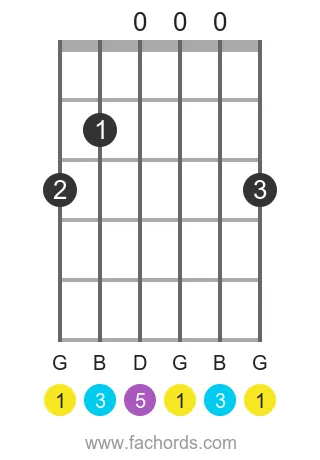
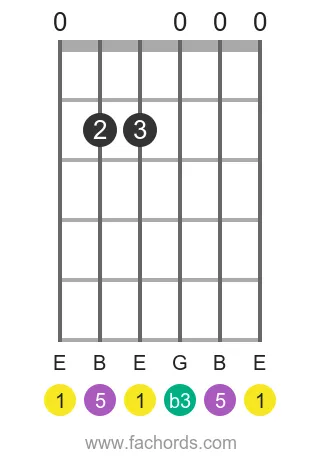
Sometimes the home note turns out to be a minor chord, and the song feels darker. The key of G major and the key of E minor share the same chords (E minor is the relative minor of G), so the method doesn't change: only the home chord does. Listen to how the same chords can rest on G or on Em:
G
Em
G, then Em
Step 2: Follow the Bass Line, Not the Strum
This is the step that clears up the blur. When you listen to the whole band, the strumming, the vocals and the drums all shout at the same time. The bass line is much simpler: in most songs it plays one low note per chord, and very often that note is the root of the chord.
So, forget the guitar for a moment and follow the lowest note. When the bass moves, the chord has (almost certainly) changed. Here is the bass line of our mystery song on its own:
The bass line alone: one note per bar, played twice
Now play the full version again and listen underneath the strumming. Can you hear the same four low notes? Hum them along with the recording, then find them on the guitar. Stay on the low E and A strings: that's where the bass lives.
| Bar | Bass note | Where on the guitar |
|---|---|---|
| 1 | G | low E string, 3rd fret |
| 2 | D | open D string (or A string, 5th fret) |
| 3 | E | open low E string |
| 4 | C | A string, 3rd fret |
While you do it, count the bars (1-2-3-4, 2-2-3-4...). You'll notice the bass moves on the "1" of each bar: in pop and rock, chords usually change on the first beat, and often every bar or every two bars. That regular pulse helps you predict the next change before it happens.
Tip: if you can't hear the bass at all, it might be your speakers. Use headphones, and don't listen too quietly: at low volume the ear loses the low frequencies first, so the bass fades before the rest of the mix.
Step 3: Major or Minor? Test Both Over the Bass Note
Once you have the bass notes, you have the names of the chords. What's missing is their quality: is that E an E major or an E minor chord?
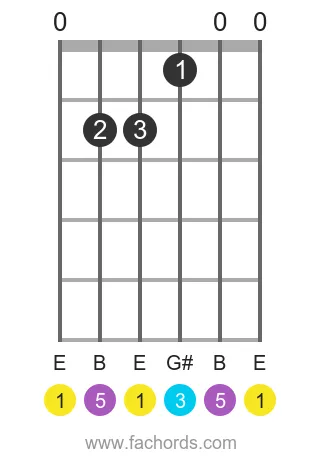
Don't think too much about it. Loop the bar, play both chords over the recording and listen. The wrong one clashes, the right one blends into the song. Here's the difference on the same bass note:
E
Em
E vs Em
Only one note changes: G# (1st fret, G string) becomes G (open G string).
That single half step turns a bright chord into a dark one.
Bass E, then E and Em strummed, then E and Em arpeggiated
In our song, the third bar is Em: the E major chord has a G# that rubs against the G in the recording, while Em sits perfectly. If telling major from minor is hard for you right now, don't worry: it's a very trainable skill, and our chord recognition game is built exactly for that.
Step 4: Use the Key: the 6 Likely Chords
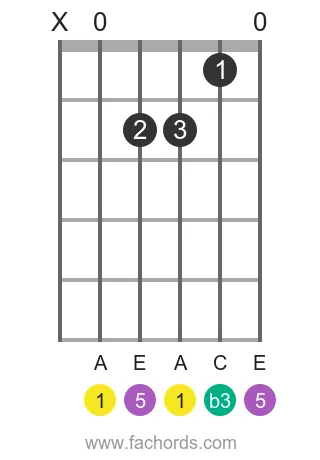
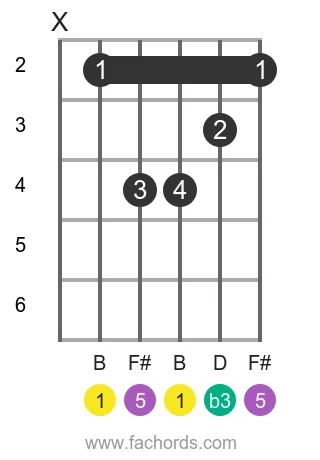
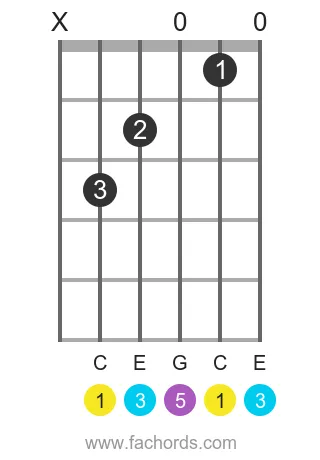
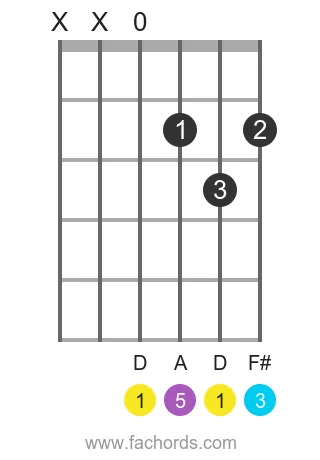
Here comes the biggest shortcut. You don't have to choose among all the chords in the world: once you know the key, most songs only use the six chords built on the notes of the major scale.
In G major they are:
G
Am
Bm
C
D
Em
G - Am - Bm - C - D - Em
Notice the pattern: I, IV and V are major, ii, iii and vi are minor. It's the same in every major key. (There's a seventh chord in the key, the diminished vii° (F#dim in G), but it's rare in pop and rock, so leave it for later.)
This also answers step 3 for you most of the time: if the bass plays E in the key of G, the chord is almost certainly Em, because E major is not in the key. Here are the same six chords in the most common guitar keys:
For all twelve keys, grab our free guitar keys chart, or use the circle of fifths: the I, IV and V chords of a key always sit next to each other on the circle.
Step 5: Recognise the Usual Progressions
The more songs you work out, the more you'll notice that the same few chord orders come back again and again. Learn to recognise them, and sometimes you'll hear a whole progression in one go instead of chord by chord. These are the ones to know first (all the details are in our list of common chord progressions):
| Progression | In G | What it sounds like | Song example |
|---|---|---|---|
| I - IV - V | G - C - D | Simple, happy, rock and roll | "Twist and Shout" (The Beatles) |
| I - V - vi - IV | G - D - Em - C | The modern pop sound | "Let It Be" (The Beatles) |
| I - vi - IV - V | G - Em - C - D | 50s doo-wop | "Stand By Me" (Ben E. King) |
| vi - IV - I - V | Em - C - G - D | The same four chords, starting sad | "Zombie" (The Cranberries) |
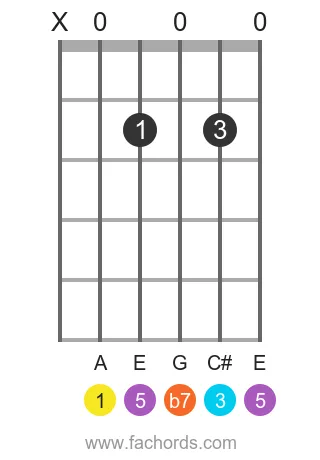
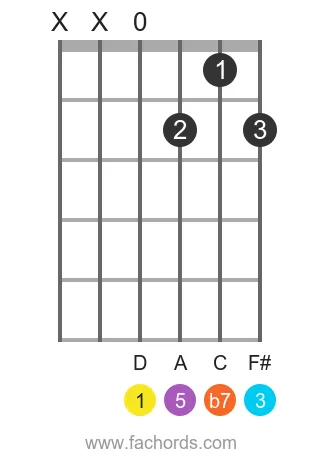
| 12-bar blues | (in A) A7 - D7 - E7 | Blues, rock and roll | "Johnny B. Goode" (Chuck Berry) |
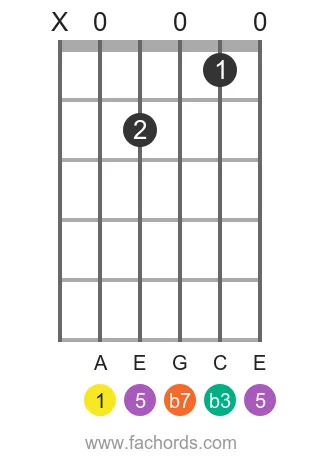
| ii - V - I | Am7 - D7 - Gmaj7 | Jazz, smooth and resolved | "Autumn Leaves" (opening) |
Listen to three of them. Pay attention to the bass in each one: you'll recognise the "shape" of the line before you can name the chords.
G
C
D
G
I - IV - V - I: G - C - D - G
A7
D7
E7
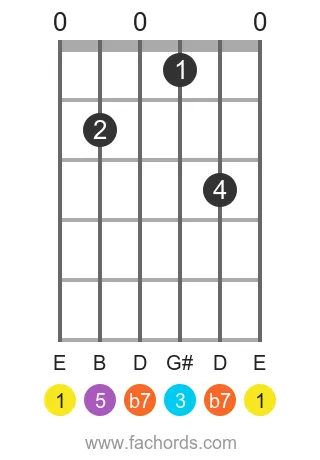
12-bar blues in A: A7 (4 bars) - D7 (2) - A7 (2) - E7 - D7 - A7 - E7
Am7
D7
Gmaj7

ii - V - I in G: Am7 - D7 - Gmaj7
A great habit: write progressions with numbers instead of chord names (I - V - vi - IV, or 1 5 6- 4). That's the idea behind the Nashville number system, and it lets you spot the same progression in any key.
Step 6: When a Chord Doesn't Fit the Key
Sooner or later you'll find a bass note whose chord isn't in the key. Don't panic: the "outsiders" are usually one of these three.
A Major Chord Where You Expected a Minor One (Secondary Dominant)
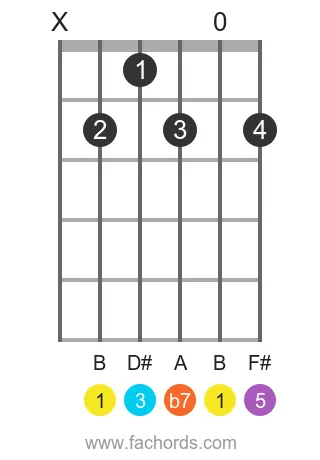
Very common: the bass plays B in the key of G, but Bm sounds wrong. Try B7. It's the V of vi, a chord that pushes strongly towards Em. We call it a secondary dominant, and the clue is that it's almost always followed by the chord a 5th below.
G
B7
Em
C
G - B7 - Em - C
A Minor Chord Where You Expected a Major One (Borrowed Chord)
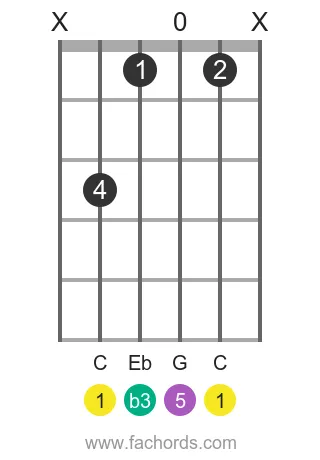
The opposite case: the bass plays C, but C major sounds too bright. Try Cm, the minor iv borrowed from G minor. It gives that bittersweet "sad turn" just before going home. A famous example is "Creep" by Radiohead, which goes G - B - C - Cm: a major III (the B, another chord from outside the key) and a minor iv in the same four-chord loop. More examples in our guide to borrowed chords.
G
C
Cm
G
G - C - Cm - G
The Bass Isn't Playing the Root (Slash Chords)
Bass players love smooth lines. Instead of jumping from G to C, they might walk G, B, C. If you follow the bass blindly you'll look for a B chord, and nothing will fit. The trick: ask yourself which chord in the key contains that bass note. B is the 3rd of G, so the chord is G/B (G with B in the bass), played x-2-0-0-3-3. Slash chords like this one are explained in our guide on how to name any guitar chord.
G
G/B
x-2-0-0-3-3
The 3-2-0-0-3-3 G shape without the low G: the low E string is muted and B (2nd fret, A string) is the lowest note.
C
D
G - G/B - C - D: the bass walks up G, B, C, D
When you hear a bass line moving step by step (up or down the scale), suspect chord inversions: the chords may change less often than the bass does.
Worked Example: From First Listen to Chord Chart
OK, let's put the six steps together on our mystery song. Play it one more time:
The mystery progression
- Home note: humming along, the note that fits the ending is G (3rd fret, low E). The song is in G major.
- Bass line: one new low note every bar: G, D, E, C, then it repeats. Four chords, one per bar.
- Major or minor: G and D sound bright, E sounds dark: Em. C is bright.
- Check the key: G, D, Em and C are all among the six chords of G (I, V, vi, IV). Nothing needs fixing.
- Recognise the progression: I - V - vi - IV, the four-chord pop progression.
- Outsiders: none in this song. If one bar had sounded wrong, step 6 is where we'd look.
Here is the result, with the shapes used in the recording. Look at the C and D shapes: they're the versions without the open low strings, so the lowest note of each chord is its root, exactly like the bass line.
G
D
Em
C
G - D - Em - C (x2)
Chord chart: | G | D | Em | C | (x2)
In numbers: | 1 | 5 | 6- | 4 |, so you can play it in any key: in C it becomes C - G - Am - F.
Now take a real song you like and do the same, one step at a time. Write down what you find, even if you're not sure: a chart with question marks is a great starting point, and the next listen will fix it. If you need to move the song to a key that suits your voice, our chord transposer does it in a second.
Can an App Tell Me the Chords?
Yes and no. Chord detection apps and software can give you a quick first draft, and they're getting better. But they still stumble on inversions, busy arrangements and chords with extensions, and they can't tell you why a chord is there.
My suggestion: work out the song first, then use the app as a second opinion. When the two disagree, that's exactly the bar where you'll learn something. And when you find a shape on the guitar and don't know its name, look it up in our guitar chord library.
Train Your Ear: Short Daily Drills
Figuring out chords by ear gets faster with every song, but a few minutes of focused training speeds things up a lot. Start with the skill that unlocks step 3, telling chord qualities apart: open our chord recognition game, switch to training mode, leave only maj and min ticked, and add more chord types (7, maj7, min7) once you get them right without thinking.
Then build a short routine. Ten minutes a day is enough:
| Minutes | Drill | Resource |
|---|---|---|
| 2 | Hum the home note of a song you hear, then check it on the guitar | Find the key of a song |
| 3 | Major vs minor (then 7th chords) recognition | Chord recognition game |
| 3 | Follow and hum the bass line of one song, chorus only | Your playlist and headphones |
| 2 | Recognise intervals, the building blocks of chords | Interval ear training or Interval Invaders |
If you want to go deeper, singing what you play is one of the most effective ear training habits there is: try the exercises in Sing Every Note, and read our ear training guide for guitarists for the big picture.
How to Figure Out Chords by Ear - Conclusion
Let's recap the method:
| Step | What you do | In our example |
|---|---|---|
| 1. Home note | Hum the note that feels like the end, find it on the low E | G: key of G |
| 2. Bass line | Follow the lowest note, mark where it moves | G, D, E, C |
| 3. Major or minor | Test both over the bass note | E is minor: Em |
| 4. The key | Choose among the 6 chords of the key | G, Am, Bm, C, D, Em |
| 5. Progressions | Recognise the usual patterns | I - V - vi - IV |
| 6. Outsiders | Secondary dominants, borrowed chords, slash chords | none |
Start with an easy three-chord song this week, then a four-chord one. The first song can take an hour; by the tenth you'll be surprised how often the bass gives the whole thing away in a couple of listens.
That's all for today.
Remember that you can subscribe here to stay updated on new tutorials and gain access to the free download area, where you'll find some free chords and scales PDFs.

Created by
Giancarlo is a musician (teaching guitar since 2000), software engineer, AI consultant and published researcher
FAQ
How do you figure out the chords of a song by ear?
Work in this order: find the home note (the note the song wants to end on), follow the bass line to hear where the chords change and which note each chord sits on, test a major and a minor chord on each bass note, then use the six chords of the key to fill the gaps. Most pop, rock and folk songs only use those six chords, so the job is choosing, not guessing.
Why can't I hear when the chords change in a song?
Because you are listening to the whole mix at once, and the strumming, vocals and drums blur together. Listen to the bass line instead: in most songs the bass moves when the chord changes, and it often plays the root of each chord. Count the bars, hum the low note, and mark the moment it moves. That moment is the chord change.
How do I know if a chord is major or minor by ear?
Find the bass note first, then strum a major chord and a minor chord on that note while the song plays. The wrong one clashes, the right one blends. As a rule of thumb, major chords sound bright and settled, minor chords sound darker or sadder. A chord recognition game helps you hear the difference faster.
What chords are most likely in a song?
The six chords built on the major scale of the key: I, ii, iii, IV, V and vi. In the key of G they are G, Am, Bm, C, D and Em; in C they are C, Dm, Em, F, G and Am. The I, IV, V and vi chords are by far the most common, so try those first.
Is the bass note always the root of the chord?
No, but it is most of the time. Bass players sometimes play another chord tone (a G chord with B in the bass is written G/B) to create a smooth walking line. If the bass note gives you a chord that doesn't fit the key, try the chords that contain that note: G/B, for example, sounds like G with a B underneath.
Can an app figure out the chords of a song for me?
Chord detection apps and software can give you a quick first draft, and slow-down tools are great for difficult passages. They still make mistakes with inversions, busy arrangements and chords with extensions, so check every chord with your guitar and your ears. Use the app as a second opinion, not as the answer.
How long does it take to learn to figure out chords by ear?
It depends on how much you practice, but short daily sessions work better than long occasional ones. Start with three-chord songs, then four-chord songs, then songs with one surprise chord. Ten minutes a day of bass-line listening and major or minor recognition builds the skill steadily.