The Three Chord Progression
Play Thousands of Songs With Just 3 Chords (I IV V)
Three chords are all you need to play thousands of songs on the guitar.
The I-IV-V, or 1-4-5, is one of the most common chord progressions in music, and it works across many genres. In the key of C the chords are C F G, and in the key of G they are G C D.
Here we will see where this progression comes from and why it has so many uses. When you are ready to play it, jump to the chords and audio in C, G, D, A and E.
Why These Three Chords?
If you haven't studied any basic music theory yet, now is a good time to start or brush up.
Western music uses 12 notes, and the distances between them make all the difference in how they sound. These distances are called intervals, and they are the best place to start for ear training.
The fourth, the fifth and the octave are known as perfect intervals. They are consonant and strong, and even in unusual modes and scales it is common to resolve back to them.
The chords built on these degrees share the same qualities. They are known as the tonic (I), the subdominant (IV) and the dominant (V). Together they contain all seven notes of the major scale, so they can harmonize any melody in the key.
The other chords of the key bring flavor to the music, but these three can survive all alone. In fact, bringing in other chords can change the mood.
If you want a strong composition that stands out, the I-IV-V is the way to go.
The same idea applies to the four chord progression.
To find these chords in any key, take the 1st, 4th and 5th degrees of its major scale. My Roman Numbers vs Nashville Number System tutorial has a chart of every degree in every key, and it explains the notation too. You can also see the most common guitar keys.
Genres That Use the 1 4 5 Chords
It would be hard to find a genre that doesn't use the I-IV-V. It is most common in folk and popular music, because simple consonance appeals to everyone.
Play a simple C-F-G and back to C again, and notice that the F is the "weakest" of those chords. The I and V are the strongest and can hold a song on their own, while the IV pulls away from home and builds tension.
Songs with just I and V, or just I and IV, get a little repetitive. One extra chord is all you need to write some great music.
Keep in mind that some songs use it the whole time, and others only for specific sections.
| Song | Artist | Section | Chords | Key |
|---|---|---|---|---|
| Twist and Shout | The Beatles | verse and chorus | D G A7 | D major |
| Blitzkrieg Bop | Ramones | verse | A5 D5 E5 | A major |
| I Love Rock 'n Roll | Joan Jett and the Blackhearts | intro riff | E A B | E major |
| La Bamba | Ritchie Valens | intro and verse | C F G7 | C major |
| Rock and Roll All Nite | KISS | chorus | Ab Db Eb | Ab major |
| Aria sopra la Bergamasca | Marco Uccellini | whole piece | I IV V I | |
| Ancient Airs and Dances, Suite No. 2, final movement | Ottorino Respighi | whole movement | I IV V I | |
| The Tide Is High | Blondie | intro | B E F# B | B major |
| Blowin' in the Wind | Bob Dylan | verse and chorus | D G A D | D major |
You will quickly find a lot of variation and different orders. A lot of early blues follows I-IV-I-V-I, which goes back to the tonic before moving to the V.
Another trick is to play the V as a V7, a favorite in blues, jazz, country and rock. It adds a little more tension to an already solid progression, as in Blue Suede Shoes.
These three simple chords, with some added tones, can be an entire career of guitar playing.
Many musicians have found fame on the I-IV-V7 alone!
The Closed Version: The Bergamasca
Written as I-IV-V-I, this is the same loop with the return home spelled out. As the Bergamasca (also bergamask or bergomask), it was a dance and variation pattern from Bergamo, played over this repeating harmony. It is the simplest complete tonal phrase: tonic, subdominant, dominant, tonic, with the V to I cadence closing every cycle.
Variations of the Three Chord Progression
Try different orders, like the blues I IV I V I, or I IV V IV, the loop behind "Wild Thing". Reversing the chords gives the V-IV-I turnaround of "Bad Moon Rising".
Of course, once the home chord changes we are no longer playing a I-IV-V. C-F-G feels different from G-F-C with G as home, which is a I-bVII-IV. It still sounds great, but it's a new progression, not a variation.
However, don't let the details of music theory stop you from experimenting. Try any order that sounds good to you.
Not Only Major and Minor Chords
Just playing I-IV-V all the time does get boring, and a little extra can really stand out. The V7 mentioned above is the most used extension, but you can also try sixth chords, ninths and add9 chords. When you want more than a little extra, explore these uncommon chord progressions picked by guitar teachers.
You can also drop notes instead of adding them. Using just the 1 and 5 of the chord gives you a power chord, which is very common in rock, alternative and metal. "Blitzkrieg Bop" is all power chords, which leaves a solid base to sing, riff and solo over. "Good Riddance" mixes both ideas with a I5-IVadd9-V5.
Major to Minor
Besides extensions there are also substitutions, and the most obvious one is a minor chord in place of a major. "Louie Louie" plays a I-IV-v-IV, and that minor v is what makes it stand out. Play the V and then the v on your guitar and hear how much it changes.
Uppercase numerals are major chords and lowercase numerals are minor. Make all three chords minor and you get the i-iv-v, which is a different key and a much darker sound.
Once we jumble the order too much or change the chords to minor, we move away from that major and uplifting feeling.
1 4 5 as a Foundation for Substitutions
Some substitutions will take you into new territory and away from the original consonance, but this is not always a bad thing.
In the end, the best way to learn the varieties of the I-IV-V is to play as many songs as you can across genres. Once you can hear the I, IV and V, you can start to work out song chords by ear.
These chords are the backbone of western music, and you will soon see that it's hard to play guitar without running into them.
To learn more progressions, in all keys, check my 52 Chord Progressions ebook, and don't forget to subscribe here.
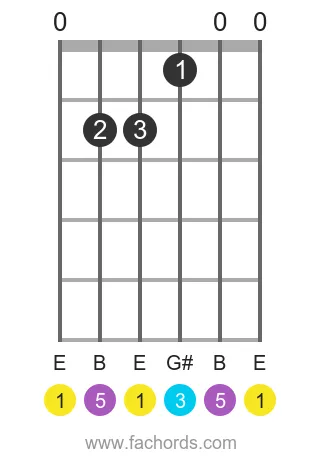
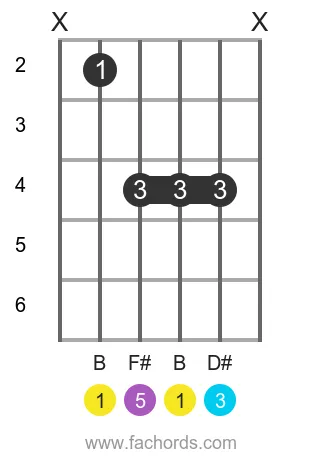
Three Chord Progression: Chords and Audio in C, G, D, A and E
Press play to hear each key. The diagrams show the shapes used in the audio, and every chord links to its full page.

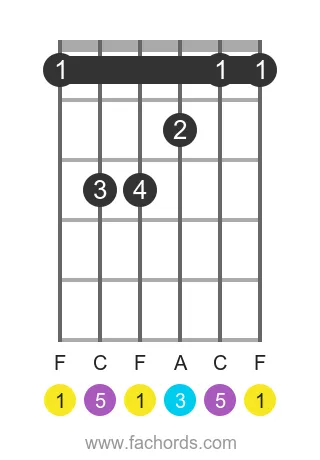
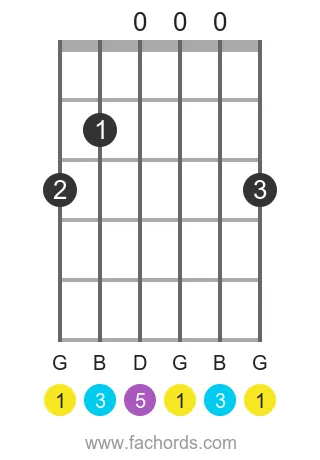
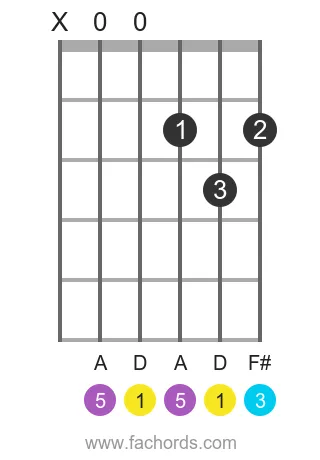
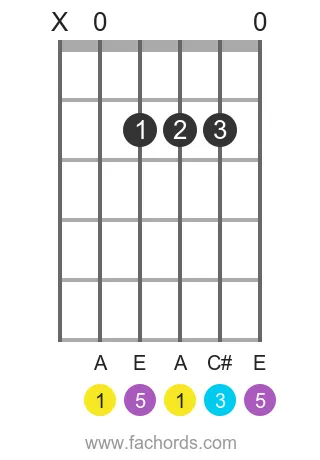
Longer progressions that contain it
- Wild Thing loop: C F G F
- Pachelbel's Canon progression: C G Am Em F C F G
More progressions like this one
- 50s progression: C Am F G
- Axis progression: C G Am F
- Komuro progression: Am F G C
- IV-I-V-vi: F C G Am
All guitar chord progressions →

Created by
Giancarlo is a musician (teaching guitar since 2000), software engineer, AI consultant and published researcher
FAQ
What does the 'I-IV-V' notation mean in the context of guitar chord progressions?
The 'I-IV-V' notation represents a fundamental three-chord progression where 'I', 'IV', and 'V' refer to the major chords built on the first, fourth, and fifth degrees of a musical scale. For example, in the key of G, the I chord is G, the IV chord is C, and the V chord is D.
How can I identify the I, IV, and V chords for any given key on the guitar?
To find the I, IV, and V chords for any key, you need to know the major scale for that key. The I chord is the major chord built on the root note of the key. The IV chord is the major chord built on the fourth note of that scale, and the V chord is the major chord built on the fifth note. The chords and audio on this page show them in the keys of C, G, D, A and E.
What are some common ways to vary the basic I-IV-V progression to make it more interesting?
You can vary the I-IV-V progression by changing the order of the chords, such as I-IV-I-V-I or I-IV-V-IV. You can also add extensions to the chords, like using a V7 (dominant seventh) chord to add tension, or other extensions like sixth or add9 chords. Another common variation is to use power chords (just the 1st and 5th notes) or substitute a major chord with its minor counterpart, like using a 'v' (minor five) instead of a 'V' (major five), which alters the mood and can change the key.
What is the difference in feel or sound when using a minor chord in place of a major chord in the I-IV-V progression, such as a 'v' instead of a 'V'?
Using a minor chord, like a 'v' (minor five) instead of a 'V' (major five), creates a different feel and changes the mood of the progression. While the standard I-IV-V often has an uplifting, consonant quality, incorporating a minor chord introduces a different emotional character, often described as more somber or bluesy. This change can significantly alter the harmonic context and may even imply a temporary shift to a different key.