Amaj7 Guitar Chord | Play, Hear and Practice Interactively
Want a structured chord roadmap instead of jumping between pages?
Go to the full guitar chords tutorial.
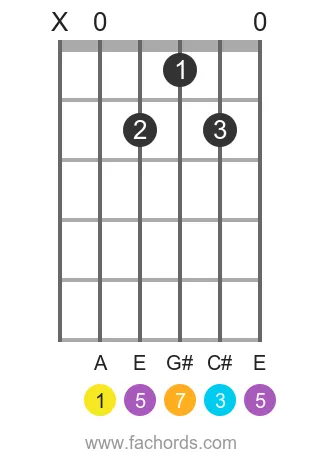
The Amaj7 chord, a beautiful and versatile member of the Major Chords family, is built from four notes: A, C#, E, and G# – corresponding to the intervals Root (1), Major Third (3), Perfect Fifth (5), and Major Seventh (7). Use the interactive fretboard tool at the top of this page to visualize every fingering, listen to the chord played as a strum or arpeggio, and check your own playing with real-time microphone feedback – the tool will tell you if you're hitting the notes correctly.
The Amaj7 chord provides a rich, mellow sound often heard in jazz, R&B, and soul music, adding sophistication to progressions. Understanding its construction, based on a major triad with an added major seventh, is key to truly mastering it. Dive deeper into the theory behind building chords with our Chord Construction guide. Many Amaj7 shapes involve barre forms; if you're working on those, our guide to Guitar Bar Chords can help you master the technique. Practice fluidly transitioning into and out of Amaj7 with tips from our Improve Chords Change tutorial.
As you scroll down, you'll discover over 20 Amaj7 chord diagrams, arranged from the easiest open positions to more advanced barre and closed voicings. We also include detailed music theory, common songs that feature Amaj7, and the keys where this chord frequently appears. But before you explore the diagrams, spend some time with the interactive tool above. Set a comfortable tempo with the drum & BPM tool, strum the chord, and let the mic feedback confirm your finger placement. This hands-on, immediate feedback loop is the most effective way to integrate new chords into your playing.
A major 7th guitar chord is also written as Amaj7, AM7, AΔ7 or Ama7.
Notes of the A maj7 chord:
Chord structure of the Major Seventh chord:
A Maj7 Guitar Chord Diagrams
Position 1 Open
Finger Positions
- Mute the low E string
- Let the A string play without pressing any fret
- Let the high E string play without pressing any fret
- Place your index finger (1) on the fret 1 of the G string
- Place your middle finger (2) on the fret 2 of the D string
- Place your ring finger (3) on the fret 2 of the B string
Position 2 Movable
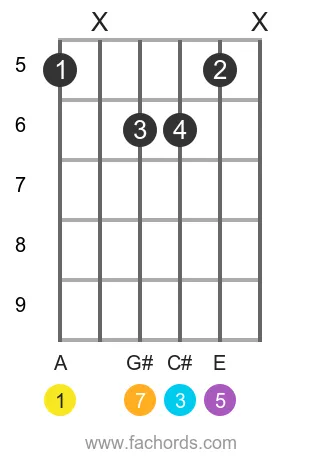
Finger Positions
- Mute the A string
- Mute the high E string
- Place your index finger (1) on the fret 5 of the low E string
- Place your middle finger (2) on the fret 5 of the B string
- Place your ring finger (3) on the fret 6 of the D string
- Place your pinky finger (4) on the fret 6 of the G string
Position 3 Open
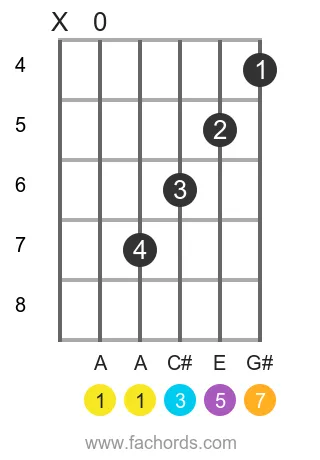
Finger Positions
- Mute the low E string
- Let the A string play without pressing any fret
- Place your index finger (1) on the fret 4 of the high E string
- Place your middle finger (2) on the fret 5 of the B string
- Place your ring finger (3) on the fret 6 of the G string
- Place your pinky finger (4) on the fret 7 of the D string
Position 4 Open
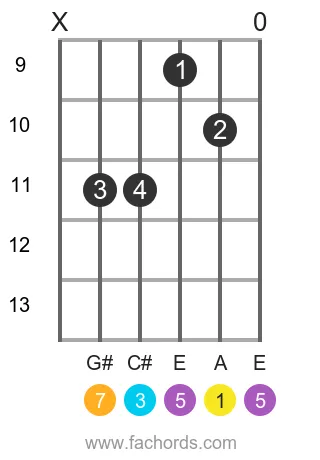
Finger Positions
- Mute the low E string
- Let the high E string play without pressing any fret
- Place your index finger (1) on the fret 9 of the G string
- Place your middle finger (2) on the fret 10 of the B string
- Place your ring finger (3) on the fret 11 of the A string
- Place your pinky finger (4) on the fret 11 of the D string
Position 5 Barre Movable
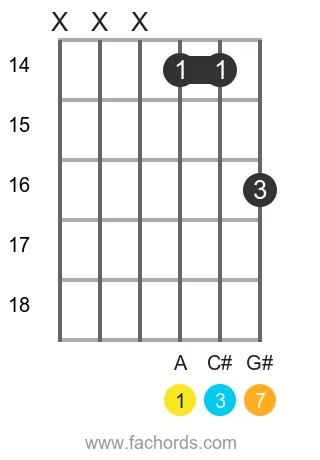
Finger Positions
- Mute the low E string
- Mute the A string
- Mute the D string
- Place your index finger (1) on the fret 14 of the G and B strings at the same time
- Place your ring finger (3) on the fret 16 of the high E string
Position 6 Barre Movable
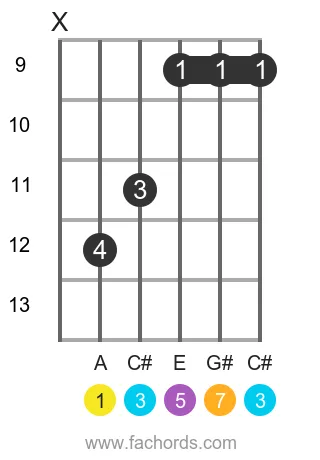
Finger Positions
- Mute the low E string
- Place your index finger (1) on the fret 9 of the G, B and high E strings at the same time
- Place your ring finger (3) on the fret 11 of the D string
- Place your pinky finger (4) on the fret 12 of the A string
 Find more shapes in our all guitar chords online library. If you
prefer a printable pdf, download
the Free Guitar Chords Chart Pdf

Created by
Giancarlo is a musician (teaching guitar since 2000), software engineer, AI consultant and published researcher
FAQ
What are the specific notes and intervals that constitute an A maj7 chord?
The A maj7 chord is built from four distinct notes: A, C#, E, and G#. These notes correspond to the 1st (Root), 3rd (Major Third), 5th (Perfect Fifth), and 7th (Major Seventh) intervals, respectively, when starting from the root note A.
Why is the A maj7 chord classified under the 'Major Chords family'?
The A maj7 chord belongs to the Major Chords family because its fundamental construction includes a Major Third (C# relative to A) and a Perfect Fifth (E relative to A), which establish its major quality, along with a Major Seventh (G# relative to A).
What is the characteristic sound of the A maj7 chord, and in what musical styles is it typically used?
The A maj7 chord produces a rich, full, and often sophisticated sound. Due to its unique harmonic color, it is frequently used in various genres, most notably in jazz music.
Is the A maj7 chord generally difficult for beginner guitarists to play?
Yes, playing the A maj7 chord might present a challenge for beginners initially. This is typically due to the finger placement required on the fretboard. However, with consistent practice, it can be mastered and incorporated into your playing.
How do chord diagrams and fretboard patterns help in learning to play the A maj7 chord?
Chord diagrams and fretboard patterns are visual aids that clearly demonstrate where to position your fingers on the guitar neck. They provide a precise map of the strings and frets you need to press to correctly form and sound the A maj7 chord.