Key Signatures: The Complete Chart and How to Read Them
All 15 major and minor keys, the order of sharps and flats, and what a key signature means on the guitar
Open any piece of sheet music and, right after the clef, you'll find a little cluster of sharps or flats. That's the key signature, and in one glance it tells you two things: which notes are sharp or flat for the whole piece, and which key the music is (most likely) in.
Guitarists can go a long way without it, thanks to tabs and chord charts. But the moment you read a lead sheet, play with a pianist or a horn section, or wonder why a song uses the chords it uses, the key signature is the shortest summary of a key you'll ever find.
Below you'll find the key signatures chart with all 15 keys in treble and bass clef, the order of sharps and flats, a two-step trick to name any key, a quick quiz, and what all of this means on the fretboard.
What is a key signature? It's the group of sharps (#) or flats (b) written at the start of every staff, right after the clef. Each one applies to that note in every octave, for the whole piece, unless an accidental cancels it. There are 15 key signatures: no accidentals, 1 to 7 sharps, or 1 to 7 flats.
Example: one sharp on the top line of the treble staff is F#. The key is G major (or its relative minor, E minor), and every F you meet is played as F#.
Key Signatures Chart: All 15 Major and Minor Keys
Here is every key signature in the treble clef, the clef guitar music is written in. The sharp keys are on the left, the flat keys on the right, lined up by the number of accidentals: G major has 1 sharp and F major has 1 flat, D major has 2 sharps and Bb major has 2 flats, and so on.

Each key signature belongs to two keys: a major key and its relative minor. The table below spells out the sharps or flats in the order they are written, with links to the scale and the chords of each key on the guitar.
| Key signature | Sharps / flats in order | Major key | Relative minor | Chords on guitar |
|---|---|---|---|---|
| No sharps or flats | - | C major | A minor | chords in C, chords in A minor |
| 1 sharp | F# | G major | E minor | chords in G, chords in E minor |
| 2 sharps | F# C# | D major | B minor | chords in D |
| 3 sharps | F# C# G# | A major | F# minor | chords in A |
| 4 sharps | F# C# G# D# | E major | C# minor | chords in E |
| 5 sharps | F# C# G# D# A# | B major | G# minor | - |
| 6 sharps | F# C# G# D# A# E# | F# major | D# minor | - |
| 7 sharps | F# C# G# D# A# E# B# | C# major | A# minor | - |
| 1 flat | Bb | F major | D minor | chords in F |
| 2 flats | Bb Eb | Bb major | G minor | - |
| 3 flats | Bb Eb Ab | Eb major | C minor | - |
| 4 flats | Bb Eb Ab Db | Ab major | F minor | - |
| 5 flats | Bb Eb Ab Db Gb | Db major | Bb minor | - |
| 6 flats | Bb Eb Ab Db Gb Cb | Gb major | Eb minor | - |
| 7 flats | Bb Eb Ab Db Gb Cb Fb | Cb major | Ab minor | - |
Free PDF: download the key signatures chart (2 pages: treble clef and bass clef) and keep it on your music stand.
The Order of Sharps: F C G D A E B
Sharps never show up in random order. A key with one sharp always has F#, a key with two sharps has F# and C#, a key with three sharps adds G#, and so on. Each key keeps the sharps of the one before it and adds one more.

The classic way to remember it: Father Charles Goes Down And Ends Battle.
Why this order? Look at the letters: F to C, C to G, G to D... each new sharp is a perfect 5th above the previous one. The keys move the same way: G, D, A, E, B, F#, C#, one 5th at a time, clockwise around the circle of fifths.
On the guitar a 5th is easy to see: one string higher and two frets up (from the G to the B string, three frets up, because of the B string tuning). Play G on the 3rd fret of the low E string, then D on the 5th fret of the A string: you just moved from the key with 1 sharp to the key with 2 sharps.
One more detail that will come in handy in a minute: the sharp a key adds is always its 7th note, the one a half step below the tonic. G major adds F#, D major adds C#, A major adds G#.
The Order of Flats: B E A D G C F
The order of flats is the order of sharps backwards. One flat is Bb, two flats are Bb and Eb, three flats add Ab, and so on up to seven.

Read the same sentence backwards: Battle Ends And Down Goes Charles' Father. Or notice that the first four flats spell BEAD, followed by GCF (Greatest Common Factor, if you liked math at school).
This time each new flat is a perfect 4th above the previous one (B to E, E to A...), and the flat keys move in 4ths too: F, Bb, Eb, Ab, Db, Gb, Cb, counterclockwise around the circle. The flat a key adds is always its 4th note: F major adds Bb, Bb major adds Eb.
How to Read a Key Signature in 2 Steps
You don't need to memorize 15 key signatures. With the two orders above and two little tricks, you can name the major key of any signature in a couple of seconds.
Key signatures with sharps: last sharp + a half step
Find the last sharp, the one furthest to the right, and go up a half step. That note is the major key. Remember? The last sharp is always the 7th note of the key, a half step below the tonic.
Three sharps: F#, C#, G#. A half step above G# is A, so it's A major. On the guitar, a half step is simply one fret higher.
Key signatures with flats: the second to last flat
Find the second to last flat: that's the name of the major key.
Four flats: Bb, Eb, Ab, Db. The second to last is Ab, so it's Ab major.
The two you just memorize
- No sharps or flats: C major (or A minor).
- One flat (Bb): there is no second to last flat, so remember it: F major (or D minor).
Major or minor?
The signature alone can't tell you, because a major key and its relative minor share it. The music tells you:
- Look at the first and last chord (or the last bass note): pieces usually start and end on the tonic.
- In minor keys, look for the raised 7th written as an accidental. With no sharps or flats, a lot of G# notes point to A minor: they come from the E major chord (the V chord) of the harmonic minor.
For songs without sheet music, our guide on how to find the key of a song shows how to do it by ear and from the chords.
Relative Minor: Same Key Signature, Different Home
Every major key has a relative minor that uses exactly the same notes, and so the same key signature. C major and A minor both have no sharps or flats; G major and E minor both have F#.
To find it, go down three half steps from the major tonic (a minor 3rd), or count up to the 6th note of the major scale. On the guitar that's three frets lower on the same string: C on the 8th fret of the low E string, A on the 5th fret. That's why the C major and A minor shapes overlap on the fretboard.
Watch the letter name: the relative minor is always three letters below the major (counting the tonic as one). From C# major you count C, B, A and get A# minor, not Bb minor, even though the two sound the same.
If you want to see what this means for scales and modes, read relative and parallel modes, or open the natural minor scale page.
Key Signatures in Bass Clef
Bass players, pianists' left hand and cellists read the bass clef. The sharps and flats are the same, in the same order, but they sit one line lower on the staff: F# goes on the 4th line instead of the top line.

Every Key Signature, One by One
Here is each key signature on the grand staff (treble and bass clef), with the notes of its major scale and the guitar pages for the keys that share it.
C Major and A Minor: No Sharps or Flats

No accidentals. C major scale: C D E F G A B. On the guitar: C major scale, A minor scale, chords in C, chords in A minor.
G Major and E Minor: 1 Sharp

Sharps: F#. G major scale: G A B C D E F#. On the guitar: G major scale, E minor scale, chords in G, chords in E minor.
D Major and B Minor: 2 Sharps

Sharps: F#, C#. D major scale: D E F# G A B C#. On the guitar: D major scale, B minor scale, chords in D.
A Major and F# Minor: 3 Sharps

Sharps: F#, C#, G#. A major scale: A B C# D E F# G#. On the guitar: A major scale, F# minor scale, chords in A.
E Major and C# Minor: 4 Sharps

Sharps: F#, C#, G#, D#. E major scale: E F# G# A B C# D#. On the guitar: E major scale, C# minor scale, chords in E.
B Major and G# Minor: 5 Sharps

Sharps: F#, C#, G#, D#, A#. B major scale: B C# D# E F# G# A#. On the guitar: B major scale.
F# Major and D# Minor: 6 Sharps

Sharps: F#, C#, G#, D#, A#, E#. F# major scale: F# G# A# B C# D# E#. On the guitar: F# major scale.
C# Major and A# Minor: 7 Sharps

Sharps: F#, C#, G#, D#, A#, E#, B#. C# major scale: C# D# E# F# G# A# B#. On the guitar: C# major scale.
F Major and D Minor: 1 Flat

Flats: Bb. F major scale: F G A Bb C D E. On the guitar: F major scale, D minor scale, chords in F.
Bb Major and G Minor: 2 Flats

Flats: Bb, Eb. Bb major scale: Bb C D Eb F G A. On the guitar: Bb major scale, G minor scale.
Eb Major and C Minor: 3 Flats

Flats: Bb, Eb, Ab. Eb major scale: Eb F G Ab Bb C D. On the guitar: Eb major scale, C minor scale.
Ab Major and F Minor: 4 Flats

Flats: Bb, Eb, Ab, Db. Ab major scale: Ab Bb C Db Eb F G. On the guitar: Ab major scale, F minor scale.
Db Major and Bb Minor: 5 Flats

Flats: Bb, Eb, Ab, Db, Gb. Db major scale: Db Eb F Gb Ab Bb C. On the guitar: Bb minor scale.
Gb Major and Eb Minor: 6 Flats

Flats: Bb, Eb, Ab, Db, Gb, Cb. Gb major scale: Gb Ab Bb Cb Db Eb F. On the guitar: Eb minor scale.
Cb Major and Ab Minor: 7 Flats

Flats: Bb, Eb, Ab, Db, Gb, Cb, Fb. Cb major scale: Cb Db Eb Fb Gb Ab Bb. On the guitar: Ab minor scale.
Enharmonic Key Signatures
Three pairs of major keys sound exactly the same but are written with different key signatures. They are enharmonic: same pitches, different names.
| Sharp key | Flat key | Relative minors |
|---|---|---|
| B major (5 sharps) | Cb major (7 flats) | G# minor = Ab minor |
| F# major (6 sharps) | Gb major (6 flats) | D# minor = Eb minor |
| C# major (7 sharps) | Db major (5 flats) | A# minor = Bb minor |
On the guitar they are literally the same frets, so which one should you expect? Usually the one with fewer accidentals: you'll see Db major far more often than C# major, and B major more often than Cb major. F# and Gb tie at six, and you'll find both.
Here's a curious pattern: take any sharp key (or C major) and the flat key with the same letter a half step below it, and the sharps of the first plus the flats of the second always make 7. G major has 1 sharp, Gb major has 6 flats; A major has 3 sharps, Ab major has 4 flats. And because three keys have an enharmonic twin (B = Cb, F# = Gb, C# = Db), there are 15 major keys (and 30 keys in all) rather than 12, as we explain in how many keys are there. More on the naming side in understanding enharmonics.
Key Signatures on the Guitar
Guitar music sounds an octave lower than written
Guitar music is written in the treble clef, often with a small 8 under the clef: the notes sound one octave lower than they look. That keeps most of the guitar's range on the staff instead of on a forest of ledger lines.
Here is the G major scale in the open position, in standard notation with the matching tab below. Look at the F on the 4th fret of the D string: there is no sharp next to the note, yet you play F#, because the key signature already says so.
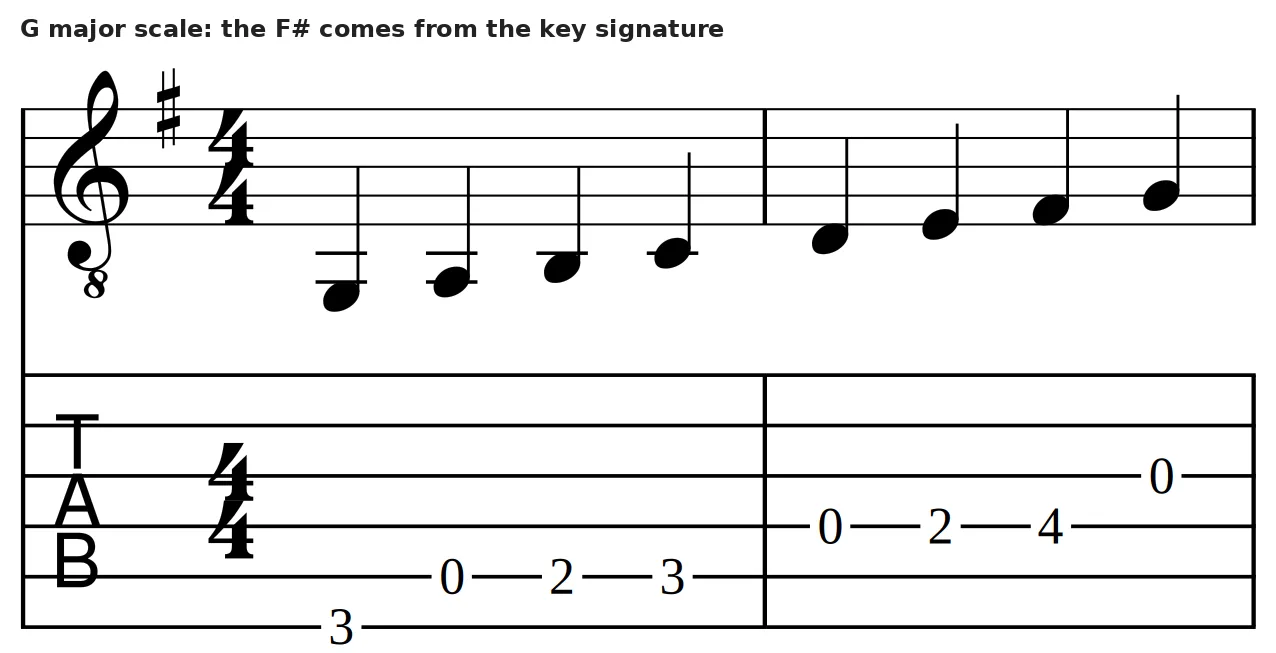
G major scale, open position: G A B C D E F# G
If tab is your first language, our guides on how to read guitar tabs and how to read music for guitar cover the rest of the staff.
The key signature gives you the chords
Once you know the notes of a key, you know its chords. One sharp means the G major scale, G A B C D E F#, and stacking its notes gives you the seven chords of the key: G, Am, Bm, C, D, Em and F#dim. See them with diagrams and audio in chords in the key of G, or grab the guitar keys chart with the chords of every major and minor key on one page.
Why guitarists love the sharp keys
Check the open strings, E A D G B E. Every one of them is a note of C major, G major and D major (and of their relative minors, A minor, E minor and B minor). In those keys the open strings always fit, which is why so many guitar songs live there. E and A major are home turf too, because their roots are open strings, even if the open G string falls outside both keys.
Flat keys like Bb, Eb and Ab are everyday keys for horns and keyboards, and they mean barre chords on the guitar. The quick fix is a capo: D shapes with a capo on the 1st fret sound in Eb. To move a whole song to another key, use the chord transposer.
Key Signature vs Time Signature
They sit next to each other, so they are easy to confuse. At the start of a piece the order is always clef, key signature, time signature. The key signature tells you which notes are sharp or flat; the time signature (4/4, 3/4, 6/8...) tells you how the beats are grouped.
The key signature is repeated at the start of every line, the time signature is written only once (and again only when it changes). When the key itself changes in the middle of a piece, you'll see a double bar line followed by the new key signature, often with naturals that cancel the old sharps or flats: that's a key change.
Key Signature Quiz: Name the Key
Time to test yourself. Name the major key and the relative minor of each key signature, then open the answer.

Answer 1
A major / F# minor (3 sharps: F# C# G#)

Answer 2
Ab major / F minor (4 flats: Bb Eb Ab Db)

Answer 3
B major / G# minor (5 sharps: F# C# G# D# A#)

Answer 4
Bb major / G minor (2 flats: Bb Eb)

Answer 5
E major / C# minor (4 sharps: F# C# G# D#)

Answer 6
Db major / Bb minor (5 flats: Bb Eb Ab Db Gb)
Tips to Memorize Key Signatures
- Learn the two orders first. F C G D A E B and B E A D G C F: with these and the two tricks above, you can work out every key.
- Use the circle of fifths. Clockwise adds a sharp (or removes a flat), counterclockwise adds a flat (or removes a sharp). The interactive circle of fifths shows the keys and their chords.
- Learn them in pairs. The sum to 7 rule links each sharp key to the flat key a half step below: E major (4 sharps) and Eb major (3 flats).
- Put them on the fretboard. Play the major scale in each key and say the sharps or flats out loud as you hit them.
- Quiz yourself a few minutes a day. Short and frequent beats one long session, the same way you'd practice a chord change.
Conclusion
| What | Rule |
|---|---|
| Order of sharps | F C G D A E B (Father Charles Goes Down And Ends Battle) |
| Order of flats | B E A D G C F (Battle Ends And Down Goes Charles' Father) |
| Major key, sharps | Last sharp + a half step (one fret up) |
| Major key, flats | The second to last flat |
| Memorize | No accidentals = C major / A minor; one flat = F major / D minor |
| Relative minor | Three half steps down (three frets lower), same key signature |
| Enharmonic pairs | B = Cb, F# = Gb, C# = Db |
| Guitar notation | Treble clef, sounding an octave lower than written |
Next time you open a song book, read the key signature before anything else: you'll know the scale to play, the chords to expect and where to put your hand before the first note. To keep going, find the key of a song you like with the circle of fifths and play its chords.
That's all for today.
Remember that you can subscribe here to stay updated on new tutorials and gain access to the free download area, where you'll find some free chords and scales PDFs.

Created by
Giancarlo is a musician (teaching guitar since 2000), software engineer, AI consultant and published researcher
FAQ
What is a key signature in music?
A key signature is the group of sharps or flats written at the start of every staff, right after the clef. Each sharp or flat applies to that note in every octave for the whole piece, unless an accidental cancels it. It tells you which notes are raised or lowered and points to the key: one sharp (F#), for example, means G major or E minor.
What is the order of sharps and flats?
Sharps are always added in the order F C G D A E B (Father Charles Goes Down And Ends Battle). Flats come in the reverse order, B E A D G C F (Battle Ends And Down Goes Charles' Father). A key with three sharps has the first three of the list, F#, C# and G#; a key with two flats has Bb and Eb.
How do you find the major key from a key signature?
With sharps, take the last sharp on the right and go up a half step: three sharps end on G#, so the key is A major. With flats, the second to last flat is the key: four flats (Bb Eb Ab Db) give Ab major. Two key signatures you simply memorize: no sharps or flats is C major, one flat (Bb) is F major.
How do you tell if a key signature is major or minor?
Every key signature is shared by a major key and its relative minor, so the signature alone cannot tell you. Look at the music: the chord or bass note the piece starts and ends on is usually the tonic, and in a minor key the raised 7th shows up as an accidental, like G# in A minor, which comes from the E major chord (V) of the harmonic minor.
What key has 7 sharps?
C# major and its relative minor, A# minor, have seven sharps: F#, C#, G#, D#, A#, E# and B#. Every note is sharp. C# major sounds the same as Db major, which needs only five flats, so you will meet Db much more often.
What key has no sharps or flats?
C major and its relative minor, A minor. Their scales use only the natural notes, C D E F G A B, so the staff after the clef stays empty.
What is the key signature of G major?
G major has one sharp, F#, written on the top line of the treble clef staff (the 4th line in bass clef). E minor, its relative minor, shares the same key signature. Every F in the piece is played as F#, in any octave.
Do guitar players need to know key signatures?
If you only read tabs and chord charts you can get by without them, but key signatures tell you a lot in one glance: which notes belong to the key, which chords will show up, and where to put your scale shapes. They are essential the moment you read standard notation, lead sheets or play with pianists and horn players.