Chords in the Key of G Major
G, Am, Bm, C, D, Em and F#dim, with diagrams, audio and the progressions that use them
If you play acoustic guitar, you spend a lot of time in G. The key fits the instrument so well that most campfire songs, country tunes and worship sets live here. The chords in G major are G, Am, Bm, C, D, Em and F#dim, and five of them are open chords you probably learned in your first month.
G major has one sharp, F#. That single sharp is why the seventh chord is F#dim, and why the key has a D major chord rather than Dm.
The Seven Chords of G Major
Each chord is built from the notes of the G major scale (G A B C D E F#), stacking every other note on top of the root.
| Numeral | Chord | Notes | 7th chord | Role |
|---|---|---|---|---|
| I | G | G B D | Gmaj7 | Tonic: the home chord |
| ii | Am | A C E | Am7 | Leads to the V chord |
| iii | Bm | B D F# | Bm7 | Shares two notes with I |
| IV | C | C E G | Cmaj7 | Moves away from home |
| V | D | D F# A | D7 | Pulls back to I |
| vi | Em | E G B | Em7 | Relative minor, a softer home |
| vii° | F#dim | F# A C | F#m7b5 | Tense, leans into I |
D7 is the only dominant seventh chord in G, and the one that leads home most strongly. Try it in place of D whenever a phrase goes back to G.
Chord Shapes in G
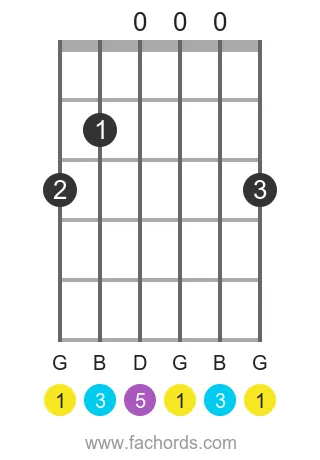
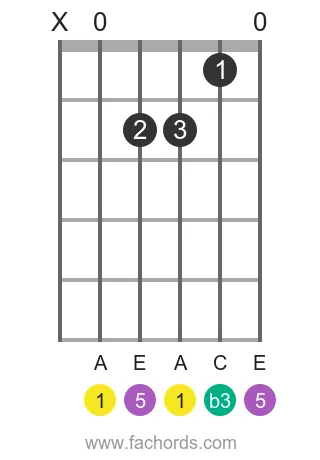
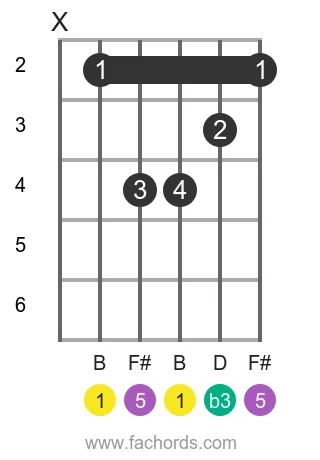
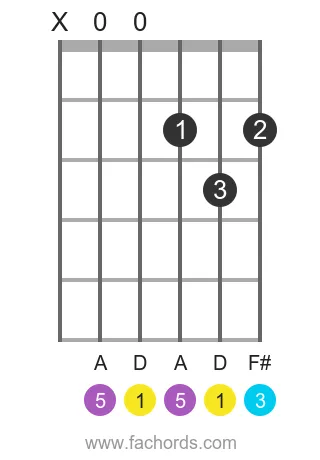
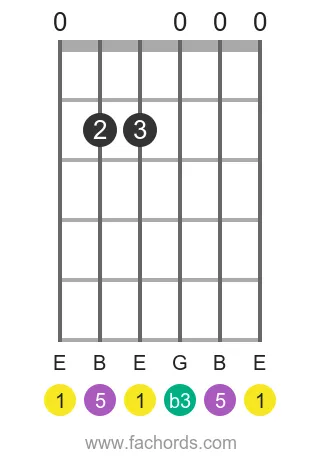
G, C, D, Em and Am are open shapes. Bm is the first barre chord many players learn, and F#dim is a small shape you will use mostly as a passing chord. Click any diagram for more ways to play it.


Hear the Key: G - C - D - Em
The I, IV, V and vi chords cover most of what you hear in pop and folk. Listen to how Em gives the loop a softer, more reflective ending.
Common Chord Progressions in G
Three loops worth having under your fingers, from the oldest to the most modern.
Three Chord Progression: G - C - D
If you only learn one thing in G, learn this. G, C and D are the three chords of thousands of folk, country and rock songs. Use D7 for a bluesier pull back to G.
Circle Progression: G - Em - Am - D
The classic turnaround of jazz standards and old pop songs. Each chord moves to the next by a fifth, so the progression keeps rolling forward. Try Gmaj7 - Em7 - Am7 - D7 for a smoother color.
Full page: chords in five keys and songs
I-IV-vi-V: G - C - Em - D
A singer-songwriter staple. It starts bright, dips into Em and climbs back with D. If the key is too low for your voice, put a capo on the 2nd or 3rd fret and keep the same shapes.
Tips for Playing in G
- Play G with the B string fretted at the 3rd fret (320033). Your ring finger and pinky can then stay put while you change to Cadd9 (x32033) and Dsus4 (xx0233), a trick you hear on countless acoustic songs.
- With a capo, the same shapes take you to other keys: capo 2 gives you A major, capo 4 gives you B major.
- Soloing: the G major scale and the G major pentatonic fit over every chord of the key.
Where to Go Next
- Chords in E minor, the relative minor key
- G major scale on the fretboard
- How to find the key of a song
- Circle of fifths, to see how the keys connect
- Transpose chords to another key
- All chord progressions
Chords in other keys: E minor · C major · D major · F major · A minor · A major · E major

Created by
Giancarlo is a musician (teaching guitar since 2000), software engineer, AI consultant and published researcher
FAQ
What chords are in the key of G?
The chords in G major are G (I), Am (ii), Bm (iii), C (IV), D (V), Em (vi) and F#dim (vii°).
What are the I, IV and V chords in G?
G, C and D. The V chord is often played as D7, which resolves more strongly to G.
What is the relative minor of G major?
E minor. It uses the same notes and chords as G major, with Em as the home chord.
Is F#m in the key of G?
No. The chord built on F# in G major is F# diminished (F# A C), because the key has C natural, not C#. F#m belongs to keys like D major and A major.