Chord Construction
Build Any Guitar Chord From the Root Up
Most guitarists learn chords as fixed shapes: put the fingers here, strum, done. It works, but it's a dead end. You can only play the shapes someone showed you, and every new chord name in a song sheet means another trip to the chord dictionary.
In this lesson we're going to do the opposite: we'll start from one single note and build chords on top of it, adding one note at a time. At every step you'll see the diagram, hear the result, and understand what that new note does to the sound.
By the end, chord names like Cm7b5 or C7#5 won't look like secret codes anymore: they're just a list of instructions to build a shape.
The path in 7 steps:
- The root
- Add the 3rd: major or minor
- Add the 5th: perfect, augmented or diminished
- Add the 7th: five kinds of seventh chord
- Drop the 5th: shell voicings
- Move notes an octave: inversions
- Recap and practice
This is Part 1. In Part 2: advanced chord construction we continue with sus, 6th, diminished 7th, 9th, 11th, 13th, drop 2 and altered chords.
Two Root Positions, Only Movable Shapes
We'll build everything on a C root, and every chord in two versions:
- Root on the 6th string: C at the 8th fret of the low E string.
- Root on the 5th string: C at the 3rd fret of the A string.
There are no open strings in this lesson, on purpose. Every shape is movable: slide it up or down the neck and you get the same chord type on a different root. Learn one shape, get twelve chords.
If you prefer to see the same ideas on the open C chord you already know, read my C chord variations: it changes one note at a time in the first position.
Before We Start: Intervals in Two Minutes
A chord is a root plus other notes, and what makes a chord major, minor or anything else is the distance between the root and those notes. In music, a distance between two notes is called an interval.
On the guitar, intervals are easy to see:
- 1 fret = 1 half step (a semitone, H)
- 2 frets = 1 whole step (a tone, W)
Here's the C major scale played along one string. The pattern of steps is W W H W W W H: notice that E-F and B-C are only one fret apart.

Measure every note of the scale from C and you get the intervals we'll use to build chords:
| Note | Interval from C | Half steps (frets) | Symbol |
|---|---|---|---|
| C | Root | 0 | 1 |
| D | Major 2nd | 2 | 2 |
| E | Major 3rd | 4 | 3 |
| F | Perfect 4th | 5 | 4 |
| G | Perfect 5th | 7 | 5 |
| A | Major 6th | 9 | 6 |
| B | Major 7th | 11 | 7 |
| C | Octave | 12 | 8 (or 1) |
Lower an interval by one fret and you write a flat in front of the number: b3 is the minor 3rd (3 half steps), b5 the diminished 5th (6), b7 the minor 7th (10). Raise it by one fret and you write a sharp: #5 is the augmented 5th (8 half steps).
Why is G# a "#5" and not an "Ab"? Same sound, different name: it depends on the job the note does in the chord. These are enharmonic equivalents, and the short version is: in chord formulas, the number tells you the job, the sharp or flat tells you the fret.
Tip: sing the intervals while you play them. The major 3rd is the start of "When the Saints Go Marching In", the perfect 5th the start of "Twinkle Twinkle Little Star". If you're an Iron Maiden fan like me, the major 3rd opens the riff of "The Number of The Beast". To drill all intervals across the neck, use the fretboard intervals map and trainer.
Step 1. The Root
Everything starts here: the root is the note that gives the chord its name. The "C" in "C major", "C7" or "Cm7b5" is the root, and it's usually the lowest note you play.
C (root)
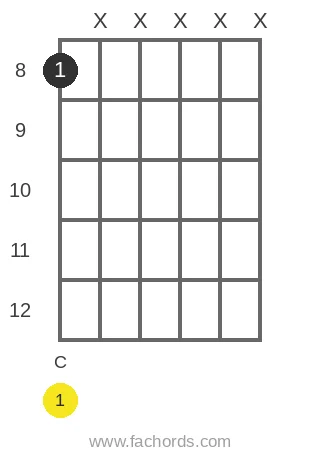
8 x x x x x
C (root)
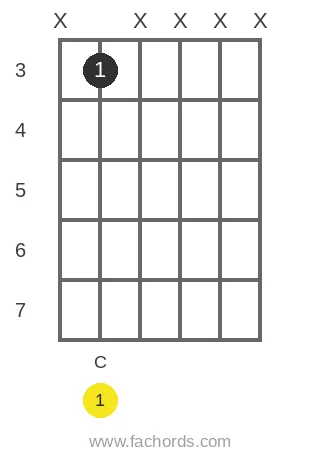
x 3 x x x x
Fun fact: these two Cs are the same note, at the same pitch. The 8th fret of the low E string and the 3rd fret of the A string are two places for one sound. This is why the two shape families we'll build sound so similar.
Now add the octave: the same note, twelve frets higher. On the guitar you find it two strings up and two frets up.
C + octave

8 x 10 x x x
C + octave
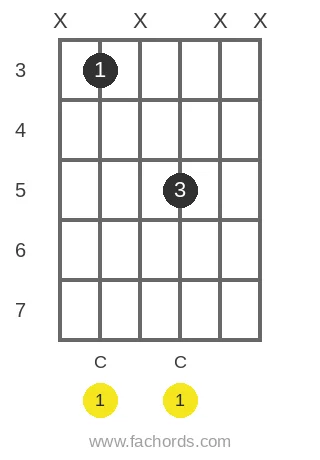
x 3 x 5 x x
Listen: the octave makes the sound fuller, but it adds no new note. We still have just "C". It's an empty frame, and in the next steps we'll fill it.
Step 2. Add the 3rd: Major or Minor
The 3rd is the most important note after the root, because it decides the mood of the chord:
- Major 3rd (4 half steps, E): bright, happy, stable.
- Minor 3rd (3 half steps, Eb): darker, sadder.
In our shapes the 3rd sits above the octave, on the G string (root on the 6th) or on the B string (root on the 5th):
Root + major 3rd

8 x 10 9 x x
Root + minor 3rd

8 x 10 8 x x
Root + major 3rd

x 3 x 5 5 x
Root + minor 3rd

x 3 x 5 4 x
One single fret, and the whole character flips. That's the power of the 3rd.
Technically, in these shapes the E is an octave plus a major 3rd above the low C (a 10th). For chord names it doesn't matter: an E is the 3rd of C in any octave. This is great news on the guitar, where we spread notes across several octaves all the time.
Here are the 3rd shapes from the low strings. A minor 3rd is the same shape one fret lower:
Major 3rd, root on the 6th string

Major 3rd, root on the 5th string

Minor 3rd, root on the 6th string

Minor 3rd, root on the 5th string

In these diagrams the root is the black dot and the 3rd the empty circle. The shape is the same from every string except when you cross from the G to the B string, where it shifts one fret up (the B string tuning is the reason).
Step 3. Add the 5th: Perfect, Augmented or Diminished
Root + 5th Only: the Power Chord
Before we stack the 5th on top of the 3rd, try it alone. Root plus perfect 5th (7 half steps, G) is the famous power chord, C5:
C5
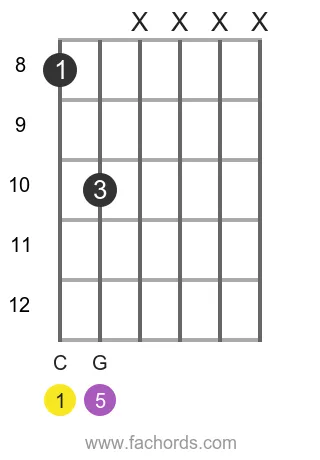
8 10 x x x x
C5
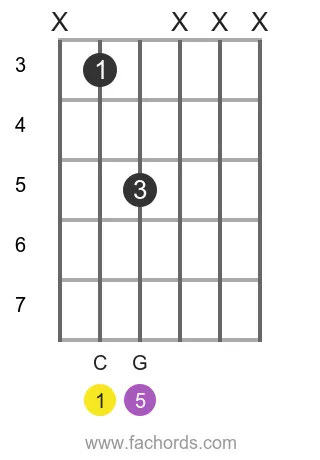
x 3 5 x x x
It sounds strong but neutral: without a 3rd it's neither major nor minor. That's why it works so well with distortion and in rock riffs (more on power chords here). With the root on the 6th or 5th string, the perfect 5th is one string up and two frets up:
Perfect 5th, root on the 6th string

Perfect 5th, root on the 5th string

Root + 3rd + 5th: Major and Minor Triads
Now put everything together: root, 3rd and perfect 5th. Three different notes make a triad, the basic chord of western music:
- Major triad: 1 3 5 (C E G)
- Minor triad: 1 b3 5 (C Eb G)
C

8 x 10 9 8 x
Cm

8 x 10 8 8 x
C

x 3 5 5 5 x
Cm
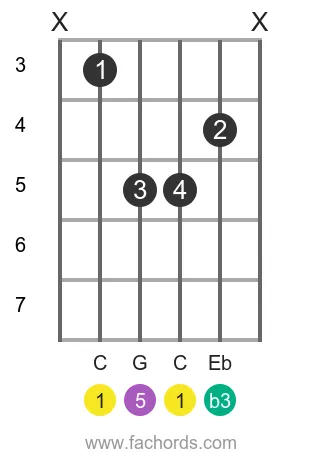
x 3 5 5 4 x
With the root on the 6th string, the 5th (G) is on the B string. With the root on the 5th string, it's on the D string, inside the octave. Both are correct: you can put chord tones in any order and any octave, as long as the root stays at the bottom.
Raise the 5th: the Augmented Chord
Take the major triad and move the 5th one fret up: G becomes G#, and the formula becomes 1 3 #5. This is C augmented (Caug or C+):
Caug
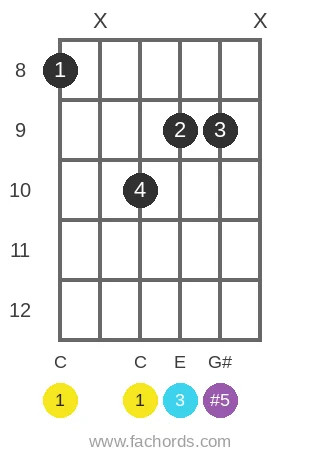
8 x 10 9 9 x
Caug
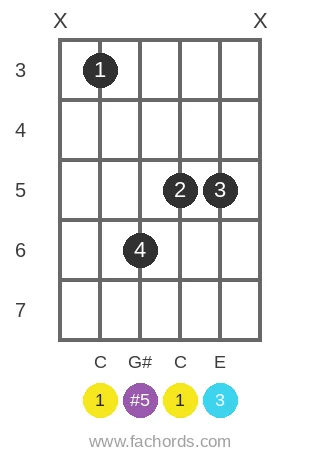
x 3 6 5 5 x
The chord suddenly sounds suspended in the air, like a question. It wants to move on, and the G# often goes up to A in the next chord.
The augmented triad is made of two major 3rds stacked (C-E, E-G#), and the next major 3rd up brings you back to C. That's why the same shape repeats every 4 frets: Caug, Eaug and G#aug have the same three notes.
Lower the 3rd and the 5th: the Diminished Chord
Now start from the minor triad and move the 5th one fret down: G becomes Gb, and the formula is 1 b3 b5. This is C diminished (Cdim or C°):
Cdim
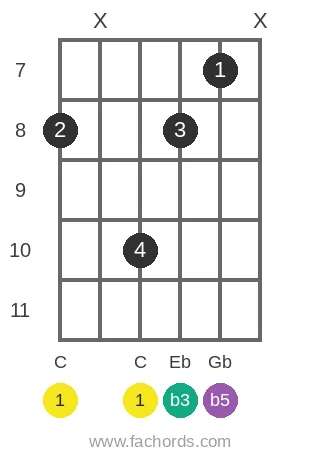
8 x 10 8 7 x
Cdim

x 3 4 5 4 x
Two minor 3rds stacked (C-Eb, Eb-Gb) give a tense, dark sound. Between the root and the b5 there's a tritone (6 half steps), the most unstable interval in music. More on these chords in the diminished chords guide.
You Already Know These Shapes
Look at the major and minor triads again, then at the two barre chords below. The full barre shapes are the same triads with a few notes doubled: more Cs and more Gs, still only C, E (or Eb) and G.
C (full barre)

8 10 10 9 8 8
Cm (full barre)
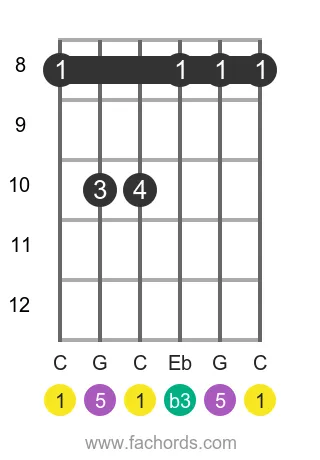
8 10 10 8 8 8
C (full barre)

x 3 5 5 5 3
Cm (full barre)
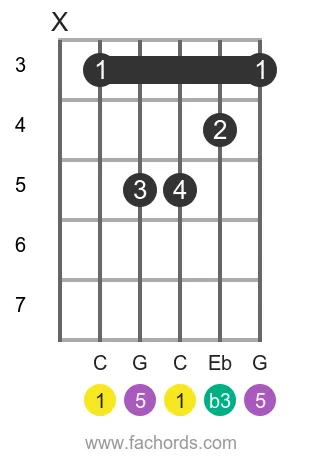
x 3 5 5 4 3
So the barre chords you learned as a beginner aren't magic shapes: they're root, 3rd and 5th, spread over six strings.
| Triad | Formula | Notes in C | Sound |
|---|---|---|---|
| Major | 1 3 5 | C E G | bright, stable |
| Minor | 1 b3 5 | C Eb G | dark, stable |
| Augmented | 1 3 #5 | C E G# | floating, unresolved |
| Diminished | 1 b3 b5 | C Eb Gb | tense, unstable |
Step 4. Add the 7th
Triads have three notes. Add a fourth one, the 7th, and you get a seventh chord. There are two 7ths to choose from:
- Major 7th (7): 11 half steps, B. One fret below the octave.
- Minor 7th (b7): 10 half steps, Bb. Two frets below the octave.
On the guitar we don't need an extra string: we simply replace the octave (the doubled C) with the 7th. With the root on the 6th string, the octave was on the D string at fret 10: move it to fret 9 for the major 7th, or fret 8 for the minor 7th. With the root on the 5th string, the octave was on the G string at fret 5: fret 4 is the major 7th, fret 3 the minor 7th.
Combine the four triads with the two 7ths and you get the five most common seventh chords:
| Chord | Formula | Notes in C | Built from |
|---|---|---|---|
| Cmaj7 (major 7th) | 1 3 5 7 | C E G B | major triad + major 7th |
| C7 (dominant 7th) | 1 3 5 b7 | C E G Bb | major triad + minor 7th |
| Cm7 (minor 7th) | 1 b3 5 b7 | C Eb G Bb | minor triad + minor 7th |
| Cm7b5 (half-diminished) | 1 b3 b5 b7 | C Eb Gb Bb | diminished triad + minor 7th |
| C7#5 (augmented 7th) | 1 3 #5 b7 | C E G# Bb | augmented triad + minor 7th |
(The diminished triad with a diminished 7th, and the minor triad with a major 7th, are waiting for you in Part 2.)
Seventh Chords, Root on the 6th String
Cmaj7
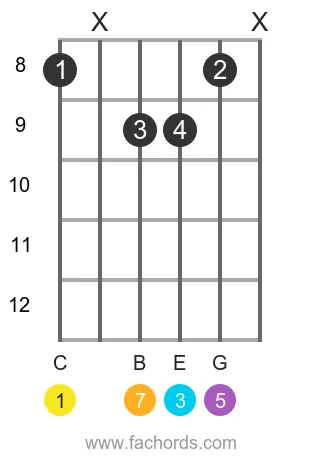
8 x 9 9 8 x
C7
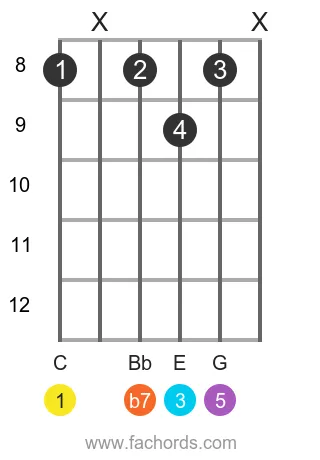
8 x 8 9 8 x
Cm7
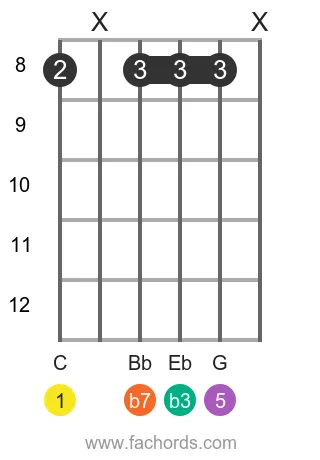
8 x 8 8 8 x
Cm7b5

8 x 8 8 7 x
C7#5
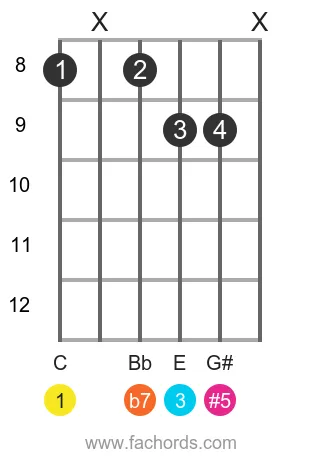
8 x 8 9 9 x
Seventh Chords, Root on the 5th String
Cmaj7
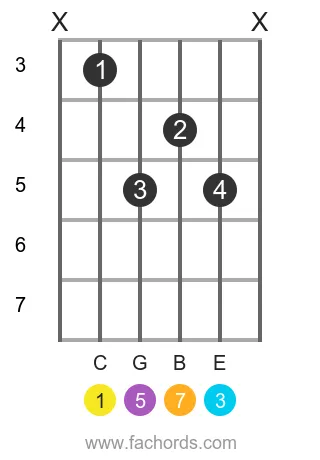
x 3 5 4 5 x
C7
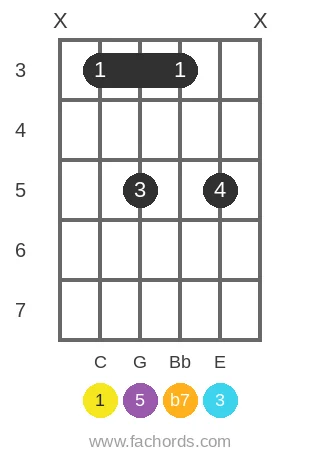
x 3 5 3 5 x
Cm7

x 3 5 3 4 x
Cm7b5
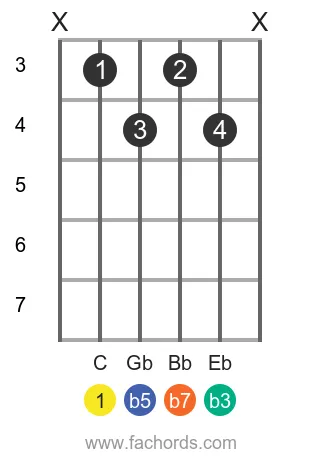
x 3 4 3 4 x
C7#5

x 3 6 3 5 x
Listen to what each 7th does:
- Cmaj7: soft, dreamy, jazzy. The B rubs gently against the C.
- C7: bluesy and restless. The E and the Bb form a tritone that wants to resolve, usually to an F chord. This is the dominant chord, the engine of blues and jazz.
- Cm7: smooth and mellow, softer than a plain minor triad.
- Cm7b5: dark and unstable, the classic ii chord of a minor ii-V-i.
- C7#5: a dominant with an extra push, often used right before the chord it resolves to.
Step 5. Drop the 5th: Shell Voicings
A four-note chord on six strings starts to get crowded, and in a band the bass player is already covering the low end. So guitarists often leave a note out. Which one?
Ask yourself which note tells you the least about the chord:
- The 3rd tells you major or minor: keep it.
- The 7th tells you maj7, dominant or minor 7: keep it.
- The root tells you the name (and the bass player may play it, but on your own you want it).
- The perfect 5th is the same in C, Cm, Cmaj7, C7 and Cm7. It says almost nothing. And the low C already contains a faint G among its natural overtones.
So the 5th goes first. What's left is 1 3 7, the shell voicing, a favorite of jazz guitarists since the swing era:
Cmaj7 (no 5th)
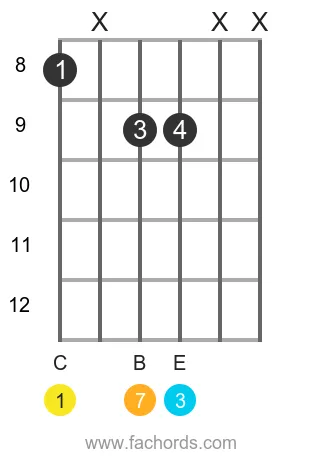
8 x 9 9 x x
C7 (no 5th)
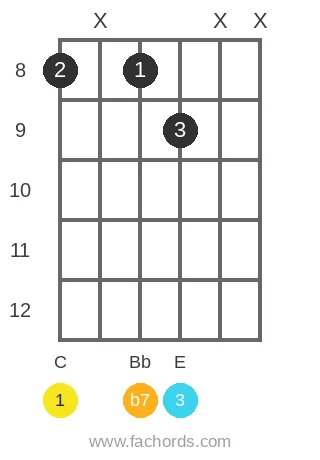
8 x 8 9 x x
Cm7 (no 5th)
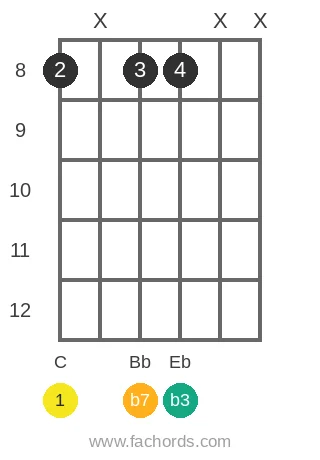
8 x 8 8 x x
Cmaj7 (no 5th)
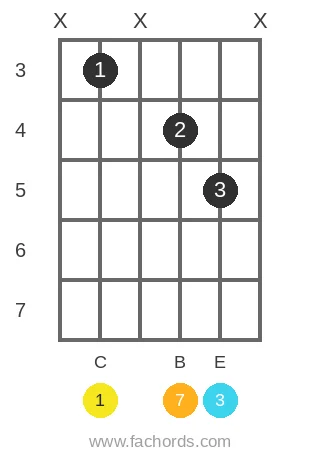
x 3 x 4 5 x
C7 (no 5th)
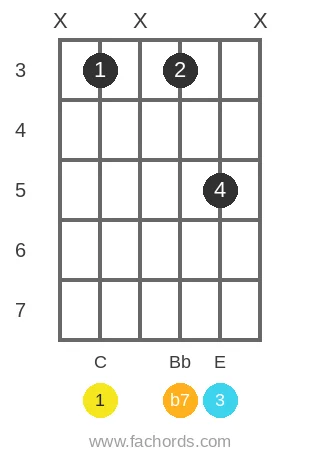
x 3 x 3 5 x
Cm7 (no 5th)
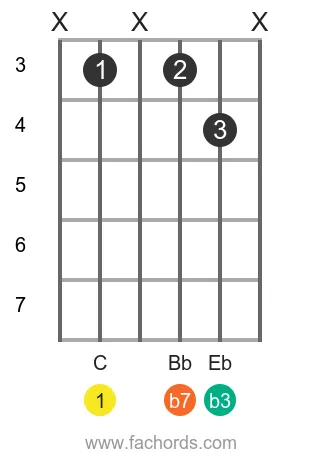
x 3 x 3 4 x
Three notes, and you can still hear exactly which chord it is. Shells are light, easy to switch, and they leave room for the extra colors (9ths, 13ths) we'll add in Part 2. They're also the starting point for smooth voice leading.
Exception: drop the 5th only when it's a perfect 5th. In Cdim, Caug, Cm7b5 or C7#5 the altered 5th is part of the chord's identity: leave it out and the chord changes name.
Step 6. Inversions: Move a Note an Octave
So far the root has always been the lowest note. But the notes of a chord can be stacked in any order. When the lowest note is not the root, the chord is inverted:
- Root position: root in the bass (C E G).
- 1st inversion: 3rd in the bass (E G C), written C/E.
- 2nd inversion: 5th in the bass (G C E), written C/G.
The slash means "C chord, with this note in the bass". Same notes, different order, different color.
Move the Top Note Down an Octave
Here's a simple way to build inversions on the guitar. Start from a C triad on the D, G and B strings. Then take the highest note and move it one octave down, so it becomes the new bass:
C, root position
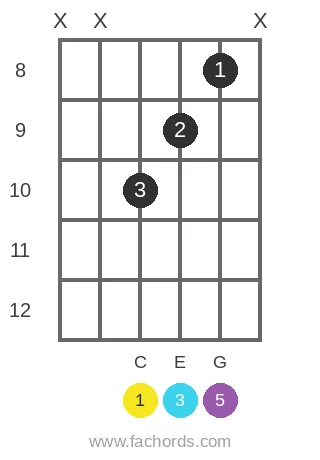
x x 10 9 8 x
C/G, 2nd inversion

x 10 10 9 x x
C/E, 1st inversion

x 7 5 5 x x
- Root position: C E G, from low to high.
- The top note, G, goes down an octave to the 10th fret of the A string. Now the order is G C E: 2nd inversion, C/G.
- Now the top note is E: move it down an octave to the 7th fret of the A string. The G and the C keep their pitch but move to the next string down (D string fret 5, G string fret 5), so the hand stays in one area. The order is E G C: 1st inversion, C/E.
Each move puts a different chord tone in the bass, and each version has its own weight: the 1st inversion sounds lighter, the 2nd inversion a bit unstable, the root position the most solid.
The Same Triad on the Top Three Strings
The process also works the other way round: move the lowest note up an octave. On the G, B and high E strings you get the three shapes that every rhythm player uses:
C, root position

x x x 5 5 3
C/E, 1st inversion

x x x 9 8 8
C/G, 2nd inversion

x x x 12 13 12
Three shapes, the same three notes, climbing the neck. For all the triad shapes across the fretboard, see guitar triads and chord inversions with octave intervals.
Seventh Chord Inversions
A seventh chord has four notes, so it has three inversions: the 7th itself can be the bass. Here are the four versions of C7 on the top four strings:
C7, root position
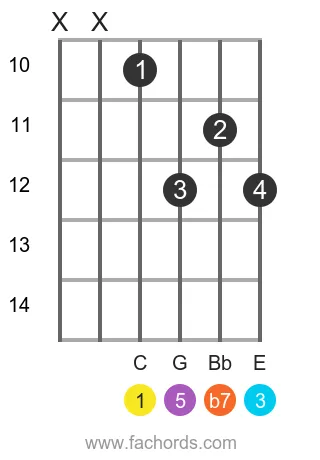
x x 10 12 11 12
C7/E
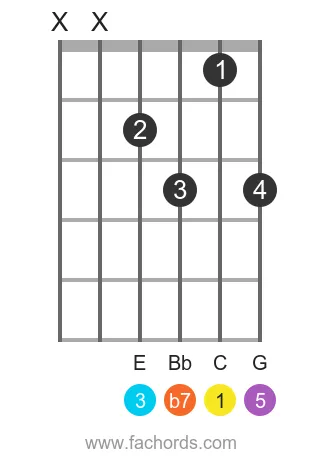
x x 2 3 1 3
C7/G
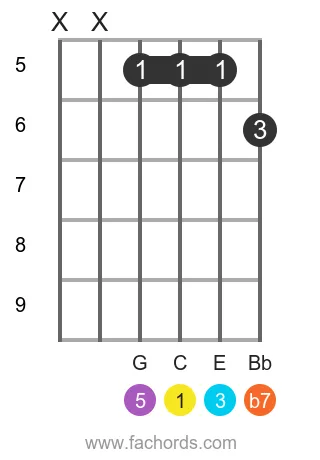
x x 5 5 5 6
C7/Bb
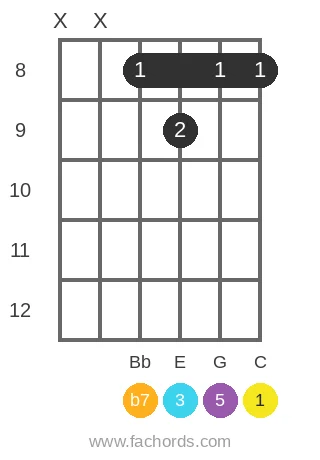
x x 8 9 8 8
| Chord | Bass note | Name | Order (low to high) |
|---|---|---|---|
| C7 | C (root) | Root position | C G Bb E |
| C7/E | E (3rd) | 1st inversion | E Bb C G |
| C7/G | G (5th) | 2nd inversion | G C E Bb |
| C7/Bb | Bb (7th) | 3rd inversion | Bb E G C |
The 3rd inversion, with the b7 in the bass, is a beautiful passing chord: the Bb wants to step down to A, the 3rd of the F chord that follows (C7/Bb to F/A).
Step 7. Recap and Practice
Here is the whole path in one table. Every chord is the previous one plus (or minus) one note:
| Step | Chord | Formula | Notes in C |
|---|---|---|---|
| 1 | Root | 1 | C |
| 2 | Root + 3rd | 1 3 / 1 b3 | C E / C Eb |
| 3 | Power chord | 1 5 | C G |
| 3 | Major / minor | 1 3 5 / 1 b3 5 | C E G / C Eb G |
| 3 | Augmented / diminished | 1 3 #5 / 1 b3 b5 | C E G# / C Eb Gb |
| 4 | maj7 / 7 / m7 | 1 3 5 7 / 1 3 5 b7 / 1 b3 5 b7 | C E G B / C E G Bb / C Eb G Bb |
| 4 | m7b5 / 7#5 | 1 b3 b5 b7 / 1 3 #5 b7 | C Eb Gb Bb / C E G# Bb |
| 5 | Shells | 1 3 7 / 1 3 b7 / 1 b3 b7 | C E B / C E Bb / C Eb Bb |
| 6 | Inversions | 3, 5 or 7 in the bass | C/E, C/G, C7/Bb |
Practice Routine
- Pick a new root. F: 6th string fret 1, or 5th string fret 8. A: 6th string fret 5. D: 5th string fret 5.
- Play the root, add the octave, add the major 3rd, switch to the minor 3rd.
- Add the 5th, then raise it (augmented) and lower it (diminished).
- Replace the octave with the 7th: maj7, 7, m7, m7b5, 7#5.
- Drop the 5th and play the shells.
- Say the name of every chord out loud while you play it.
After a week of this, you won't need to memorize seventh chord shapes anymore: you'll build them.
Drill down: the chord intervals and symbols page lists the formulas of 40+ chord types, and my ebook Chords Domination shows how to play any of them across the whole fretboard. To find chord tones anywhere on the neck, use the chord tones fretboard map. And if you have a shape and want its name, read how to name any guitar chord.
Next: Part 2
We've built triads and seventh chords. In Part 2: advanced chord construction we keep going: we replace the 3rd (sus chords), add the 6th, build the last two seventh chords (diminished 7th and minor-major 7th), stack 9ths, 11ths and 13ths, learn drop 2 and drop 3 voicings, and alter the dominant chord (7b9, 7#9).
Interactive Fretboard Interval Trainer Game

To memorize the interval shapes we used in this lesson, try the free guitar interval trainer: a browser game that makes the geometry of the fretboard stick.
Guitar Chords Theory PDF To Download

There's also a free PDF with the interval shapes from every string and the formulas of sevenths, augmented, diminished and many more chords. Get your free access to the download area here.
For questions and feedback, drop a line below. I'd love to hear how the path works for you!

Created by
Giancarlo is a musician (teaching guitar since 2000), software engineer, AI consultant and published researcher
FAQ
How do you build a chord on guitar?
Start from the root, the note that names the chord. Add a 3rd (major or minor), then a 5th (perfect, augmented or diminished), and then, if you want a seventh chord, a 7th (major or minor). On the guitar you place each new note on a higher string, inside a shape you can move along the neck.
What makes a chord major or minor?
The 3rd. A major 3rd is four half steps (four frets) above the root, a minor 3rd is three half steps. In C, E makes the chord major and Eb makes it minor. The root and the 5th stay the same.
What is the difference between augmented and diminished chords?
An augmented chord is a major chord with a raised 5th (1 3 #5, C E G#). A diminished chord is a minor chord with a lowered 5th (1 b3 b5, C Eb Gb). Augmented sounds open and unresolved, diminished sounds tense and dark.
What is the difference between Cmaj7 and C7?
Both start from a C major triad. Cmaj7 adds the major 7th (B), one half step below the octave, and sounds soft and dreamy. C7 adds the minor 7th (Bb), a whole step below the octave, and sounds bluesy and restless, because the E and the Bb form a tritone that wants to resolve.
Why do guitarists leave out the 5th of a chord?
The perfect 5th adds the least information: the 3rd says major or minor, the 7th says which kind of seventh chord, while the 5th is the same in major, minor and dominant chords. Dropping it gives easier three-note shell voicings that leave room for the bass and for extensions. If the 5th is altered (b5 or #5) it is part of the chord's identity and stays.
What is a chord inversion?
A chord is inverted when its lowest note is not the root. C major with E in the bass (C/E) is the first inversion, with G in the bass (C/G) the second inversion. A seventh chord also has a third inversion, with the 7th in the bass (C7/Bb). The notes are the same, only their order changes.
Can I use these chord shapes in other keys?
Yes. All the shapes in this lesson are movable: they have no open strings, so you slide the whole shape until the root sits on the note you want. With the root on the 6th string, F is at fret 1 and A at fret 5. With the root on the 5th string, F is at fret 8 and D at fret 5.